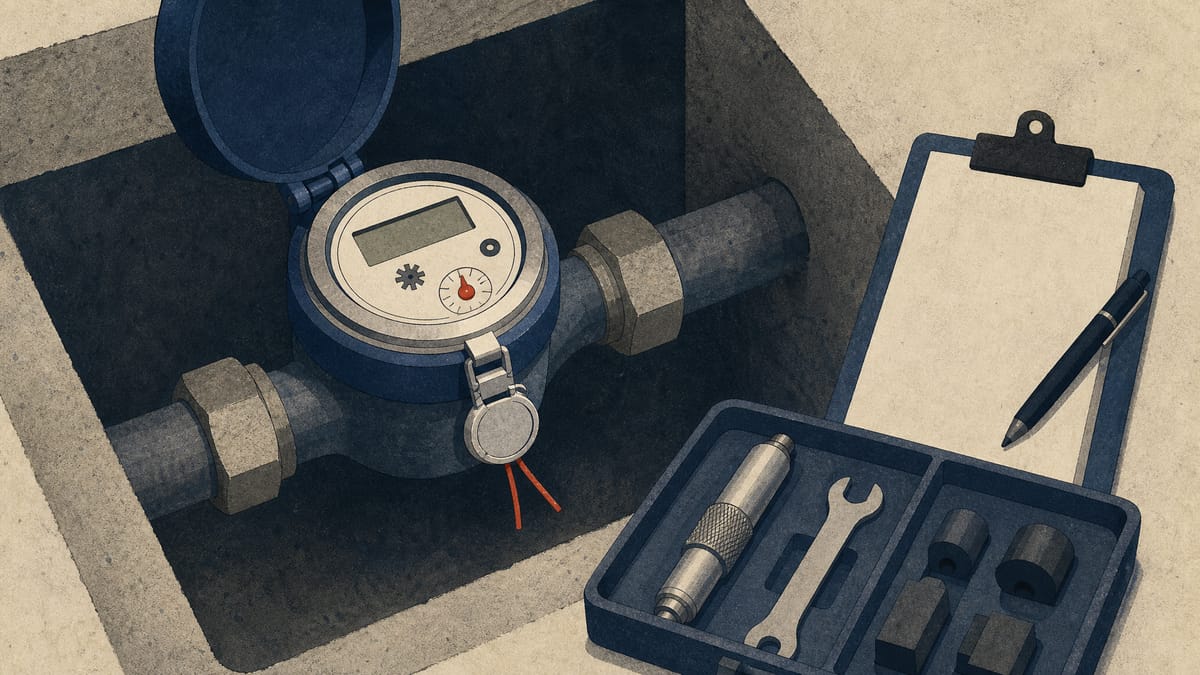
Japan's industry ministry wants to give two of the newer types of water meter an extra two years before they need to be recertified, a change meant to make smart water metering cheaper to run.
The Ministry of Economy, Trade and Industry (METI) opened a 30-day public comment period on September 25, 2026 for a draft Cabinet Order amending the enforcement order of the Measurement Act. The order would extend the validity of the verification seal on electromagnetic and ultrasonic water meters from eight years to ten years. Impeller-type meters, the mechanical kind that still dominate Japan's water networks, stay on the current eight-year cycle.
The split rests on wear. METI's Measurement Administration Office says electromagnetic and ultrasonic meters have no moving mechanical parts to degrade, and a technical review by the Measurement Administration Council concluded there was no problem stretching their certification cycle to ten years even accounting for electronic-component durability. Impeller meters keep wearing internally, so their cycle is unchanged.
| Meter type | Current validity | Proposed validity |
|---|---|---|
| Electromagnetic water meter | 8 years | 10 years |
| Ultrasonic water meter | 8 years | 10 years |
| Impeller-type water meter | 8 years | 8 years (unchanged) |
The push traces to a Regulatory Reform Promotion Council report from May 2025, which flagged the uniform eight-year certification rule as one obstacle to rolling out smart water meters: electromagnetic and ultrasonic units already cost more to buy than impeller meters, and recertifying them just as often added to that expense. Stretching their certification cycle to ten years cuts how often that bill comes due.
METI's own filing concedes the savings are hard to put a number on today, because electromagnetic and ultrasonic meters have almost no current market share among Japan's water utilities. The ministry plans to track the policy's effect through hearings with operators on how their meter mix shifts, rather than a projected cost figure.
The rule carries transitional protection. Water meters that already carry a verification seal when the new order takes effect keep the old eight-year validity period regardless of the schedule change. The same eight-year term also applies to meters of an already-approved type, or a type with a pending approval application, as long as the seal is affixed within four years of the order taking effect. METI consulted water meter manufacturers individually and reported no objections to the change.
Comments close October 24, 2026. METI expects to promulgate the order in mid-November 2026 and bring it into force in late November 2026. The ministry estimates outreach costs to municipalities and industry associations at about ¥53,120, filed under a simplified impact-assessment track reserved for deregulatory measures expected to cost less than ¥1bn a year in total compliance burden.