Japan's Ministry of Economy, Trade and Industry (METI) wants to widen the ways a high-pressure gas plant can fix equipment on a temporary basis, but only for certified operators with a high-level safety system. Its draft amendments to four ordinances under the High Pressure Gas Safety Act are open for public comment from 27 October to 25 November 2026.
Resin sealants as a temporary fix
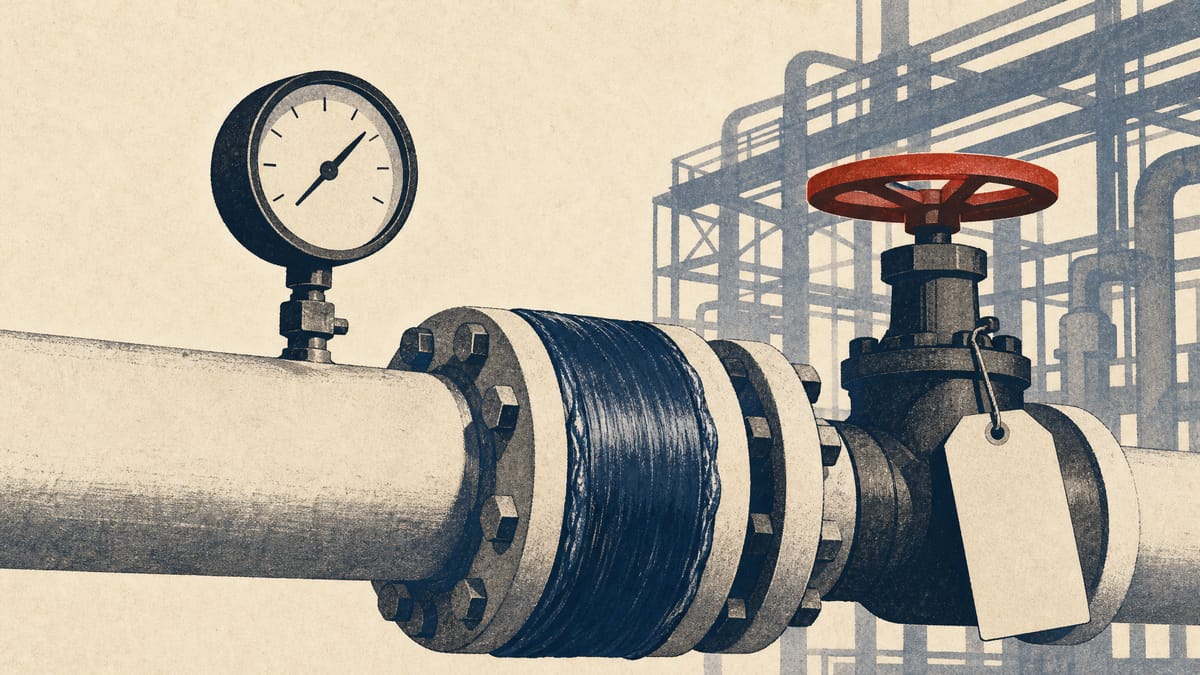
Until now, repairs to high-pressure gas equipment have been limited to replacing parts or welding. The draft adds a temporary-repair method that uses hardening resin and similar sealing materials. METI says the repair method may be used only by certified advanced safety implementers, the operators with a high-level safety system, because management after the repair matters.
The draft ordinance text treats such a repair as a minor change when it prevents a high-pressure gas blowout or leak and the minister has recognised it as a temporary, minor repair. A minor change does not need the permit that larger modifications require. The draft also adds the minister-recognised measure to the pressure, airtightness, strength and material standards for stationary production equipment.
The supplementary provisions extend the new repair rule to operators still covered by the earlier certified completion-inspection and safety-inspection systems. The transition runs until 3 years and 6 months after the date the amending act's supplementary provision, Article 1, item 4, takes effect. METI says this matches when those old certifications lapse.
Less routing, clearer removal rules
Two further changes are administrative. Applications, change notices and succession notices from certified advanced safety implementers currently go to the minister through the head of the industrial safety supervision office covering the site. The draft deletes that routing so filings go directly to the minister, which METI describes as streamlining procedure and cutting workload.
The draft also addresses removal of high-pressure gas equipment. A first-class producer needs no permit for such removal as a minor change. For certified implementers, METI says, it was unclear whether a permit was needed when the work does not change processing capacity. The draft clarifies that removal work posing no risk to the production facility's functions needs no permit, unless it changes processing capacity at the certified facility. This part covers the LPG, general high-pressure gas and industrial-complex safety regulations, not the refrigeration rules.
Scope and timetable
The draft amends the refrigeration, LPG, general high-pressure gas and industrial-complex safety regulations. The Act regulates the production, storage, sale and movement of high-pressure gas, which includes compressed gas at 1 megapascal or more, to prevent accidents.
Comments must be in Japanese and arrive by 25 November 2026, through the e-Gov portal, by post or by email to METI's high-pressure gas safety office. METI says it will consider the comments in its final decision but will not reply to individuals, and submissions may be published without names and contact details.
METI's schedule shows promulgation and enforcement in mid-December 2026. The draft ordinance itself leaves the effective date blank.