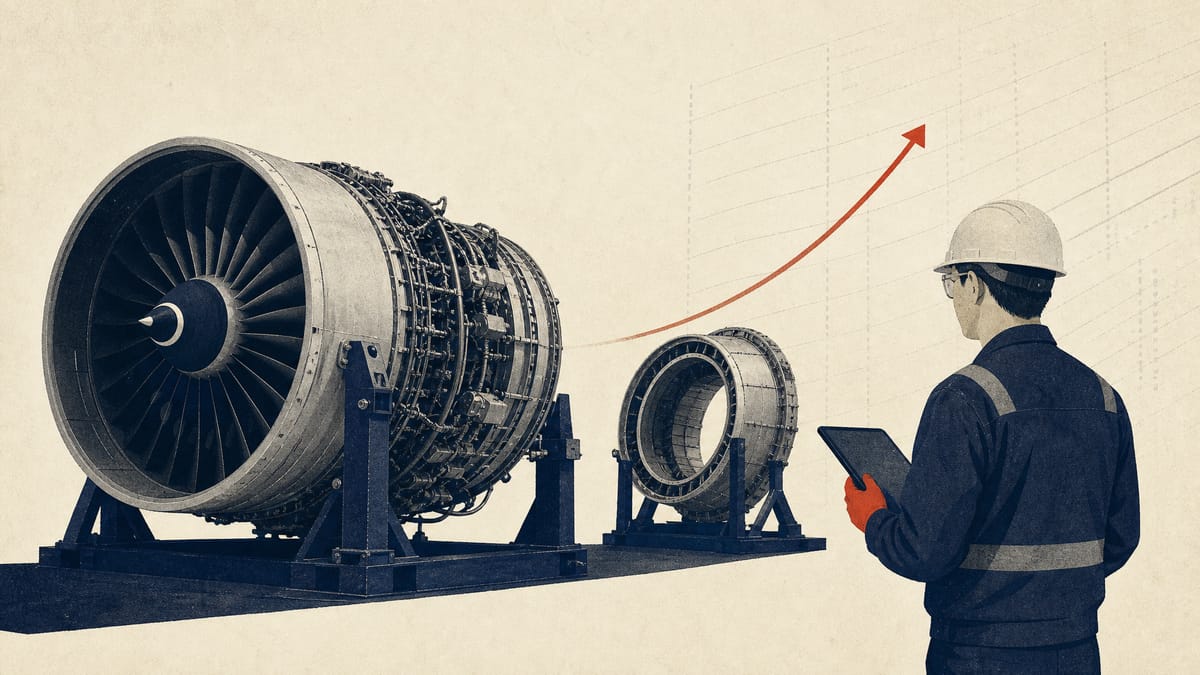
Kawasaki Heavy Industries posted its strongest first quarter on record for the three months to June 2026, with business profit up 74.3% year-on-year to ¥35.8bn and revenue up 11.3% to ¥543.6bn. Net profit attributable to parent-company shareholders rose 269% to ¥15.7bn.
| Metric | Q1 actual | YoY change | Full-year forecast (revised) |
|---|---|---|---|
| Revenue | ¥543.6bn | +11.3% | ¥2.56tn |
| Business profit | ¥35.8bn | +74.3% | ¥180bn |
| Net profit (parent) | ¥15.7bn | +269.0% | ¥115bn |
The gain came from a weaker yen, which averaged ¥158.05 to the dollar in the quarter versus ¥143.79 a year earlier, and an ¥8.0bn refund of US tariffs paid under the International Emergency Economic Powers Act, most of which landed in the Powersports & Engine division. That unit's business profit more than doubled to ¥19.2bn.
Kawasaki used the strong start to raise its full-year business profit forecast by ¥10bn to ¥180bn and its net profit forecast by ¥5bn to ¥115bn, while holding its planning rate at ¥150 to the dollar. Part of the increase reflects a brighter full-year outlook for Precision Machinery & Robotics, whose profit forecast rose ¥10bn to ¥31bn on a litigation settlement and better margins; that gain sits in the annual guidance, not in the June-quarter result.
Days after the quarter closed, Kawasaki went to the capital markets. On July 22 it completed an overseas offering of 37.35 million new shares, paying in ¥93.4bn, and on July 31 it issued two Euro-yen convertible bonds, each with a ¥50bn face value, maturing in 2031 and 2033 at conversion prices of ¥3,913 and ¥3,783. Roughly ¥92.4bn of the net share proceeds are earmarked for capacity expansion at aircraft and engine plants in Gifu, Nagoya and Akashi, plus robotics and shipbuilding sites, while the bond proceeds are set aside for a liquefied-hydrogen supply chain and physical-AI development.