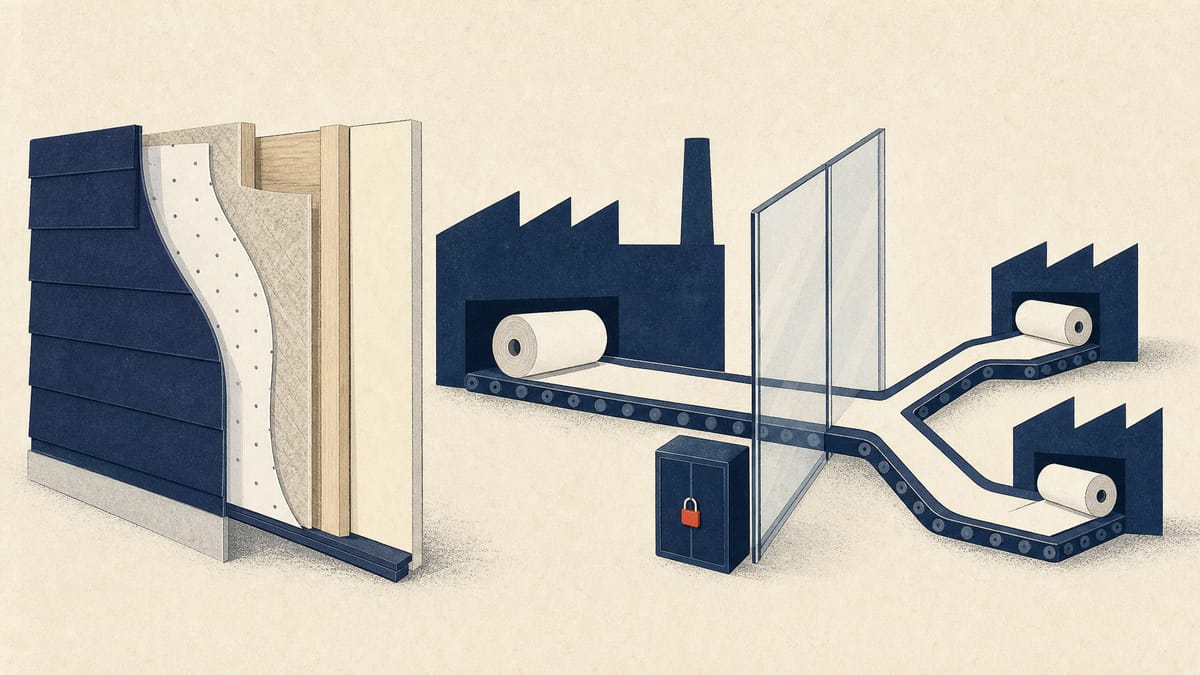
The Japan Fair Trade Commission has ended its review of a textile maker's plan to buy all the voting shares of a contract manufacturer of breathable waterproof building sheets. It found that the deal would not substantially restrict competition, but only on the premise that the parties carry out the remedies they offered, according to its 27 November 2026 release.
A review the law did not require
The plan falls below the notification requirement in Article 10, paragraph 2, of the Antimonopoly Act, the provision that obliges parties to notify qualifying share acquisitions. The parties nonetheless consulted the JFTC with a concrete plan. The commission therefore reviewed it under its 2011 procedural policy, treating it like a notifiable deal. The release does not give a price or a closing date, and the review's conclusion does not establish that the acquisition has been completed.
Why a vertical deal drew scrutiny
The buyer makes and sells the sheets, which are installed inside exterior walls to keep out rain and let vapour escape. The target does contract manufacturing of the multilayer version. In 2025 the target held about 75% of that upstream market, ahead of two other contractors with about 20% and about 5%. Downstream, among sellers of building-material sheets, the buyer held about 20%, behind rivals with about 35% and about 30%, and ahead of one with about 10%. The JFTC rounds shares to 5% steps, and the deal falls outside the safe harbour for vertical mergers.
Two of those rivals, which the release anonymises as companies B and C, outsource most of their production to the target. The JFTC judged that the other two contractors have limited spare capacity. It also found that switching to a contractor from another sheet category, or to a new entrant, would take at least two to three years, covering supplier selection, equipment investment, technical guidance and JIS durability testing. The commission added that falling building starts are shrinking the market and that entry requires expensive dedicated machinery. On that basis it found the merged group would have the ability to cut off or disadvantage the two rivals. It also found an incentive: doing so would sharply weaken the two rivals and let the buyer expand its share of the downstream market.
The second concern was information. If the target keeps making for those rivals, the buyer could obtain their product and material specifications, processes, technology, contract prices and volumes, and customer data. The JFTC could not rule that out. It judged the risk of coordinated behaviour low and found no foreclosure problem on the contractor side.
What the parties have offered
The parties put forward four sets of remedies, which the JFTC judged sufficient.
- Supply: from the execution date the target keeps supplying B and C and may not refuse their orders without justifiable reason.
- Equal terms: it may not treat them worse than the buyer when setting trading conditions.
- Firewall: staff on the target's sheet business may not pass the rivals' non-public information to other staff or to the buyer, and access is restricted by electronic permissions and locked storage. No one may hold roles in both the buyer's and the target's sheet businesses, and people who work in the target's sheet business, or did so within the past three years, cannot work in the buyer's sheet business. Buyer staff seconded to the target's sheet business must not disclose the rivals' non-public information to the buyer's other staff or use it in the buyer's business, and sign pledges to that effect. Where the buyer's sheet staff also serve as target directors, the parties must withhold competitively sensitive information from them.
- Monitoring: before executing the deal, the parties appoint an independent expert with Antimonopoly Act experience as trustee. The trustee monitors compliance for five years from the execution date and reports to the JFTC once a year with an opinion.
After five years the parties and the JFTC are to discuss whether the remedies should continue or change, in light of how competition in the sheet business has evolved.