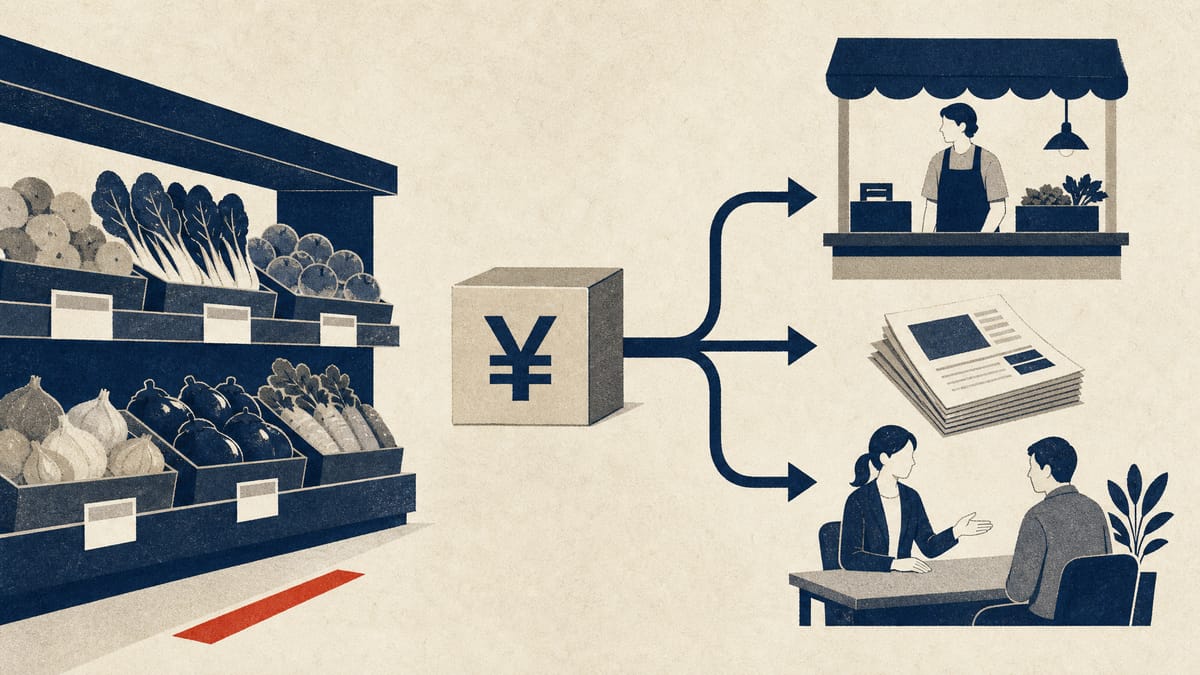
Japan's cabinet on 29 September approved ¥111.87bn from the current fiscal year's general-account reserve to prepare two measures: the temporary cut in the consumption tax rate on food and drink, and a worker burden relief support payment scheme. The largest line, ¥78.11bn, sits with the Ministry of Economy, Trade and Industry (METI), and most of it goes to the agency that supports small and medium-sized enterprises.
The money pays for implementation. It does not itself set or change the tax rate, and neither document states the rate, a start date or how long the reduction lasts. Tokyo Brief's 17 September report was headlined "Japan Bars Deficit Bonds to Fund Its Two-Year Food Tax Cut". The reserve documents say nothing about how this reserve draw is financed.
Where METI's ¥78.11bn goes
METI's reserve-use request is dated 28 September and asks the finance minister to date approval 29 September. Its stated reason is to implement the temporary reduction smoothly. The request splits the ¥78.11bn into three uses.
The biggest is ¥75.39bn, an operating grant to the independent administrative agency that supports small and medium-sized enterprises. The grant is meant to fund that agency's SME consumption tax temporary reduction countermeasure project, and the request lists it as a flat-amount grant. The request does not describe what the project does day to day.
The rest sits under the Small and Medium Enterprise Agency's policy promotion budget, which totals ¥2.72bn:
- ¥2.12bn to commission a private organisation to run publicity about the temporary reduction for SMEs.
- ¥600mn as a flat-amount subsidy to a private organisation for a project to strengthen management consultation support.
In short, the money covers three things: a grant to the agency, outreach, and management consultation support.
The wider cabinet decision
The cabinet decision lists METI's line at the same ¥78.11bn as the request, alongside spending at the Cabinet Office, the Digital Agency and the Ministry of Finance. Most of those lines are for the worker burden relief support payment scheme. The Cabinet Office also has a ¥984.4mn line for government publicity covering both the food tax cut and that scheme.
| Ministry or agency | Stated purpose | Amount |
|---|---|---|
| Cabinet Office | Government publicity on the food tax cut and the worker burden relief support payment scheme | ¥984.4mn |
| Cabinet Office | Implementation of the worker burden relief support payment scheme | ¥27.20bn |
| Digital Agency | Implementation of the worker burden relief support payment scheme | ¥5.03bn |
| Ministry of Finance | Implementation of the worker burden relief support payment scheme | ¥546.3mn |
| METI | Smooth implementation of the temporary food consumption tax cut | ¥78.11bn |
| Total | Reserve use in this decision | ¥111.87bn |
The decision also shows how much reserve is left. The reserve budget stands at ¥1.51tn. Earlier draws total ¥684.50bn, and this one adds ¥111.87bn, leaving ¥717.14bn.
What the documents leave open
The two documents cover different steps. METI's is a request to the finance minister, and the Ministry of Finance page carries the cabinet decision. Neither shows that every detail of the tax cut is in force. METI's request also gives no timetable for the SME agency's project or the consultation support work. The decision lists the Digital Agency and Ministry of Finance lines only under the worker burden relief scheme, and gives no detail on how the scheme will operate.