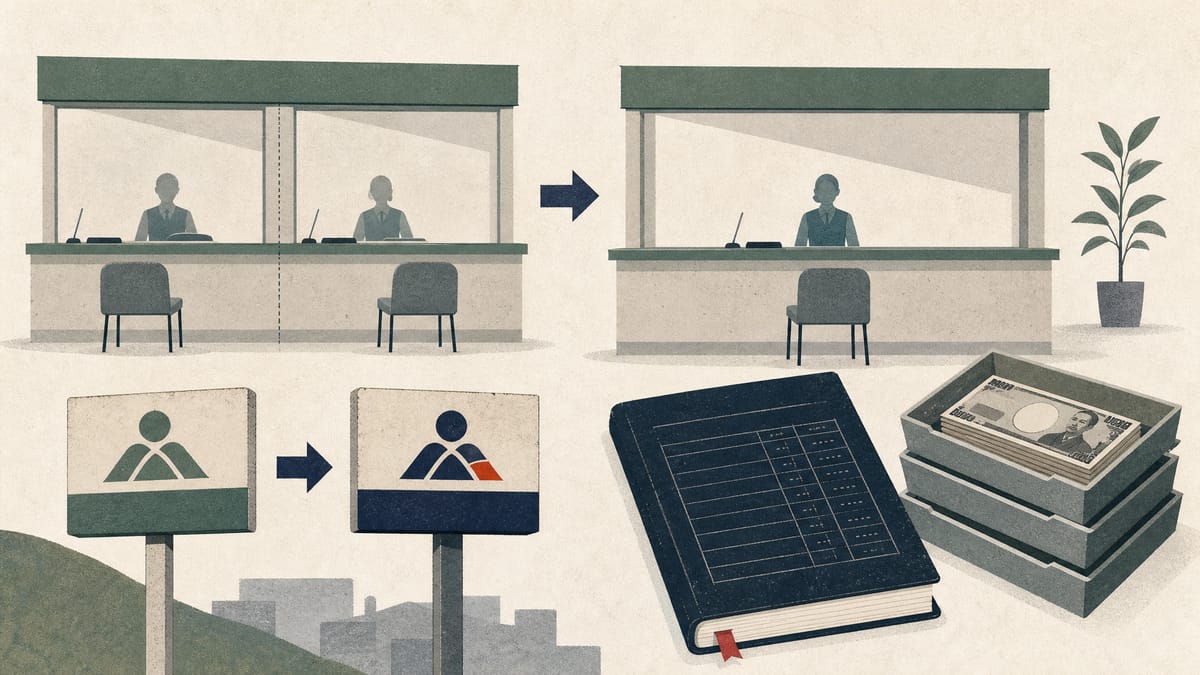
The Financial Services Agency approved on 29 September 2026 a restructuring implementation plan from two Niigata credit unions under the law on special measures for strengthening financial functions. The plan falls under the law's grant system. The two plan to merge around 24 November 2026.
The money
The plan puts the cost of the strengthening measures at ¥916.1mn, of which ¥832.8mn is eligible for the grant. The unions plan to ask the grant-paying body for ¥416.4mn. That is the amount requested under the approved plan; the documents do not show any money paid out.
| Measure | Cost | Eligible cost | Planned grant request |
|---|---|---|---|
| System upgrades | ¥41.8mn | ¥38.0mn | ¥19.0mn |
| Equipment and devices | ¥255.0mn | ¥231.8mn | ¥115.9mn |
| Branch consolidation | ¥610.4mn | ¥555.0mn | ¥277.5mn |
| Merger-related work | ¥8.9mn | ¥8.1mn | ¥4.0mn |
| Total | ¥916.1mn | ¥832.8mn | ¥416.4mn |
Branch consolidation is the largest item. The plan lists six branch moves, including converting one branch of the smaller union into a satellite of a branch of the larger one and another into a branch-within-branch.
Why they say they need it
The larger union runs 43 branches across Niigata prefecture. The smaller runs five, centred on Niigata City's Nishi ward. Together they hold 2.89% of prefectural deposits and 2.26% of loans, and 67.75% of the business clients for which data exists have five or fewer employees.
Both unions remain loss-making on core lending and fee business. Their combined basic financial services result was a ¥1.98bn loss for the year to March 2026. The plan points to population decline, higher personnel costs, inflation-driven growth in non-personnel operating expenses, and deposit costs that rose ahead of loan yields. Working-age population in the prefecture is projected to fall from 1.15 million in 2025 to 740,000 in 2050.
The estimated payoff
The plan projects losses continuing even after merger synergies. Those synergies are estimated at ¥530mn a year by the year to March 2032, made up of ¥388mn on the revenue side and ¥142mn in costs. That would leave a projected loss of ¥850mn, against ¥1.38bn before synergy effects. The plan expects a ¥201mn drag in the year to March 2028 as system and equipment costs come first. These are the unions' projections, not results.