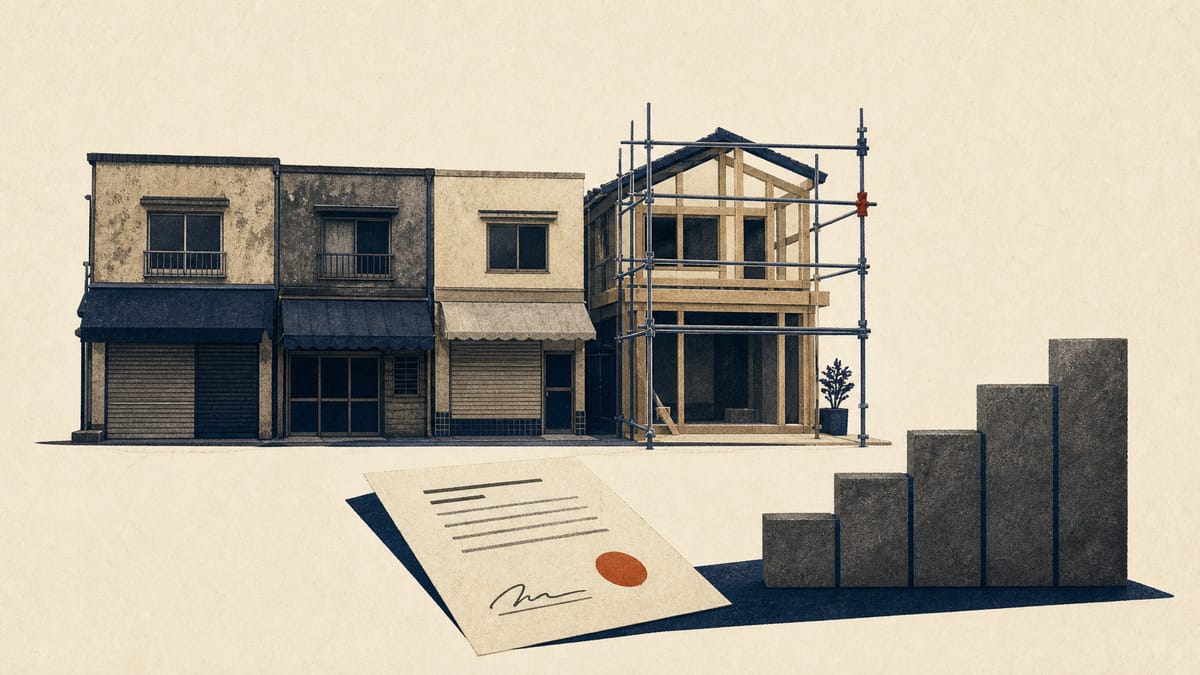
The Ministry of Land, Infrastructure, Transport and Tourism has put out for public comment a draft guideline that tells local governments how to run a new kind of building-revival scheme. Among other points, it asks them to take care over building-use fees, including setting them below market price in the early phase. Comment opened on 28 September 2026 and closes at 18:00 on 27 October 2026.
What the guideline is for
The guideline implements the landscape regeneration project created when the Landscape Act was amended by a law promulgated on 27 May 2026 (Law No. 23 of Reiwa 8, amending the Urban Renaissance Special Measures Act and others). The ministry issues it under Article 8, paragraph 5 of the Landscape Act, through the procedure the Administrative Procedure Act provides for public comment on draft rules.
In the draft's description, the project applies to areas where population or visitor decline and ageing buildings have damaged the townscape. A landscape administrative body (a local government acting under the Landscape Act) or a landscape improvement promotion corporation would renovate, manage and use buildings on the owners' behalf, in a chain of projects, to lift area value.
Small zones, written plans
Local governments that run the project must write a project zone and an implementation policy into their landscape plan. The draft says the zone should not be wider than necessary, so that effects appear early, and should be expanded or changed in stages according to how the project's effects appear. Where a locality has several such projects, each zone is to be kept to the necessary minimum.
The implementation policy must set out the target vision for the zone, the local government's role, the role expected of promotion corporations and how they will be designated, and the basic terms for the renovation, intended use and utilization of agreement buildings.
The rent provision
The draft says private operators with capital, management ability and technical skill are indispensable, and that long-idle buildings usually take a considerable time to earn money after renovation. It therefore asks that fees for using a building be set with flexibility to match the project's stage. Its example is a fee below market price in the early phase, with the restrained amount recovered after the building starts earning or after market values in the zone have risen. The draft also says neither party should be left with a one-sided disadvantage when the agreement ends.
Contracts are to state that they are made for the project. They must also fix the contract form and fee, the renovation scope and cost sharing, and what belongs to whom after renovation. A contract may be terminated if the agreement is abolished, though the draft does not stop a contract from continuing.
Money and national oversight
The draft says it is desirable for local governments to actively consider financial measures for the project during the agreement period. It gives no budget figure or subsidy rate.
The national government takes two roles. The land minister would designate a membership-based platform, published on the ministry's website, to accumulate information, train and secure operators, and match local governments with them. Local governments running the project must join it, and the draft says designating platform members as promotion corporations is desirable.
The minister would also certify landscape plans that put the project to effective use and set suitable landscape standards. Certified plans get technical advice and support through the platform. Changes to a certified plan other than minor ones need fresh certification.
The ministry's schedule has the guideline promulgated and taking effect in late November 2026, the date the amended law comes into force. The draft also says it will be revised as needed to reflect social and technological change.