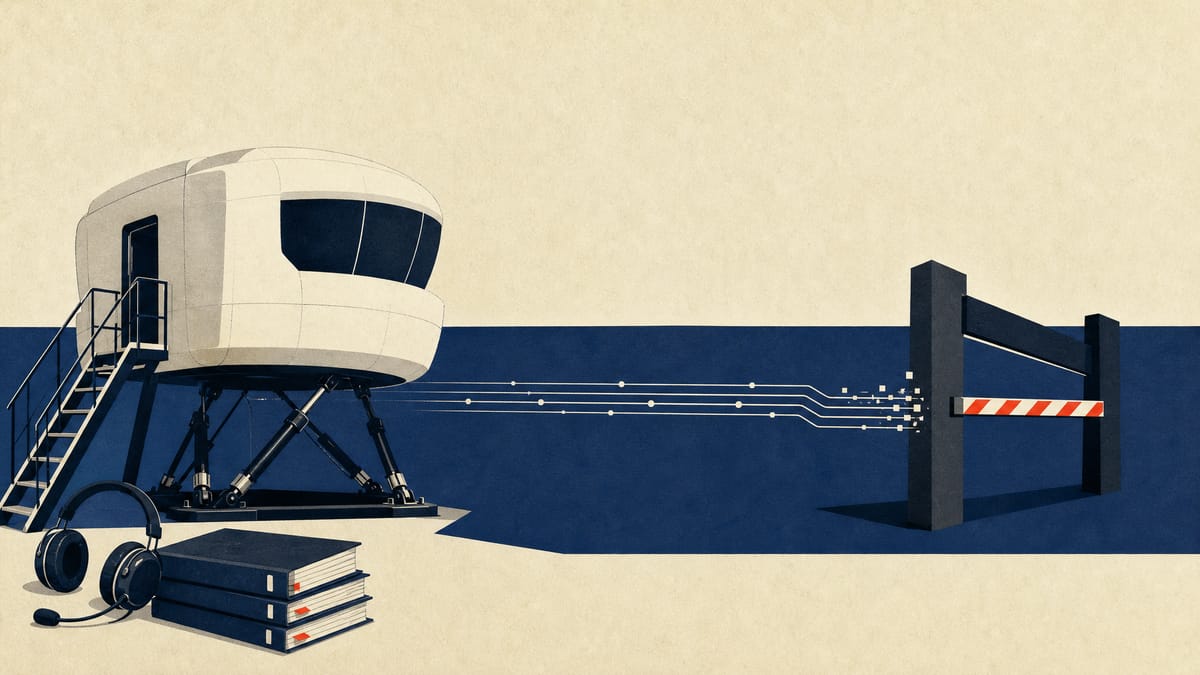
Japan's transport ministry wants to stop flying inspectors abroad to re-check flight simulators the US Federal Aviation Administration has already certified. A draft amendment to the simulator certification guideline and its implementing rules would let the Civil Aviation Bureau drop its on-site inspection for such devices and rely on the FAA's documents and results instead.
What the draft changes
Simulators certified by the transport minister can be used in the practical tests listed in the Civil Aeronautics Act enforcement regulations, and time logged on them counts toward pilots' flight experience records. Today, a device installed overseas still needs a Japanese on-site inspection. The ministry says the distance burdens both applicants and the authority and makes it harder for users to plan training and checks flexibly.
The proposed fix covers only overseas full-flight simulators that the FAA has certified at Level C or Level D and that are kept maintained. The ministry says the three requirements for Japan's on-site inspection (basic, performance and functional) conform to, and are equivalent to, the FAA's simulator qualification rules in 14 CFR Part 60. The draft rules add a new chapter covering devices certified under Part 60 or its predecessor requirements.
| Inspection | What Japan could skip | What the owner submits |
|---|---|---|
| Initial certification | All of the on-site inspection | All documents required under sections 2-3 and 2-4 of the guideline |
| Periodic inspection | All of the on-site inspection | Copy of the newly issued certification document and the full set of documents used in the FAA's periodic inspection, plus the usual application |
| Ad hoc inspection | All or part of the performance and functional checks | Documents showing the inspection was judged at least equivalent to Japan's |
Conditions attached
Applicants would still file a package. It includes the foreign certification document, the qualification test guide, the quality manual, initial certification results, the past two years of performance checks, the last three periodic inspections (or all of them if fewer) and two years of defect records.
The waiver also narrows what a device can be used for. Certified uses exclude the practical skills test, and documents on uses approved by the foreign authority are generally not required.
Owners take on reporting duties through their quality manual. They would have to tell the Civil Aviation Bureau promptly when the foreign authority's standards change, and confirm compliance with the new standards before using the device. If the foreign certification carries an expiry date, they must have a periodic inspection before it lapses so a new Japanese pass certificate can be issued. If the foreign authority revokes or suspends certification, they must report promptly and stop using the device.
Devices already holding Japanese certification do not get a free pass. To fall under the new chapter at a future inspection, the current certification would be cancelled and the device would go through a fresh certification inspection. A device already under the chapter that stays in it must have been used for the approved purposes since its last inspection.
Timing
The draft was published on 27 October, and comments are accepted until 23:59 on 25 November. They must be in Japanese, through the e-Gov form, email or post to the ministry's flight crew policy office. The overview gives promulgation and enforcement as planned for November, which leaves little room after the comment deadline. Both draft texts leave the effective date blank.