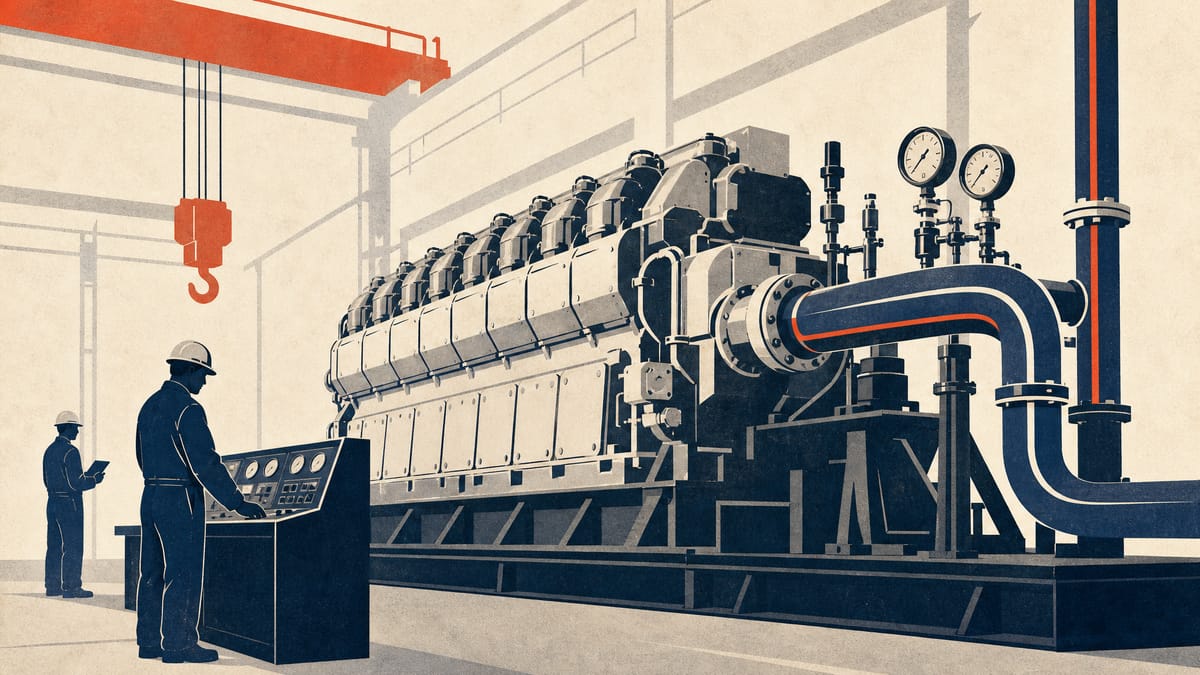
Japan Engine Corporation unveiled a completed hydrogen-fuelled engine for large merchant ships at its headquarters factory on September 7, and the machine has already cleared the approval-running tests that matter before anyone puts it on a ship. In factory operation, the 6UEC35LSGH hit a hydrogen co-firing ratio above 95% of its fuel mix and cut greenhouse-gas emissions by more than 95% compared with a conventional heavy-oil engine. NEDO, Japan's state innovation agency, and the development consortium describe it as the world's first engine of its kind built for large commercial vessels.
The engineering problem with burning hydrogen in a large marine engine is stability, and Japan Engine addressed it with high-pressure direct injection, forcing fuel straight into the cylinder under pressure to keep combustion steady. The company also built in a reinforced leak-prevention structure and double-walled piping for the hydrogen supply lines. ClassNK, the Japanese ship-classification society, witnessed the approval-running tests, which were completed without incident, and will keep assessing safety through the engine's development and through the design, construction and operation stages of the vessel it is installed on.
The engine is the product of a NEDO Green Innovation Fund project on marine hydrogen engines and fuel-supply systems, run jointly by Japan Engine, Kawasaki Heavy Industries and Yanmar Power Solutions. It is not Japan Engine's first alternative-fuel milestone: the company completed what it calls the world's first ammonia-fuelled marine low-speed two-stroke engine in August 2025, aimed at the same goal of carbon-neutral international shipping by 2050.
| Milestone | Date |
|---|---|
| Engine unveiled at Japan Engine's headquarters factory | September 7, 2026 |
| Engine installed on 17,500-DWT demonstration vessel | January 2027 |
| At-sea demonstration testing begins | April 2028 |
A factory test is not a sea trial, and the harder work is still ahead. Under the "Blue Harmony" project, the engine is due to be installed in January 2027 aboard a 17,500-deadweight-tonne multipurpose vessel being built at a shipyard in Onomichi for Mitsui O.S.K. Lines and MOL Drybulk. Kawasaki Heavy Industries is separately developing the ship's Marine Hydrogen Fuel System and the liquefied-hydrogen bunkering equipment needed to load fuel at port. After sea trials, the consortium plans an at-sea demonstration program starting in April 2028 to test the engine's durability under real operating conditions, the step that will actually determine whether hydrogen combustion holds up outside a controlled factory floor.