Japan's Ministry of Land, Infrastructure, Transport and Tourism (MLIT) is consulting on a draft ordinance that corrects a coefficient in the minimum test-load rules for ship lifting gear and writes out what shipowners must do with equipment judged unsafe. The comment period opened on 2 November 2026 and closes on 3 December 2026.
The test-load correction
The International Maritime Organization (IMO) issued a correction to part of the formula for the minimum test load of lifting gear fitted to cargo-handling cranes, MLIT's overview says. Japan applies the SOLAS convention, the international treaty on safety of life at sea, through the Ship Safety Act and its ordinances. The draft brings the Ship Safety Act enforcement regulations into line with the corrected standard.
In the draft's amendment table, the test load for blocks other than single pulleys and for hook blocks, where the safe working load is above 25 tonnes and up to 160 tonnes, becomes 0.933 times the working load plus 27 tonnes. The comparison column shows 0.993 times.
A new rule for unsafe cranes and gear
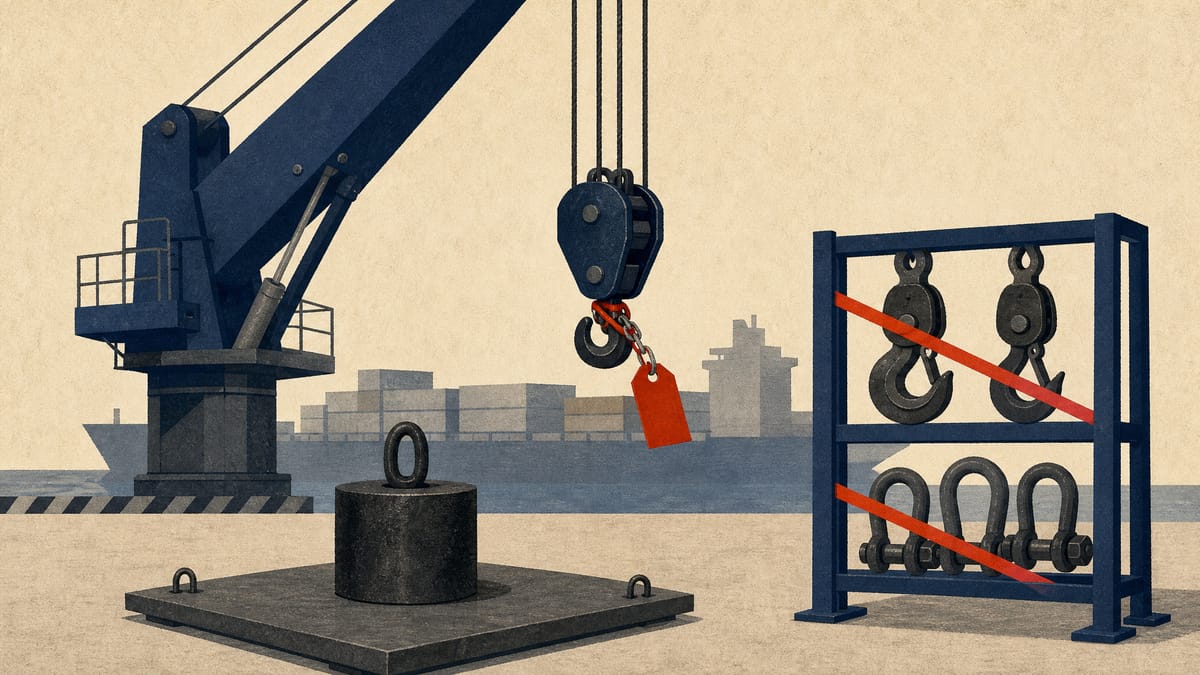
The draft adds a paragraph to Article 59 of the enforcement regulations. Lifting appliances or gear found to be unsafe must not be used, and the shipowner must take specified steps. The shipowner must make the crane impossible to operate, prevent it or its parts from moving unintentionally, and store unusable gear apart from usable gear with a mark saying it cannot be used.
MLIT says the purpose is to make the concrete measures explicit. Article 61 is also tightened: where a shipowner bans use of such equipment, the ban must be recorded in the cargo-handling equipment inspection log.
Housekeeping for the fishing-vessel treaty rules
The second part of the draft concerns the Cape Town Agreement on fishing-vessel safety. Japan's Diet approved joining it in June 2022, and a March 2023 ministerial ordinance wrote its content into domestic rules. The agreement's entry-into-force conditions were met on 24 February 2026, so that 2023 ordinance takes effect on 24 February 2027.
Because five further amendments to ship-safety ordinances were made after the 2023 ordinance, the draft adjusts its before-and-after provisions to match. The affected texts cover bridge visibility, gyrocompass requirements, the reporting of ship accidents and defects, and the issue, validity and presentation of treaty certificates, including the international fishing vessel safety certificate.
Timing and how to comment
MLIT plans to promulgate and enforce the ordinance in December 2026. The overview leaves the day blank, and the draft takes effect on promulgation. Conduct before that date remains subject to the existing penalty provisions.
Comments must be in Japanese, by the e-Gov portal, email, fax or post to the ministry's Maritime Bureau safety policy division. MLIT says it will not reply to individual comments and may publish commenters' names with their views.