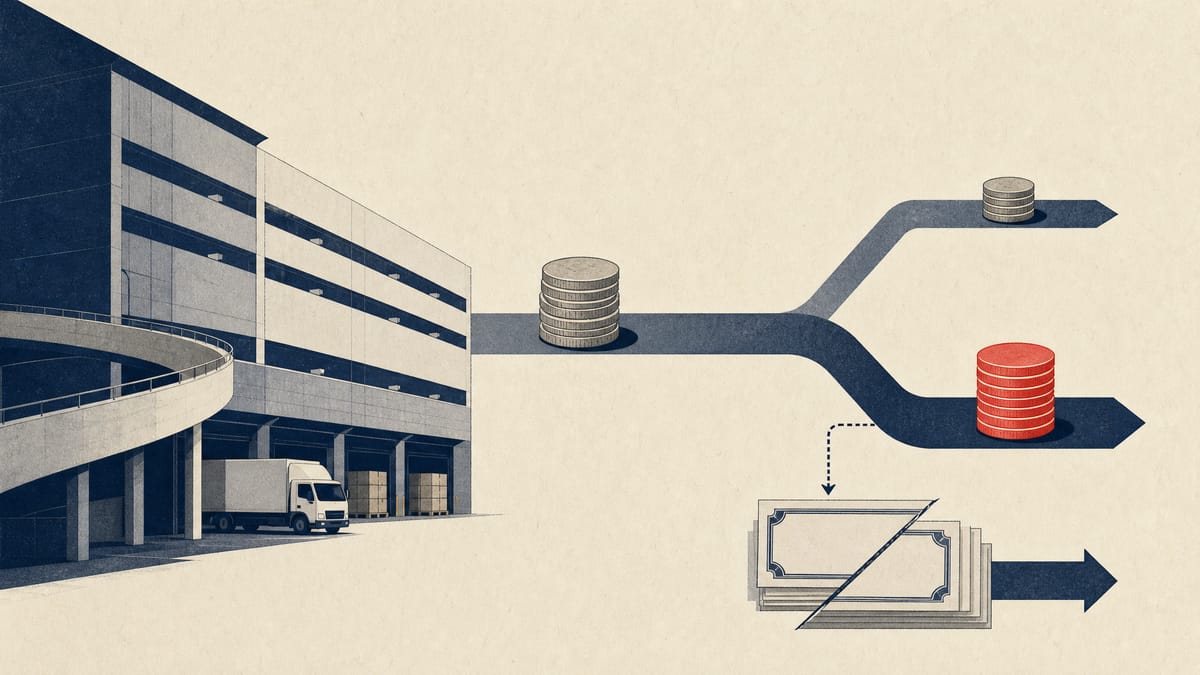
GLP J-REIT will pay ¥3,660 a unit for the half year to August 2026, but only ¥3,267 of that comes from earnings. The other ¥393 is a return of investor capital, and the REIT now uses 40% of depreciation as its benchmark for that return, up from 30%. Its board also approved a buyback of up to ¥10bn on October 15, 2026. Earlier Tokyo Brief coverage
Operating base
Operating revenue rose 5.7% to ¥30.45bn, operating profit 5.1% to ¥17.33bn and net income 4.3% to ¥15.53bn. The period includes a ¥4.38bn gain from selling one property for ¥10.4bn on August 31, against ¥3.6bn of sale gains in the previous half.
The portfolio had 88 properties with an acquisition price of ¥906.04bn and was 99.0% occupied at period end. The presentation reports rent increases of 10.1% on leases that reached expiry and 7.4% from CPI-linked clauses. It puts distribution per unit excluding sale-gain effects at ¥2,851, against ¥3,660 including them.
Earnings versus capital
The earnings distribution totals ¥15.53bn, a payout ratio of 99.9% of net income. The excess distribution totals ¥1.87bn and is, for tax purposes, a return of capital. Of that, ¥1.75bn is the ongoing excess distribution, almost 40% of the half's ¥4.38bn depreciation charge; the previous half used almost 30%. A further ¥118.8mn is a temporary excess distribution, paid because the redevelopment of one property cut the per-unit distribution.
The 40% figure is a target. The REIT says it will aim for it "for the time being", and the policy caps excess distributions at depreciation less capital spending, a ceiling of ¥2.27bn this half. Excess distributions stop if appraisal-based loan-to-value exceeds 60%; the presentation puts it at 36.9%. The forecasts do not guarantee any payment.
| Half year | From earnings | Excess (capital return) | Total |
|---|---|---|---|
| To Feb 2026 (actual) | 3,105 | 294 | 3,399 |
| To Aug 2026 (actual) | 3,267 | 393 | 3,660 |
| To Feb 2027 (forecast) | 3,032 | 412 | 3,444 |
| To Aug 2027 (forecast) | 2,968 | 418 | 3,386 |
Buyback and balance sheet
The REIT may buy up to 77,000 units, or 1.62% of units outstanding, for up to ¥10bn through market purchases from October 16, 2026 to February 17, 2027. It plans to cancel everything it buys within the half to February 2027. The stated reason is unit price level, cash on hand, finances and market conditions. In the half just ended it bought and cancelled 44,147 units for ¥5.98bn, leaving 4,753,584 units.
Net unitholders' capital fell by ¥7.39bn in the half, through excess distributions and the cancellation of repurchased units. Interest-bearing debt was ¥437.56bn and book loan-to-value 48.1%; the forecasts assume 48.8% and 48.9% at the next two period-ends. A ¥41bn borrowing taken on August 3 to fund three acquisitions is assumed to be prepaid on October 30, 2026, with the money raised through bonds or loans.
Forecast
Net income is forecast at ¥14.2bn for the half to February 2027, down 8.6%, and ¥13.9bn for the half to August 2027, down 2.1%. Sale gains of ¥2.93bn are assumed in the first, from a ¥7.2bn property sale due February 26, 2027 to an undisclosed buyer. The second assumes ¥2.58bn from a sale not yet decided.
The split shifts toward returned capital: the earnings distribution is forecast to fall from ¥3,267 to ¥2,968 a unit by the half to August 2027, while the excess distribution rises from ¥393 to ¥418.