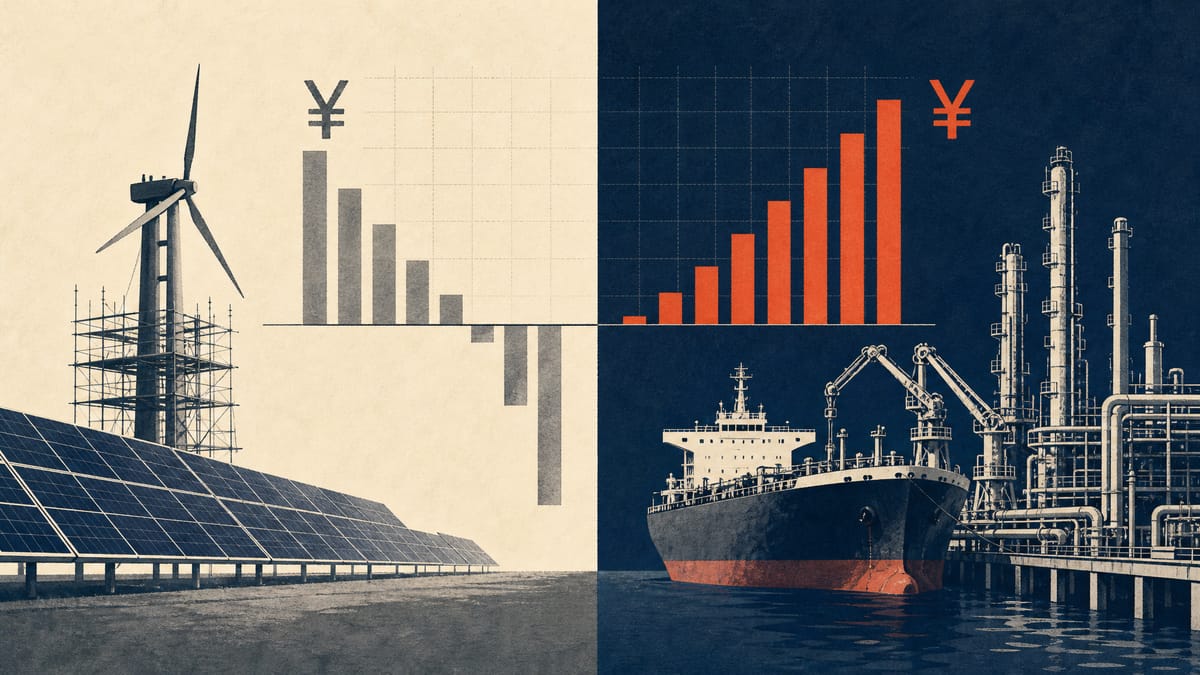
ENEOS Holdings raised its operating-profit forecast for the year to March 2027 to ¥910bn on 11 November, ¥300bn above the figure it gave on 14 May. The same revision notice records a ¥111.8bn impairment in the renewables segment, which cut profit attributable to shareholders by ¥97.8bn. Oil earnings lift the guidance despite the write-down. The notice does not say the renewables problem has gone away.
What the new guidance says
The forecast for attributable profit rises to ¥615bn from ¥415bn, and revenue to ¥13.86tn from ¥12.85tn. Excluding inventory valuation effects, operating profit is forecast at ¥770bn, up ¥180bn. ENEOS says the upgrade follows Dubai crude and overseas product prices running above its May assumptions, and it forecasts a ¥230bn increase in oil products and other, citing export opportunities captured in overseas markets.
| Measure | May forecast | Revised forecast |
|---|---|---|
| Revenue | ¥12.85tn | ¥13.86tn |
| Operating profit | ¥610bn | ¥910bn |
| Pre-tax profit | ¥590bn | ¥890bn |
| Attributable profit | ¥415bn | ¥615bn |
The new forecast assumes Dubai crude averaging $95 a barrel (up from $85) and ¥157 to the dollar (up from ¥155). The investor presentation says the Middle East disruption is assumed to last through the end of March 2027.
The renewables write-down
The impairment covers goodwill and related assets that arose when ENEOS acquired Japan Renewable Energy in 2022. ENEOS gives three drivers: slower decarbonisation, higher development costs and interest rates, and a higher discount rate applied to lower expected future cash flow. It booked the charge in the July-to-September quarter.
The presentation says ENEOS substantially revised its new investment policy, halting onshore wind development except projects already under development. After revising its future business plan, it wrote off the part of the goodwill and related assets that assumed future capacity growth. Consolidated goodwill fell from ¥74.2bn at the end of March 2026 to ¥11.8bn at the end of September.
The renewables segment reported an operating loss of ¥111.4bn for the six months to September, against a ¥1.1bn profit a year earlier. ENEOS forecasts a full-year segment operating result, excluding inventory effects, of a ¥112.0bn loss, against a ¥1.0bn profit in May.
This is a narrower retreat than a full exit. ENEOS says it is applying stricter investment discipline and selecting new development projects more carefully, and that it will keep working to raise profitability at existing plants, including by adding batteries.
How the two halves fit
For the six months to September, operating profit was ¥706.1bn, against ¥166.7bn a year earlier, and attributable profit was ¥511.9bn against ¥64.8bn. Those are actual results, and the ¥910bn figure is a forecast. Inventory valuation effects added ¥262.3bn to first-half operating profit, and ¥140bn to the full-year forecast.
Shareholders get some of the benefit. ENEOS set an interim dividend of ¥19 a share, up from the ¥17 it had forecast, and raised its full-year dividend forecast to ¥38 from ¥34.
The forecast is only as firm as its premises: oil prices near $95 and a Middle East disruption lasting to March 2027. The renewables charge, for its part, cites slower decarbonisation, higher development costs and higher interest rates.