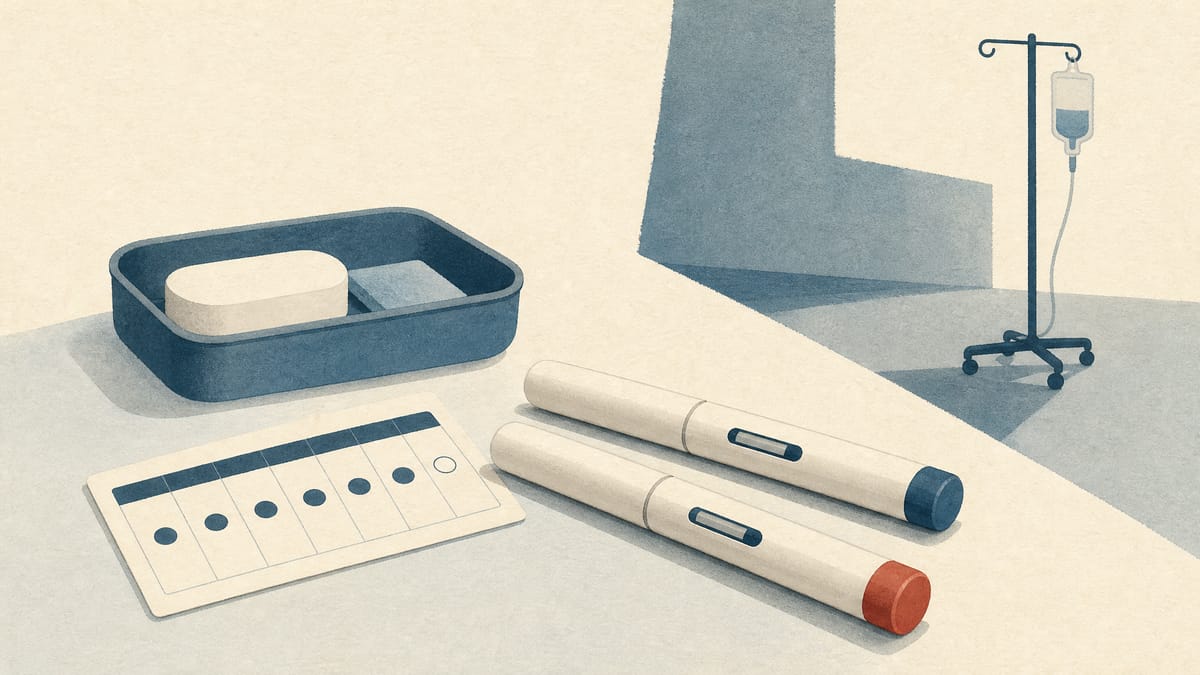
Eisai and Biogen began selling the Leqembi SC 250mg Pen in Japan on November 13, giving patients with early Alzheimer's disease a weekly injection they can give themselves at home instead of a fortnightly hospital infusion. The company says it is the first and only anti-amyloid therapy in Japan that can be given at home. Earlier Tokyo Brief coverage
What is on sale
The pen won approval on September 16, 2026 as a new-route-of-administration drug and was added to the national drug price list on the launch date, Eisai said. The listed price is ¥27,141 per pen. A package holds two 1.25mL pens. The dose is 500mg once a week, given as two pens. That is a listed drug price, not what a patient pays out of pocket.
Japan is the second country to launch the subcutaneous form of Leqembi, after the United States. IV dosing every two weeks at a medical facility remains available, and the pen adds a weekly option. Eisai puts injection time at about 15 seconds per pen.
Resource claims come from the issuer
Eisai says home and on-the-go dosing should ease travel to clinics for patients and care partners and lower the barriers to starting and staying on treatment. It also says the pen should reduce the infusion capacity and nurse monitoring that IV dosing needs, and make the Alzheimer's treatment pathway more efficient. These are expectations stated by the company, not measured outcomes.
Controls that stay
Self-injection has conditions. The first dose must be given at a medical facility, by a doctor or under a doctor's direct supervision. Home use then depends on a careful judgment that it is appropriate, sufficient training, and confirmation that the patient or a family member or carer understands the risks and how to respond and can inject reliably, all under a doctor's guidance.
Monitoring for ARIA, or amyloid-related imaging abnormalities, is unchanged. As with IV dosing, MRI checks are done before treatment starts and at set points afterwards.
Evidence behind the route
Eisai says the approval is based on integrated results from the 18-month core period of the Clarity AD phase III trial, multiple subcutaneous substudies in its long-term extension, and modelling and simulation. In the substudies, weekly 500mg subcutaneous dosing gave exposure similar to the fortnightly IV dose, and Eisai says similar efficacy is expected. Safety was broadly similar to IV dosing. Systemic injection-related reactions were less frequent at 1.4%, a figure from newly started patients given 720mg weekly from vials, not from the pen.
Financial effect
Eisai says the launch has only a minor effect on its forecast for the year to March 2027 and leaves unchanged the forecast it issued on May 15, 2026. The announcement gives no sales target for the pen. Eisai leads development and regulatory filings for lecanemab and holds final decision-making authority, while Eisai and Biogen co-commercialise it.