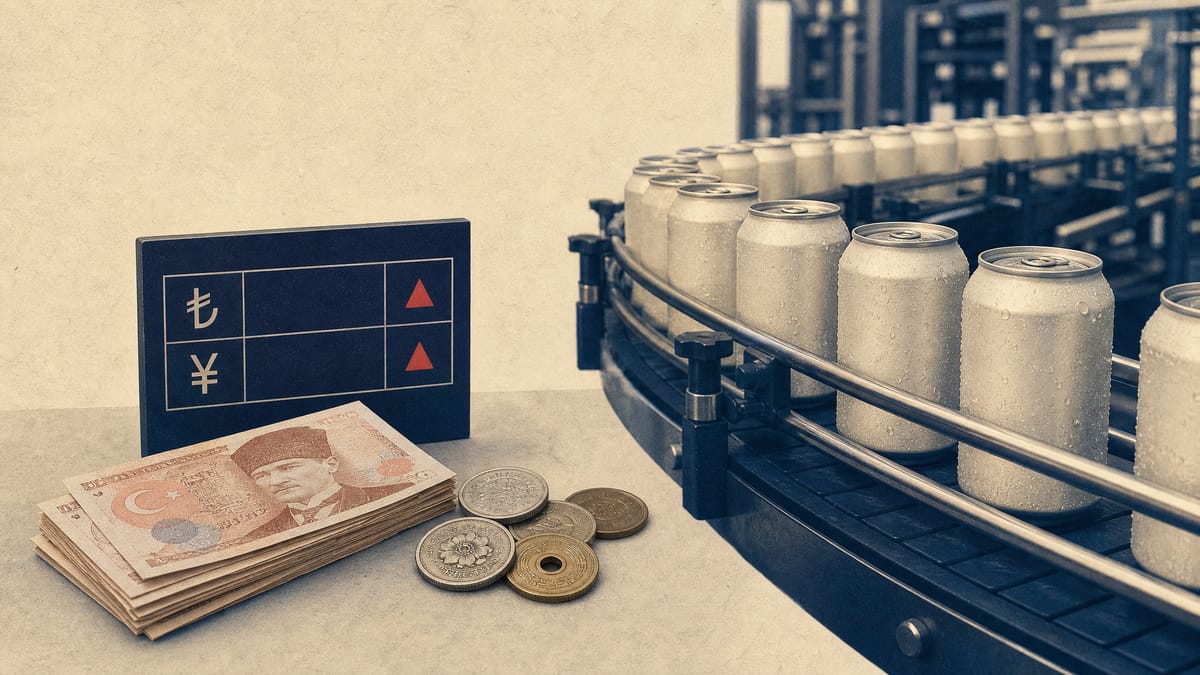
DyDo Group Holdings has raised its full-year profit forecast for the year ending January 2027, even though it now assumes Turkish inflation will run hotter than it expected five months ago. The Osaka-based vending-machine and beverage group lifted its operating profit guidance by ¥1.8bn to ¥12.3bn and its net profit guidance by ¥1.0bn to ¥6.0bn, while trimming its sales forecast by ¥500mn to ¥246.3bn. Both profit lines would mark a sharp rebound from the year to January 2026, when the company posted a net loss of ¥30.3bn.
| Metric | Previous Forecast | Revised Forecast | Change |
|---|---|---|---|
| Net sales | ¥246.8bn | ¥246.3bn | -¥0.5bn |
| Operating profit | ¥10.5bn | ¥12.3bn | +¥1.8bn |
| Ordinary profit | ¥8.4bn | ¥9.4bn | +¥1.0bn |
| Net profit | ¥5.0bn | ¥6.0bn | +¥1.0bn |
The catch sits inside the assumptions. DyDo now expects Turkish inflation to reach 28.6% by the end of 2026, up from the 21% it built into its original plan in March, and it has adjusted its currency assumptions to match: one lira is now valued at ¥3.20 (was ¥3.00), one zloty at ¥42.85 (was ¥39.00) and one yuan at ¥23.26 (was ¥20.00). Because DyDo treats its Turkish subsidiary as operating in a hyperinflationary economy under IAS 29, the revised guidance embeds that adjustment: the company now expects the rule to add ¥1.6bn to full-year sales but subtract ¥1.1bn from operating profit, ¥3.8bn from ordinary profit and ¥3.5bn from net profit.
The upgrade was possible because the underlying business outran that drag. First-half sales rose 2.0% to ¥120.1bn and operating profit jumped 388.2% to ¥6.7bn, turning a ¥1.36bn net loss a year earlier into a ¥2.8bn net profit. Overseas beverages, led by Turkish carbonated drinks and a round of price increases, posted their best first half in four years, with segment profit up 68.1% to ¥5.2bn. Domestic beverages swung from a ¥2.0bn segment loss to a ¥2.1bn profit even as sales fell 5.5%, because depreciation dropped sharply after last year's impairment charge and DyDo trimmed vending-machine sales commissions while pulling unprofitable machines from the network.
IAS 29 also produced a ¥2.47bn charge in the first half: a loss on net monetary position, booked because the Turkish subsidiary's cash and receivables grew faster than its liabilities amid the strong sales run, and hyperinflation accounting penalizes holding net monetary assets in a fast-depreciating currency. For the full year, DyDo now targets ¥76.2bn in overseas beverage sales and ¥9.2bn in segment profit, both above the ¥70.0bn and ¥7.8bn it originally planned, while domestic beverage sales are guided down to ¥138.3bn, ¥3.2bn below the original ¥141.5bn target, against a raised profit goal of ¥6.25bn, up from ¥5.2bn.
DyDo said cost pressure tied to Middle East-linked commodity prices and marketing investment to strengthen its Turkish brand will show up more heavily in the second half. Whether the upgraded guidance holds now depends on Turkish inflation actually landing near 28.6% by the end of 2026, rather than moving again before the fiscal year closes in January.