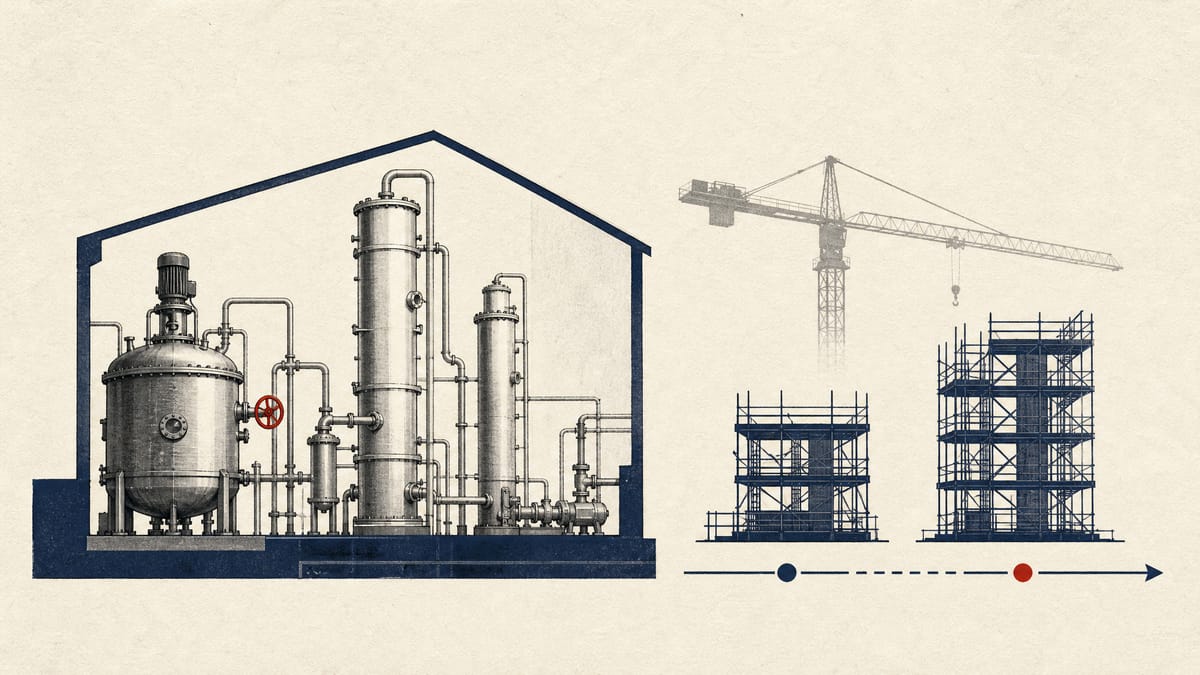
Osaka Organic Chemical Industry has doubled the planned investment in a new semiconductor-materials plant in Yuza, Yamagata Prefecture, to about ¥20bn from about ¥10bn, and delayed the schedule by a year. The board approved the change on 9 October 2026, amending a plan the company announced on 22 December 2025.
What changed
The company now expects construction to start in 2027 and finish in 2029. The earlier plan was a 2026 start and a 2028 finish. The product category (semiconductor-related materials) and the site, in the town of Yuza in Yamagata's Akumi district, are unchanged.
Two reasons for the larger bill
The company gives two explanations. One is higher prices for construction materials and equipment. The other is a review of the equipment to be installed, based on its latest demand simulation, with the aim of expanding production capacity and improving high-purity technology. Together these left the expected investment above the original plan. The company does not split the increase between the two causes.
The schedule moved for a related reason: the company said it revised the construction timetable because the equipment changed.
Why the company is building
The company says AI and high-performance devices will keep the semiconductor market growing, and that materials for finer, denser chips need stable supply. The plant sits within its medium-term plan, Progress & Development 2030, which covers the fiscal years ending November 2024 to November 2030. Under that plan the company says it has built a mid-volume laboratory and brought into operation production equipment costing about ¥8bn.
The new plant is meant to add capacity and high-purity capability and to widen its share of advanced-semiconductor materials. The company also says that production at its Kanazawa and Sakata plants would give it a two-site structure for business continuity planning.
Earnings effect
Because the plant is due for completion in 2029, the company says the effect on consolidated results for the current period is minor. The plant is still planned: the revision sets a construction start in 2027 and gives no figure for the capacity to be added.