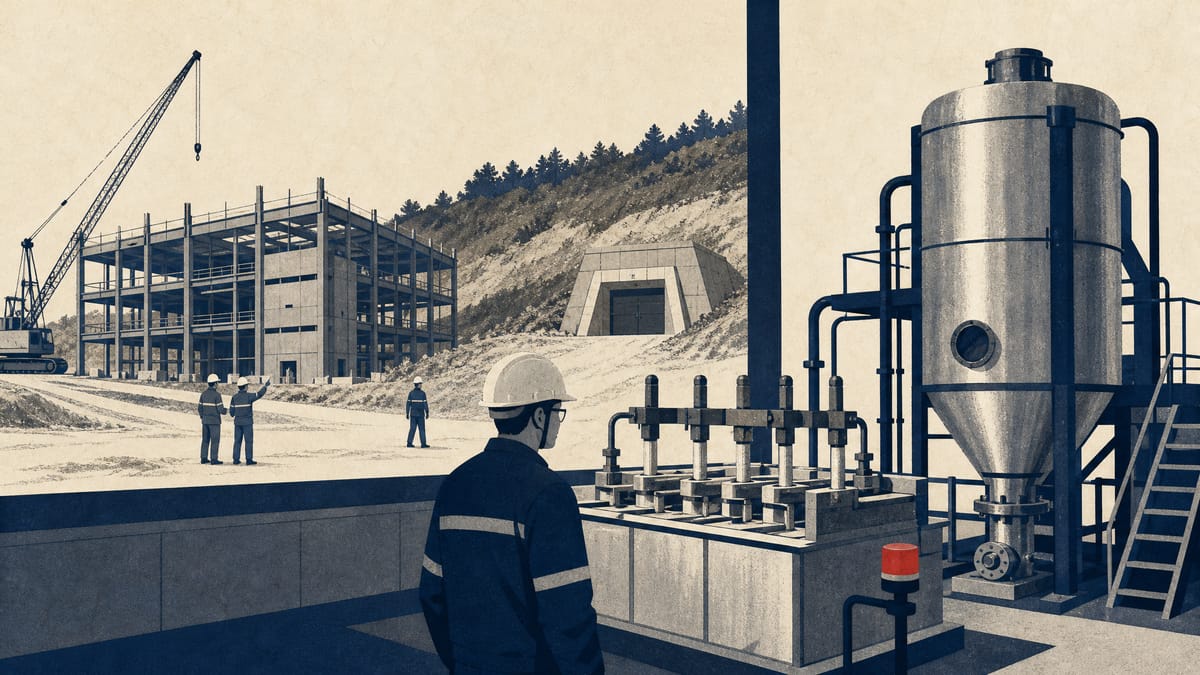
Carlit expects to finish its new defense solid-propellant plant within the 2027 fiscal year, which begins in April 2027, rather than in 2028 as first planned. The company gave the revised timetable in its interim earnings briefing materials, along with an update on its ammonium perchlorate (AP) expansion.
Capacity built, ramp-up still ahead
AP is the oxidizer that makes up about 70% of composite solid propellant by composition, and solid propellant counts as an explosive under Japan's Explosives Control Law. Carlit says its three-step AP expansion is complete, with maximum capacity two to three times the 2023 level. Equipment starts running from the 2027 fiscal year, and the company's phase plan calls for full operation that year.
The company is not stopping there. It has begun work on countermeasures for the ageing mixing and crushing plant, budgeted at ¥2bn to ¥2.5bn, with operation planned from the second half of the 2029 fiscal year. It is also studying a second plant for the double-decomposition step, which turns sodium perchlorate into AP. That plant is marked as under consideration at ¥3bn or more, with design due by the 2028 fiscal year, construction from 2029 and operation targeted during 2031.
The defense plant
The separate propellant plant sits on the grounds of Carlit's Akagi factory. It was originally to be completed and start production in the 2028 fiscal year. Carlit now says completion should come within the 2027 fiscal year, while manufacturing start remains listed as 2028. As of November 2026, land clearing is almost done and building construction is under way. The plant is a target, not a finished asset.
Carlit lists the cost at ¥7.4bn, to be covered by initial costs. It plans to book revenue equal to the full investment cost when the plant is completed, so earlier completion pulls that revenue forward in the profit and loss statement. The company says the acceptance timing is still being adjusted.
| Project | Cost | Timing | Status |
|---|---|---|---|
| Defense propellant plant (Akagi factory) | ¥7.4bn | Completion within the 2027 fiscal year; production from 2028 | Under construction |
| Mixing and crushing plant ageing countermeasures | ¥2bn to ¥2.5bn | Operation from second half of the 2029 fiscal year | Started |
| Second double-decomposition plant | ¥3bn or more | Design by 2028, construction from 2029, operation targeted in 2031 | Under consideration |
Space capacity remains a study
For space, Carlit makes the solid-fuel motors for Space One's Kairos rocket. It assumes Kairos will fly 10 or more times a year around 2030 and is studying capacity to make propellant for at least 10 rockets a year. Its pilot plant can still make full-size units, with a maximum production quantity of 15,000kg, but cannot mass-produce 10 or more a year. Carlit says it is working on estimates and studies for new facilities, including land, production and inspection equipment.
Its sales outlook for propellant and AP is unchanged: ¥1.5bn in the 2026 fiscal year, ¥4.5bn in 2030 and ¥9.5bn in 2035.
Interim results
AP sales rose on firm space and defense demand, in line with plan. Group first-half sales fell 1.8% to ¥17.5bn and operating profit fell 32.0% to ¥1.02bn, about 7% below Carlit's first-half plan. Net profit rose 36.3% to ¥1.57bn, helped by a ¥1.14bn gain on sales of investment securities. Full-year guidance is unchanged at ¥37.2bn in sales and ¥3.2bn in operating profit. The bottling segment, whose PET line is being renewed through December, now expects a ¥59mn loss.