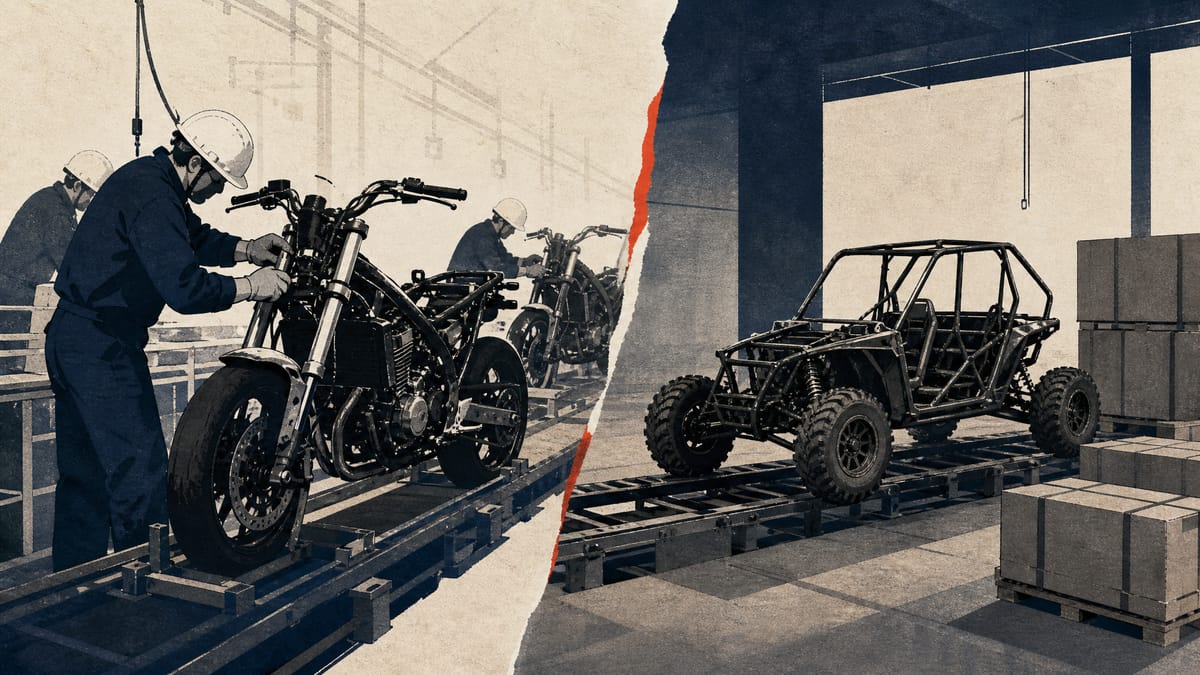
Yamaha Motor's motorcycle business had its best six months on record, and the numbers say more about who is buying bikes than about the company's home market.
Revenue for the six months to June 2026 rose 17.2% to ¥1.50tn, operating profit nearly doubled, up 88.6% to ¥158.5bn, and profit attributable to shareholders climbed 114.7% to ¥113.9bn. Management called it the best half-year performance on record for revenue, operating profit and net profit.
The growth came almost entirely from two-wheelers. In the Land Mobility segment, which also houses e-bike drive units and electric wheelchair kits, revenue rose 21.8% to ¥984.6bn and operating profit rose 89.8% to ¥112.7bn. Yamaha said demand in India and ASEAN markets grew sharply, and volumes also rose in Europe and the US even as sales in Japan fell. A weaker yen helped too: the company's average exchange rates for the half were ¥158 to the dollar and ¥185 to the euro, both 10 to 23 yen weaker than a year earlier.
Elsewhere, the Robotics segment swung back to a ¥3.7bn operating profit from a ¥1.5bn loss a year earlier, helped by a demand recovery for surface mounters in China and for industrial robots. The outdoor-vehicle unit stayed in the red, though the loss narrowed to ¥12.0bn from ¥13.7bn, as strength in four-wheel ATVs offset continued weakness in recreational off-road vehicles.
A bigger profit target, and a US refund
Management raised its full-year forecast for the second time this year. Revenue guidance moves to ¥2.90tn and operating profit guidance to ¥260.0bn, up 44.4% from the ¥180.0bn Yamaha projected in February. Net profit guidance rises 70% to ¥170.0bn.
| Metric | Initial Forecast | Revised Forecast | Change |
|---|---|---|---|
| Revenue | ¥2.70tn | ¥2.90tn | +7.4% |
| Operating profit | ¥180.0bn | ¥260.0bn | +44.4% |
| Net profit (parent owners) | ¥100.0bn | ¥170.0bn | +70.0% |
| EPS | ¥103.05 | ¥175.16 | — |
Part of the upgrade, Yamaha said, came from a refund of US additional tariffs under the International Emergency Economic Powers Act, alongside stronger-than-expected motorcycle volumes and continued yen weakness. The company now expects the annual tariff hit to come in below its original assumption for the rest of the year, even as Middle East-linked raw-material costs run higher than planned.
Retreat from Georgia
The upgrade absorbs a cost decision Yamaha announced the same day: it will stop building recreational off-road vehicles in-house at its Georgia plant, Yamaha Motor Manufacturing Corporation of America, and shift to buying them from outside partners instead. Freed-up factory space and staff will be redirected toward ATVs and golf cars, the two product lines management says can carry better margins.
The restructuring comes with roughly 300 job cuts worldwide, including about 200 regular employees, plus adjustments to temporary staffing, concentrated in development, sales and production roles. Yamaha expects to book about ¥12.0bn in one-time charges this year covering severance, promotional costs tied to winding down its own production, inventory write-offs and impairment. It is targeting a large profit improvement next year and a single-year profit for the whole outdoor-vehicle business by 2028.
That timeline matters for how the quarter should be read. The ¥12bn charge is a one-off tied to exiting Georgia production, not a recurring cost, and the tariff refund that padded first-half profit is not guaranteed to repeat. Strip those out and the story is simpler: motorcycles in India, ASEAN and Europe are doing the heavy lifting, while golf cars and ATVs are being asked to do more once the Georgia line goes quiet.