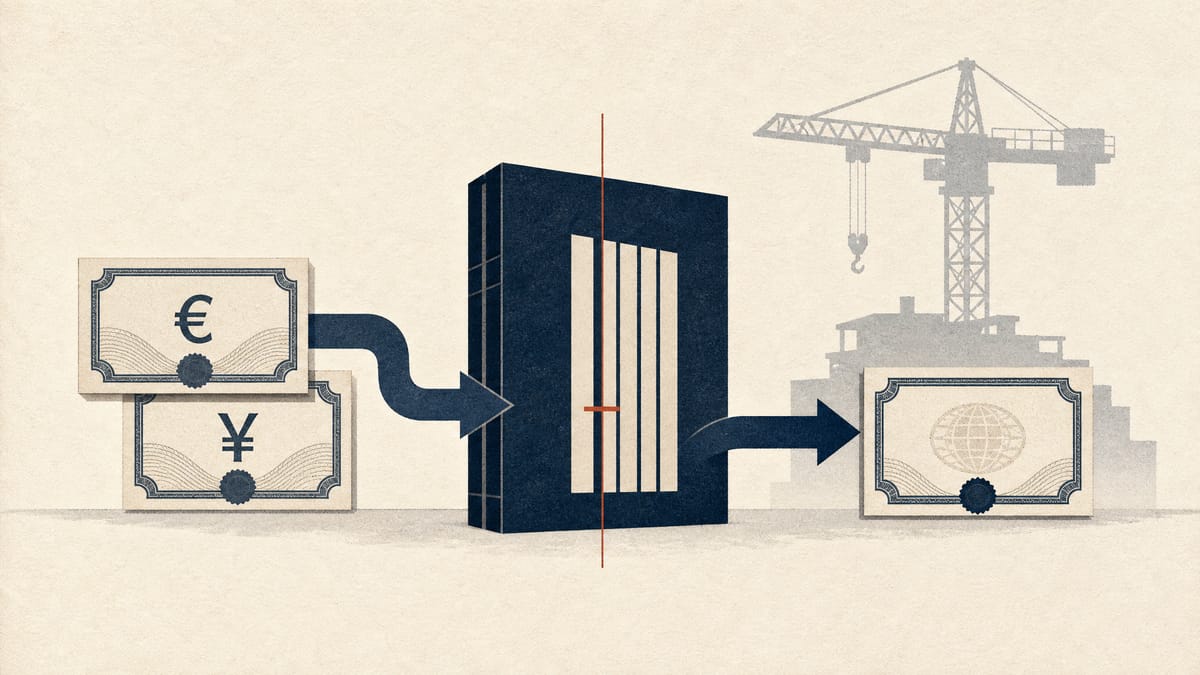
A bond raise built to cover two goals
Shimizu Corporation's board resolved on September 24, 2026 to issue two tranches of zero-coupon, euro-yen convertible bonds, one maturing in October 2031 and the other in October 2033, each with ¥50bn of face value. The bonds carry no interest, price at 103.0% of face value, and will be offered in overseas markets centered on Europe and Asia, excluding the United States, with listing on the Singapore Exchange; Nomura International and Mizuho International are joint bookrunners. Combined net proceeds come to about ¥100bn, a figure Shimizu states directly in its disclosure.
Shimizu says that money has two jobs. About ¥90bn is earmarked for construction-sector M&A by the end of March 2027, including the full acquisition of American Engineering Corporation (Okinawa), and about ¥10bn is set aside for share buybacks by the end of December 2026.
| Item | Detail |
|---|---|
| 2031-maturity tranche | ¥50bn face value, zero coupon, priced at 103.0% of face, matures October 14, 2031 |
| 2033-maturity tranche | ¥50bn face value, zero coupon, priced at 103.0% of face, matures October 13, 2033 |
| Combined net proceeds | About ¥100bn |
| M&A allocation | About ¥90bn by end of March 2027, including full acquisition of American Engineering Corporation (Okinawa) |
| Buyback allocation from proceeds | About ¥10bn by end of December 2026 |
| Same-day buyback cap increase | ¥10bn to ¥20bn (6,000,000 to 12,000,000 shares) |
Doubling the buyback to blunt dilution
On the same day, Shimizu's board separately doubled the ceiling on its running buyback program: the maximum share count rose from 6,000,000 shares (0.88% of shares outstanding excluding treasury stock) to 12,000,000 shares (1.77%), and the spending cap rose from ¥10bn to ¥20bn, with the purchase window unchanged at August 17 to December 30, 2026. The stated reason is to cushion short-term pressure on Shimizu's own shares from the convertible bond sale and to improve capital efficiency. As of September 18, Shimizu held 38.7mn treasury shares against 678mn shares outstanding excluding treasury stock, and it had bought back 1.32mn shares for ¥3.16bn since the original ¥10bn program began.
Conversion terms designed to limit new shares
The bonds' conversion price cannot be set below the closing share price on the day Shimizu signs its underwriting agreement. Bondholders can convert in quarters where, over the last 20 consecutive trading days of the prior quarter, Shimizu's closing share price exceeded 150% of the applicable conversion price, a threshold that eases to 130% in later quarters approaching maturity, unless one of several exceptions in the bond terms applies. That price test is waived if Japan Credit Rating Agency cuts Shimizu's long-term issuer rating, or Rating and Investment Information cuts its issuer rating, to BBB- or below, and also during periods tied to early bond redemption notices, corporate reorganizations, or a specified bond-pricing mismatch (a "parity event"). Shimizu's own filing frames the combination, a zero-coupon bond with a conversion price designed to be set above the current share price paired with a bigger buyback, as a way to curb earnings-per-share dilution while supporting gains in EPS and return on equity.
Separately, Shimizu amended a ¥100bn corporate-bond shelf registration filed in August to add the extraordinary report as a reference document, a procedural step tied to the new disclosure rather than a change in borrowing terms.