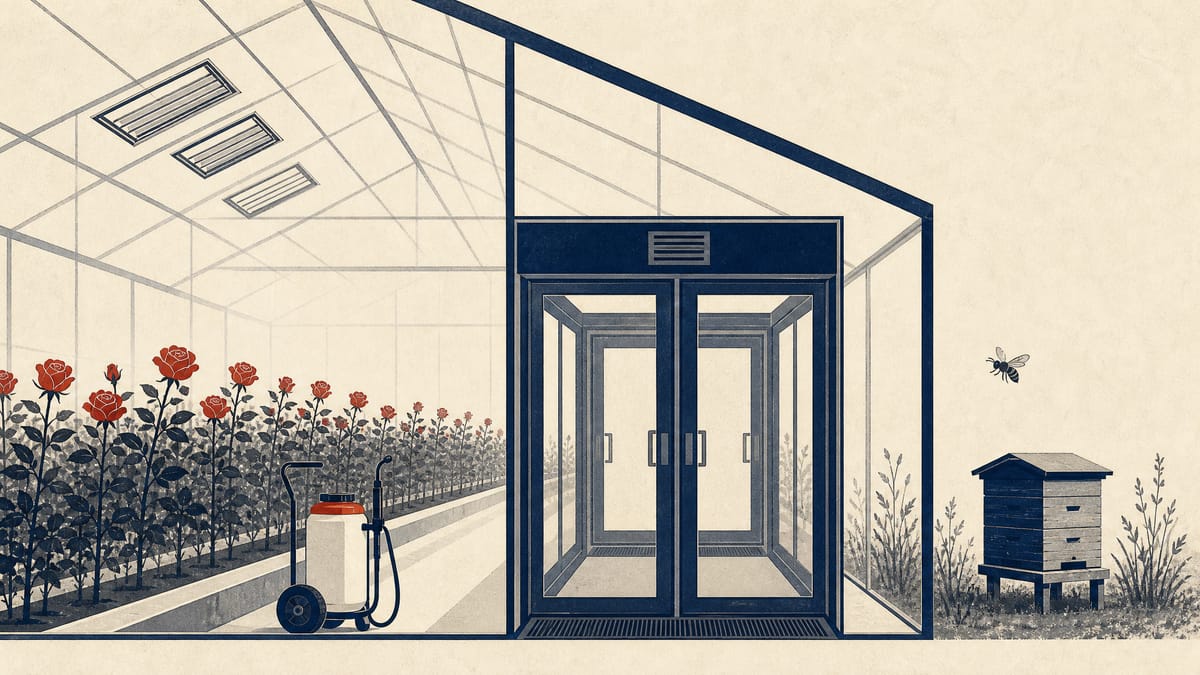
Japan's agriculture ministry is asking for public comment on a draft assessment that clears the miticide pyrimidifen for a single use, roses grown in greenhouses, on one condition: the use must be limited to closed-system facilities. The draft concludes that, applied as specified, the chemical is unlikely to impair the maintenance of honeybee colonies. Comments are open from 15 October to 13 November 2026.
What is being assessed
The applicant, listed in Japanese as Mitsui Chemicals Crop & Life Solutions, seeks approval for one formulation, a 4.0% wettable powder. The proposed use is against spider mites on greenhouse roses, diluted 500 times and sprayed at 100 to 300 litres per 10 ares at the early stage of an outbreak. It would be applied once per crop, which is also the cap on total pyrimidifen applications.
The draft describes pyrimidifen as a phenoxyethylamine insecticide and miticide that is thought to disrupt calcium-ion metabolism in muscle cells. As of 2025 it was registered in Israel, Ecuador, Colombia and Iraq.
The toxicity numbers
The draft relies on three adult honeybee studies. Two contact tests gave 48-hour LD50 values of 0.637 micrograms of active ingredient per bee (a 1991 study) and 1.5 micrograms (a 2024 study). One oral test from 1991 gave 0.616. The committee adopted a contact toxicity index of 0.97 (the geometric mean of the two contact results) and an oral index of 0.61.
Both LD50 values were below 11 micrograms per bee, so the draft says precautionary label statements are required.
Why exposure is the deciding step
The draft did not estimate exposure or run the tiered risk assessments. It reasons that the closed-system condition prevents bees from being exposed at all, which makes those steps unnecessary. No application was classed as one where bees would clearly not be exposed.
The evidence base is thin beyond the adult tests. The draft lists no repeated-dose oral, larval, pollen and nectar residue, or colony-level studies, and a literature search covering July 2009 to July 2024 found no relevant published papers on honeybees.
Process
The ministry's pesticide bee-impact subcommittee approved the draft at its 22nd meeting on 10 September 2026, after the matter was put to the Agricultural Materials Council on 7 May 2026. The ministry says it will decide on the draft after considering the comments received. The consultation is voluntary rather than a procedure required under the Administrative Procedure Act.
Submissions must be in Japanese and include a name, address and contact details. Most may be published, and the ministry will not reply to individual comments.