Otsuka Holdings disclosed new two-year data from its Phase 3 VISIONARY trial of the IgA nephropathy drug VOYXACT (sibeprenlimab), and the numbers give the company its strongest case yet that the drug does more than mask symptoms.
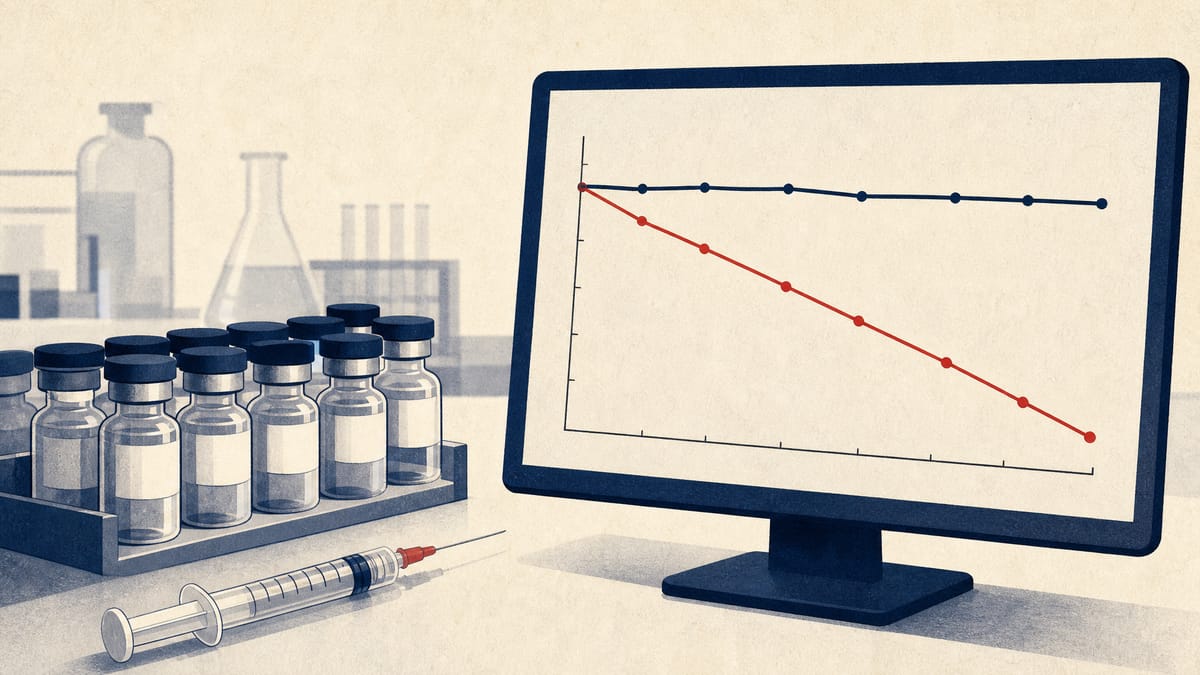
The trial's key secondary measure tracks how fast a patient's kidneys lose filtering capacity, expressed as the annual change in eGFR (estimated glomerular filtration rate). Over 24 months, patients on sibeprenlimab saw their eGFR slope hold at +0.3 mL/min/1.73 m² per year (95% confidence interval: -0.4 to 0.9), while the placebo group's kidneys declined at -4.2 (95% CI: -4.9 to -3.6) mL/min/1.73 m² per year, a gap of 4.5. That result lands inside the range international kidney guidelines from KDIGO consider comparable to normal age-related decline, below 1 mL/min/1.73 m² per year. A second measure, the total change in eGFR from baseline at 24 months, showed a similar split: +1.3 for sibeprenlimab against -7.9 for placebo, a 9.2 mL/min/1.73 m² difference with a p-value under 0.0001.
| Measure | Sibeprenlimab | Placebo |
|---|---|---|
| Annual eGFR slope change (mL/min/1.73 m²/year) | +0.3 (95% CI -0.4 to 0.9) | -4.2 (95% CI -4.9 to -3.6) |
| eGFR change from baseline at 24 months (mL/min/1.73 m²) | +1.3 (95% CI -0.3 to 2.8) | -7.9 (95% CI -9.5 to -6.4) |
| Overall adverse events | 90.7% | 90.0% |
| Infections | 51.4% | 51.0% |
| Injection-site reactions | 35.1% | 32.2% |
| Serious infections | 1.9% | 4.0% |
Safety held steady across the two years. Overall adverse events (90.7% versus 90.0%), infections (51.4% versus 51.0%) and injection-site reactions (35.1% versus 32.2%) ran at similar rates between the drug and placebo arms. Serious infections were lower on sibeprenlimab, at 1.9% against 4.0% for placebo, and Otsuka's release notes no new safety signals emerged over the full follow-up.
The timing matters for the drug's regulatory path. VOYXACT received accelerated approval from the US FDA in November 2025 after meeting its primary endpoint, a reduction in proteinuria at nine months. Otsuka and its US subsidiary, Otsuka Pharmaceutical Development & Commercialization, are now using the completed two-year data to support a supplemental biologics license application seeking traditional, full FDA approval, along with filings to regulators in other markets. The data were presented at the GlomCon Hawaii 2026 conference, running August 3 to 7.
Otsuka's disclosure is careful to separate the science from the numbers that move a balance sheet: it explicitly says the results do not change its consolidated earnings forecast for the year ending December 2026. That leaves VOYXACT as a pipeline story rather than an earnings one, for now, with the company describing it as one of several products meant to drive growth over the medium term. Whether that translates into revenue depends on the FDA's decision on the sBLA, a timeline the disclosure does not specify.