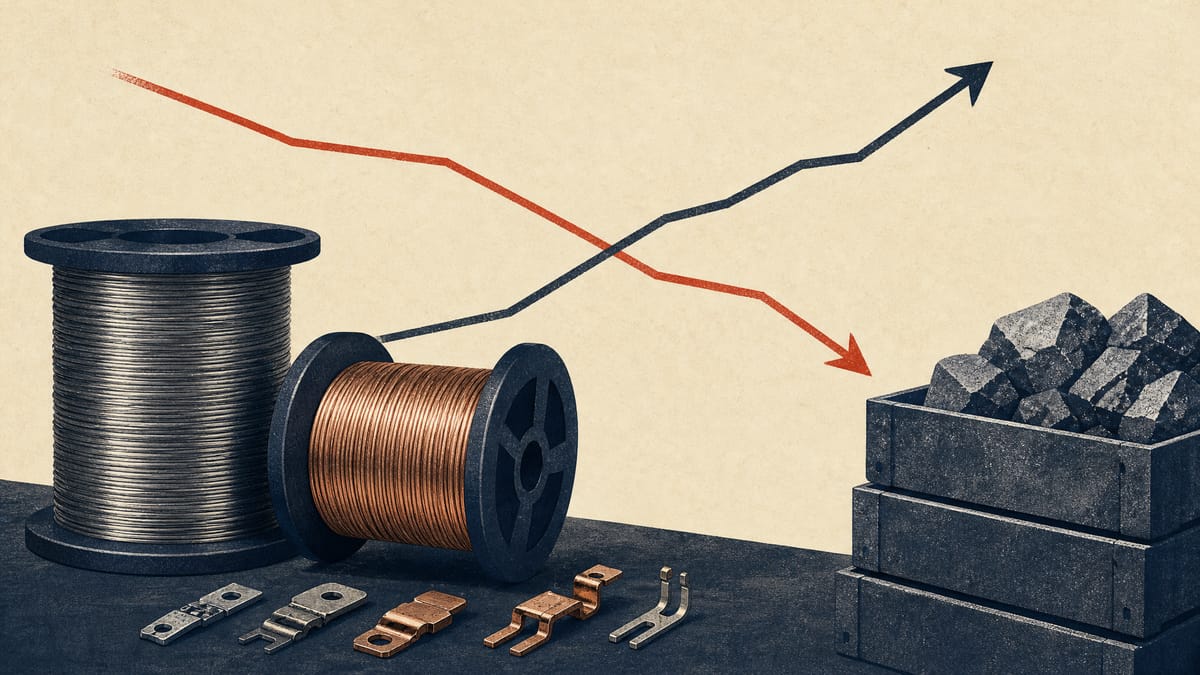
Nippon Tungsten raised its full-year guidance on 11 November, lifting expected operating profit for the year to March 2027 to ¥2.29bn from ¥730mn. In the same notice it said profitability will fall from the third quarter as dearer tungsten works through its costs.
The new numbers
The maker of tungsten and electrical-contact components now expects sales of ¥17.9bn, up 19.3% from its May forecast of ¥15.0bn. Ordinary profit is guided at ¥2.45bn and profit attributable to owners of the parent at ¥1.69bn, with earnings per share of ¥347.94 against ¥148.23 previously. The last completed year produced sales of ¥12.776bn, operating profit of ¥713mn and net profit of ¥270mn.
| Metric | Previous | Revised |
|---|---|---|
| Sales | ¥15.0bn | ¥17.9bn |
| Operating profit | ¥730mn | ¥2.29bn |
| Ordinary profit | ¥1.01bn | ¥2.45bn |
| Profit attributable to owners of parent | ¥720mn | ¥1.69bn |
| Year-end dividend per share | ¥30 | ¥80 |
A squeeze that paid, so far
The company attributes the first-half result to conditions it describes as continuing price rises and procurement difficulty for tungsten and other materials, which it links to tighter Chinese export controls. It raised product prices to absorb the higher costs and strengthened its purchasing set-up to keep customers supplied. In some products it also worked actively to win new customers because of the tight supply. Demand rose too, mainly in semiconductor-related products.
First-half sales were ¥8.65bn, up 43.0% from a year earlier. Operating profit was ¥1.917bn, against ¥297mn, and profit attributable to owners of the parent was ¥1.286bn. The company says materials bought before prices spiked also held down its cost of sales. The notice does not say how much of the gain came from price revisions, new customers or cheaper stock.
The margin catch
The company expects Chinese-export-control-related tungsten prices to stay high. From the third quarter of the current fiscal year, it says, the cost ratio will rise as materials bought at high prices are used, and profitability will fall. It still expects results well above the prior year. The full-year operating profit guide of ¥2.29bn sits beside ¥1.917bn already booked in the first half.
The balance sheet shows the cost of keeping supply moving. Raw materials and supplies rose from ¥1.111bn at the end of March to ¥2.515bn at the end of September, and short-term borrowings rose from ¥2.43bn to ¥3.13bn. Operating cash flow was an outflow of ¥878mn, against an inflow of ¥849mn a year earlier, as inventories rose by ¥1.999bn and receivables by ¥1.286bn. The interim earnings release is not covered by an auditor or accounting-firm review.
Dividend and one-off cost
The company raised its year-end dividend forecast to ¥80 a share from ¥30, taking the annual forecast to ¥140 from ¥90. The interim payout is ¥60. It cites a payout guide of 40% of net profit and a ¥60 annual floor, but says it must watch second-half operating cash flow and will weigh the year-end payment carefully against investment.
The interim period also carries ¥270mn of non-operating demolition costs at the Iizuka plant, tied to switching from extra-high-voltage to high-voltage power receiving. For the longer term, the company points to its 2028 medium-term plan, which includes diversifying suppliers, using more recycled resources and developing technology that uses less tungsten.