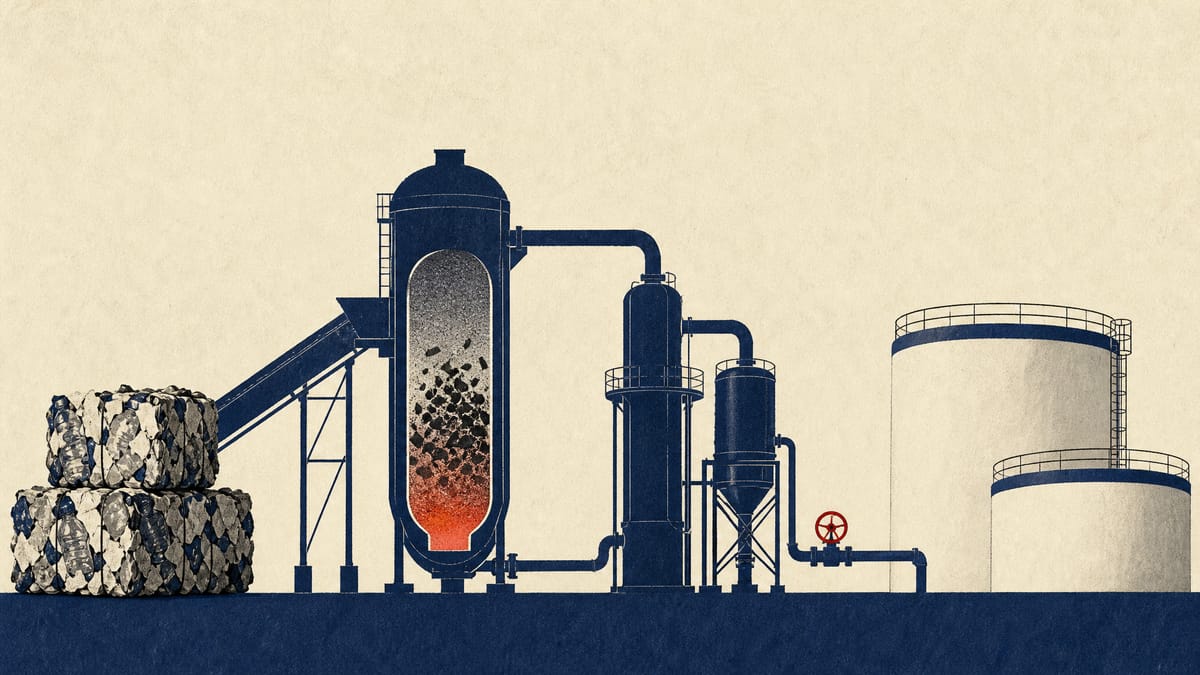
NEDO, Japan's public research and funding agency for energy and industrial technology, has selected JFE Engineering as the planned implementer of a large-scale waste chemical-recycling demonstration. The agency announced the selection on 19 October 2026 under its Green Innovation Fund programme for waste and resource circulation. It is the single new research theme added to the project's high-efficiency pyrolysis facility item.
What the demonstration has to prove
The target is set for 2030: establish a chemical-recycling technology that uses synthesis gas from a large-scale waste pyrolysis and gasification plant to make chemicals, with an overall carbon utilisation rate of at least 27%. NEDO says the system should work on a broad range of waste, from waste plastic to municipal waste, and make chemical feedstock without external hydrogen.
The new work converts waste pyrolysis gas into a feedstock suited to chemical production. The summary sheet lists four technical tasks: raising the hydrogen content of the syngas and adjusting the ratio of its main components, removing acidic components, removing trace components, and tightening coordination between the gasification plant, the gas-conditioning equipment and the chemical production equipment.
Money and timetable
The project is sized at about ¥11.2bn. NEDO's support is put at about ¥7.1bn, a figure the summary sheet says includes incentive payments and may change at later stage gates depending on progress. The two numbers are not the same: the larger one is project scale, not the subsidy. The sheet lists the subsidy rate as two-thirds moving to one-half, with a 10% incentive rate, and does not say when the step-down applies.
Work runs for five years, from the 2026 fiscal year through the 2030 fiscal year. The release gives no site or plant capacity.
Why waste is the target
NEDO puts waste at about 3% of global and Japanese greenhouse gas emissions, and says roughly 80% of Japan's waste-sector emissions come from incineration and similar thermal uses. Heat treatment will remain necessary even as recycling improves, the agency says, so the project aims to capture carbon from waste and feed it back to industry as a resource.
The project was added to and revised after deliberation by a Green Innovation Fund working group, and the new theme came through a fresh call for proposals. The fund was set up at ¥2tn, with later top-ups of ¥300bn and ¥456.4bn, and supports companies for up to ten years, from research through to commercial use.
The selection names a delivery partner and a technical target. It does not show that the process works at scale, that it is commercially viable or that any emissions have been saved. The 2030 carbon utilisation figure is the benchmark against which the demonstration will be judged.