Japan's economy ministry has proposed letting certified advanced safety implementers patch small leaks in high-pressure gas equipment with injected sealant. The change comes in a draft that also removes two older inspection certification schemes from its circulars.
Two schemes go, one stays
The draft, dated 2 November 2026 and issued by the high-pressure gas safety office of METI's Industrial Safety and Security Group, amends nine circulars and abolishes two. It accompanies the second-phase enforcement of the 2022 amendment to the High Pressure Gas Safety Act (Act No. 74 of 2022). That enforcement abolishes the certified completion-inspection implementer and certified safety-inspection implementer systems. The Act regulates the manufacture, storage, sale and movement of high-pressure gas (compressed gas and the like at 1 megapascal or more) to prevent explosions and similar accidents.
Most of the draft is housekeeping. Procedures tied to the old schemes are deleted, and citations are renumbered because the articles on certified advanced safety implementers move up. Articles 39-13 to 39-27 of the Act become 39-2 to 39-16.
Operators already certified under the old schemes get a transition. For 3 years and 6 months from the rule's enforcement date, the existing 2022 circular on applying for inspection methods stays in force for their safety inspections.
Sealant as a temporary fix
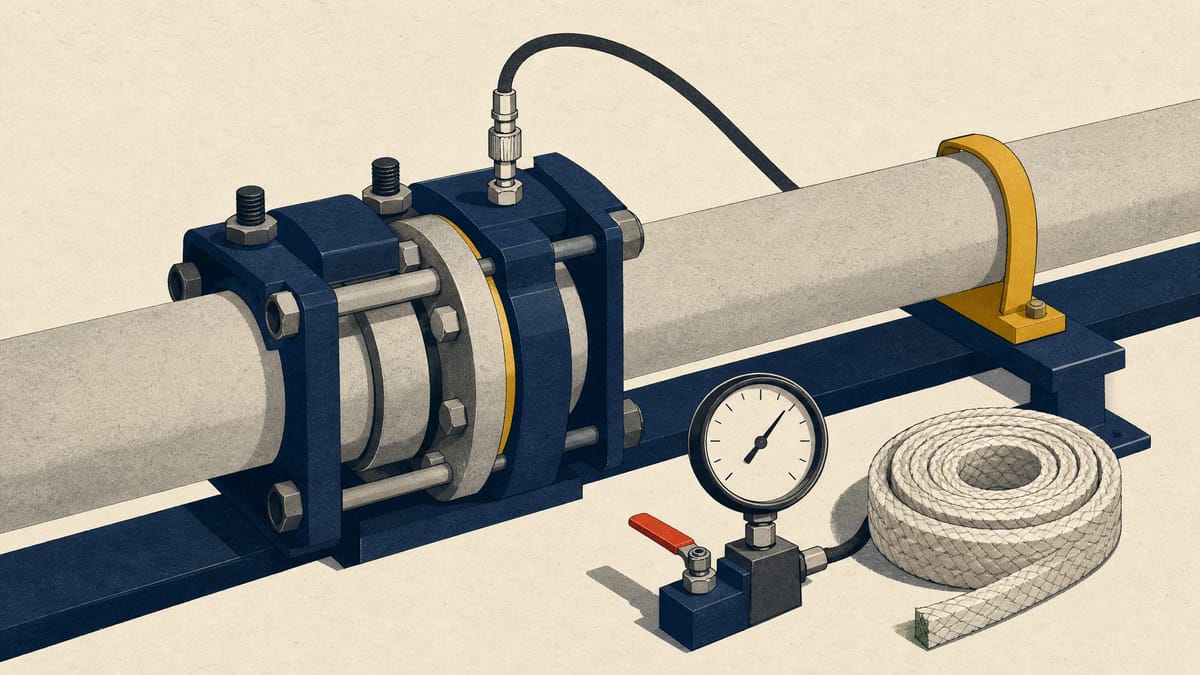
Under the current rules, repairs to high-pressure gas equipment are limited to replacing parts or welding. The draft adds temporary repair with curable resin or similar sealing material. The ministry aims the method at certified advanced safety implementers, because management after the repair matters. The revised circular also says that for 3 years and 6 months from the second-phase enforcement date, its provisions on this repair apply equally to holders of the two older certifications.
The revised circular on advanced safety implementers sets the boundaries.
- Scope: it covers slight leaks from joints, valves or movable seals, and only where no one has been harmed. Toxic gases are excluded.
- Limits: the maximum working pressure must be 20 MPa or less, and the operating temperature at least 20°C below the fluid's ignition point.
- Approval: the method needs a prior technical evaluation by the high-pressure gas safety association.
- Follow-up: the repaired spot must be confirmed free of abnormalities until a permanent repair, through remote monitoring, an inspection at least once a day or other methods, plus a check without delay after earthquakes or storms. A leak that returns means more sealant, and the operator must re-check whether it counts as a gas accident.
- Permanent fix: the operator must tell the association about the temporary work and any later permanent repair, and notify the minister and the prefectural governor.
The circular also sets a design margin for the clamp that holds the sealant: parts taking injection pressure are designed for maximum working pressure plus 7 MPa.
The draft also drops the requirement that certified advanced safety implementers route applications and notifications through the head of the regional industrial safety supervision department. The ministry cites procedural streamlining and lighter administrative burden.
Timetable and comment
The comment window runs from 2 November to 1 December 2026. The ministry's schedule calls for promulgation in mid-December and enforcement on 21 December. One addition to the circular on certified advanced safety implementers takes effect only with the enforcement date of a separate ministerial ordinance amending the refrigeration safety rules.
The consultation is voluntary rather than a procedure required by the Administrative Procedure Act. Comments must be in Japanese and can go through the government's e-Gov portal, by post or by email. METI says it will not reply to individual comments. The text is a draft, and the final wording may differ.