Kawasaki Heavy Industries has raised its 2030 defence revenue outlook to about ¥700bn to ¥800bn, from a previous ¥500bn to ¥700bn, in a four-part Group Vision 2030 progress briefing dated 6 October 2026. The company credits higher defence spending.
The targets
The briefing's headline goal is revenue above ¥3.3tn and business profit above ¥330bn in the 2030 fiscal year, a margin above 10%. Revenue and business profit set records in the 2024 and 2025 fiscal years, and the company expects another record this fiscal year, with revenue of ¥2.56tn and business profit of ¥180bn. A footnote on the profit chart refers to margin excluding one-off losses on the PW1100G-JM aircraft engine; the slide does not say which year that marker covers.
Kawasaki Heavy says the defence business should earn a margin above 10% from the 2027 fiscal year, citing contract-system changes among other factors. It aims for defence revenue above ¥1tn in the mid-2030s.
What the July raise pays for
The company ties the plan to the roughly ¥200bn equity-type financing it carried out in July, about ¥100bn from a public offering and about ¥100bn from convertible bonds, covered in the share sale itself. The new slides add a timetable: the company expects investment effects from that money to become visible from about 2028. It says it will keep net debt-to-equity near 50%.
The spending targets are specific:
- Data-centre power. Kawasaki Heavy says medium gas turbines can start operating in one to two years, against three to five for large ones, and are easier to expand in stages. It plans about ¥17bn for gas-engine capacity, which it wants to raise roughly tenfold.
- Semiconductor robots. The company will invest ¥7.5bn to double capacity by the 2029 fiscal year. It targets robot sales of ¥160bn in 2035, growing about 15% a year.
- Shipbuilding. About ¥100bn goes to the Sakaide plant between 2026 and 2035. Of that, ¥45bn is investment eligible for Japan's shipbuilding revival fund and ¥55bn is other spending. The plant's targets are a 15% business-profit margin and revenue above ¥200bn.
Physical AI
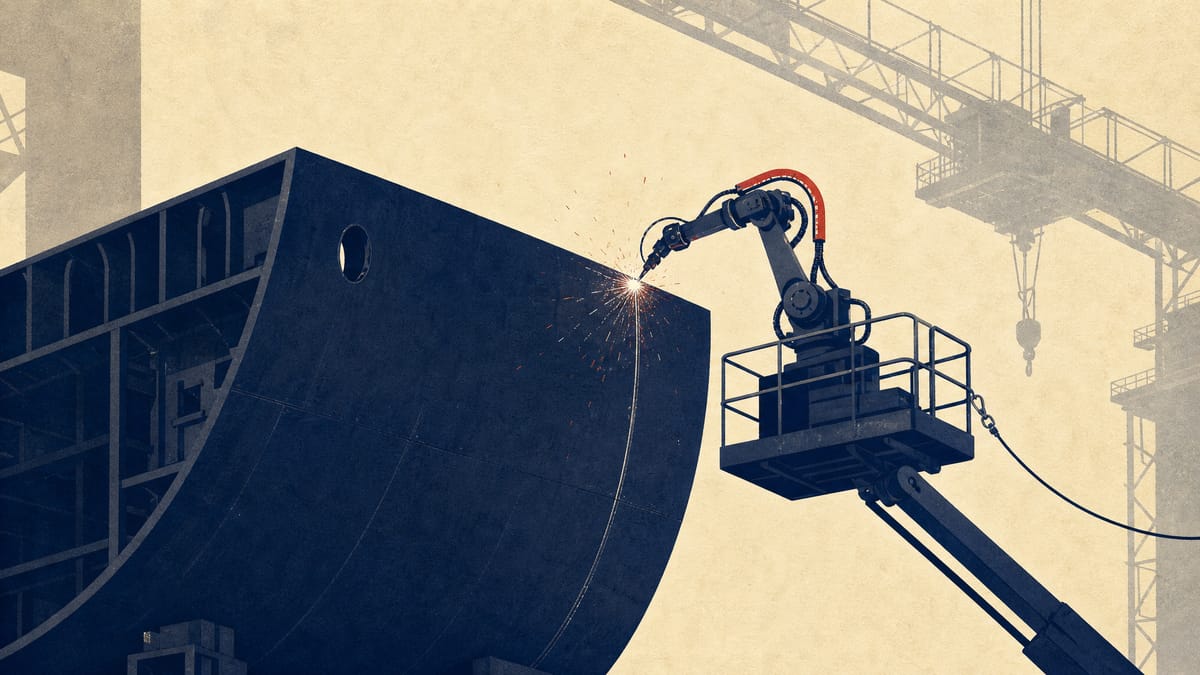
The fourth part describes physical AI, meaning AI that acts in the real world, as the thread through the plan. In shipyards, the company wants robots that copy skilled welders and work at height or in cramped spaces, with Nvidia's computing and application platforms behind a digital shipyard. It also cites a potential ¥1tn a year in medical and care cost savings from its Home LEO home-care robot, a figure it labels as its own estimate.
The slides give targets and plans, not commitments. The 2030 figures, the 2028 timing for investment effects and the Home LEO estimate are all the company's projections.