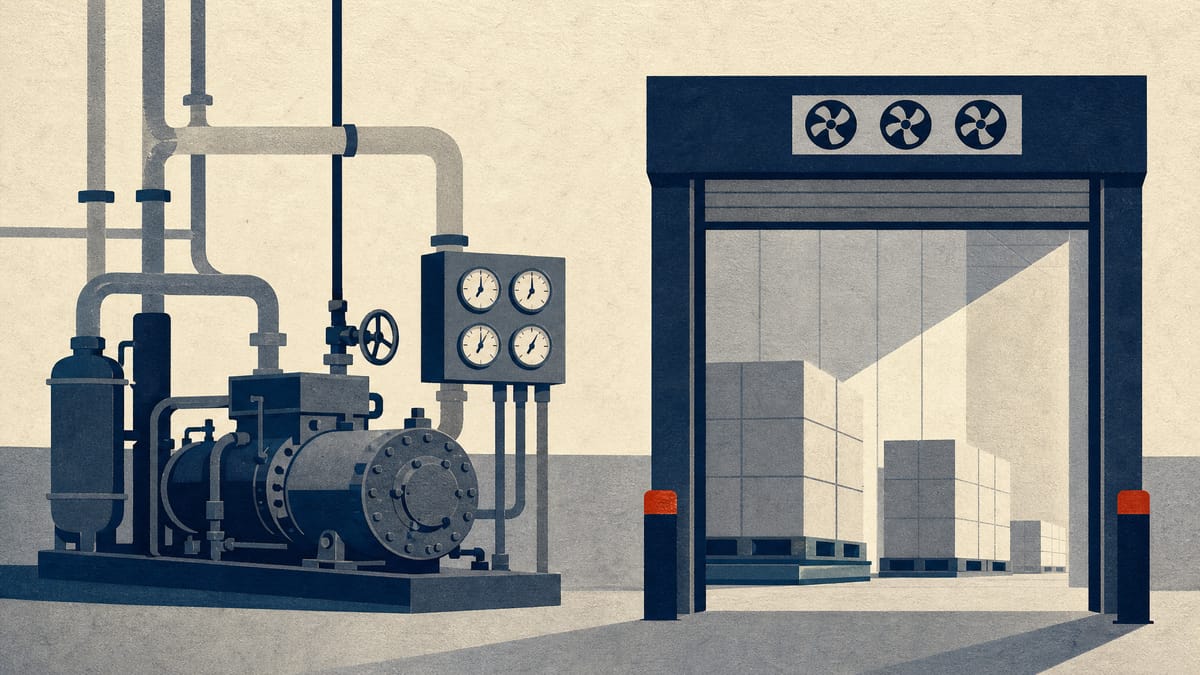
Japan's cold-chain operators have a fresh, if narrow, incentive to retire high-warming refrigerant gear. The Japan Refrigerant and Environmental Conservation Organization (JRECO), a general incorporated foundation, has opened its autumn funding round for a program that subsidizes part of the cost of installing decarbonized natural-refrigerant equipment in refrigerated warehouses, food manufacturing plants and food retail stores, including display cases. The money comes from a grant decision the Ministry of the Environment made under the current fiscal year's budget for CO2 emission reduction measures.
The target is equipment still running on HFCs (hydrofluorocarbons), refrigerants with a high global-warming potential. JRECO's subsidy instead backs machines using ammonia, carbon dioxide, air or water, natural refrigerants with far lower warming effect and, the program notes, improved energy efficiency once paired with newer compressor technology.
| Feature | Detail |
|---|---|
| Subsidy rate | Up to one-third of eligible costs, in principle |
| Maximum subsidy listed | ¥500mn |
| Eligible equipment | Natural-refrigerant systems using ammonia, CO2, air or water, replacing HFC equipment |
| Eligible sites | Refrigerated/freezer warehouses, food manufacturing plants, food retail stores (including display cases) |
| Round restriction | Autumn round limited to multi-year (national treasury debt-bearing) projects |
| Application window | September 14 to October 13, 2026, 5pm JST |
| Project period | From first-year grant decision date through February 29, 2028 (two fiscal years) |
The subsidy rate is capped at one-third of eligible costs, with the exact terms spelled out in a separate application handbook JRECO has not published in this excerpt. JGrants lists the program's maximum subsidy amount at ¥500mn. Selection is not automatic: JRECO says it will choose projects within the available budget, and even proposals that meet every requirement may see their subsidy reduced or rejected outright depending on the volume of applications.
One restriction narrows the field considerably. The autumn round is open only to multi-year projects classified as "national treasury debt-bearing" undertakings, meaning single-year equipment swaps do not qualify this time around. For projects that do qualify, the funded work can run from the date of the first-year grant decision through February 29, 2028, spanning two fiscal years.
Applicants have a four-week window: JRECO is accepting submissions from September 14 through 5pm on October 13, 2026, either through its subsidy program website or by mail. The required forms, listed as Form 1 and two attached schedules, must be downloaded directly from JRECO's site rather than substituted with applicants' own templates.
The program's real audience is the operators still budgeting for a refrigerant transition that Tokyo has been nudging along for years: cold storage warehouse operators, food manufacturers and retailers running display cases. For them, the calculus is straightforward. A third of the capital cost is real money against equipment upgrades that otherwise compete for budget with everything else on a facilities manager's list, and the multi-year restriction signals JRECO wants larger, planned installations rather than opportunistic single purchases.