The Japan Fair Trade Commission issued a recommendation on 9 October 2026 against a water-heater maker based in Fuji, Shizuoka, with capital of ¥98mn. It found five sets of conduct toward parts suppliers across the old subcontracting law and its revised successor. The recommendation is not a fine or a criminal finding.
Notes instead of money
Between February and March 2026, the company gave 11 suppliers notes with a face value of ¥22.82mn instead of paying by the due date in money or an equivalent means. The commission found this breached the revised law's ban on late payment. The company paid the full principal between the 60th day after delivery and July 2026, according to the recommendation. What remains is delay interest at 14.6% a year, counted from the 60th day after each delivery, and any fees suppliers bore to collect. The payment must be in cash or an equivalent.
Small deductions, wide reach
The two fee-deduction findings are small in yen and broad in headcount. Under the old law, the company deducted a total of ¥157,100 from 71 suppliers, in excess of the bank transfer fees it actually paid, between May 2025 and March 2026. Under the revised law, it deducted ¥33,730 from 85 suppliers in February and March 2026 as transfer fees. It must repay both, and the ¥33,730 carries the same 14.6% interest.
The revised law, in force since 1 January 2026, added an employee-count test to the capital test. Of the 85 suppliers covered by revised-law findings on deductions, 26 qualified on capital and 59 on employee count (300 or fewer). The company had more than 300 employees.
Molds left in suppliers' storerooms
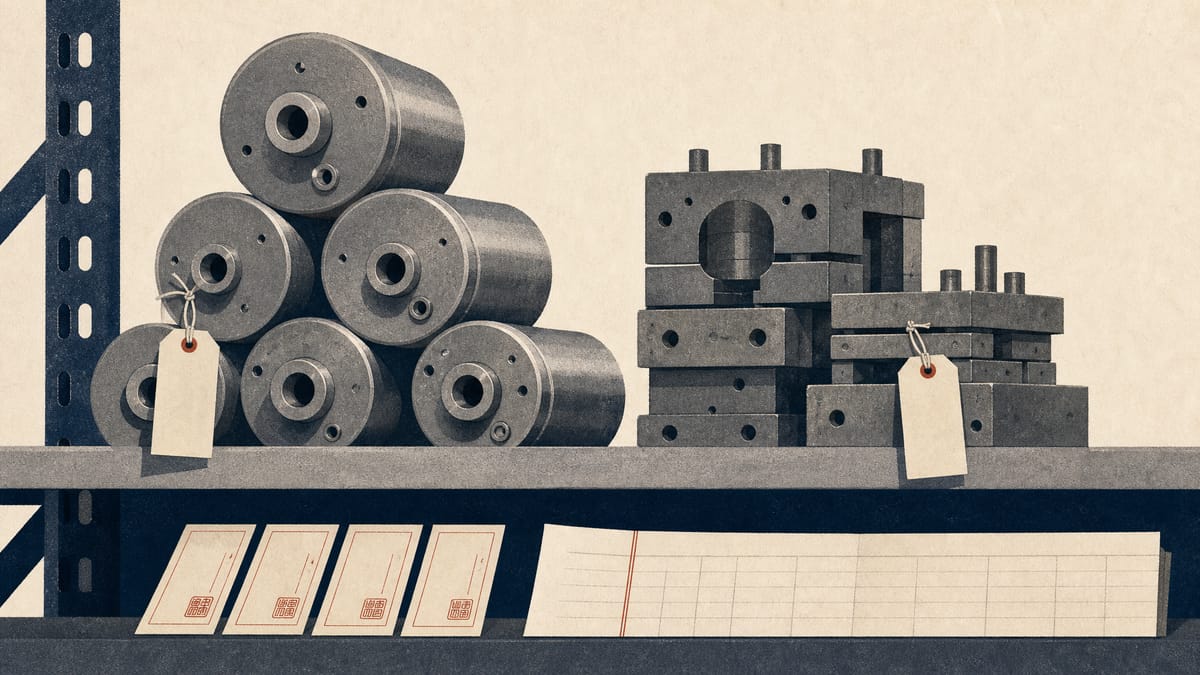
The company lent molds, resin molds and jigs to suppliers, and for a long period placed no orders for parts made with them, without paying storage costs. The commission counted 132 items held by 10 suppliers since at least March 2025 under the old law, and 64 items held by 12 suppliers since at least January 2026 under the revised law. By 24 and 25 August 2026 the company had signed storage-cost memoranda with three of the 10 suppliers and eight of the 12, covering costs incurred from then on. It must still pay the cost of past storage, with the commission's confirmation.
| Conduct | Law applied | Suppliers | Amount or items and period |
|---|---|---|---|
| Payment by notes, unpaid in money past due date | Revised law | 11 | ¥22.82mn, since paid; Feb-Mar 2026 |
| Deduction above actual bank fees | Old law | 71 | ¥157,100; May 2025-Mar 2026 |
| Deduction as transfer fees | Revised law | 85 | ¥33,730; Feb-Mar 2026 |
| Unpaid mold storage | Old law | 10 | 132 items; since at least Mar 2025 |
| Unpaid mold storage | Revised law | 12 | 64 items; since at least Jan 2026 |
The remedial checklist
The company must have its board resolve to confirm that each conduct breached the law and that it will pay within 60 days of receiving goods, using cash or an equivalent, and will not deduct from payments without a supplier-side reason. It must train its ordering staff on the revised law and tell all executives, employees and supplier counterparties about the recommendation and the steps taken. It must then report those steps to the commission promptly. The recommendation sets no dated deadline, and the release does not give the total interest owed.