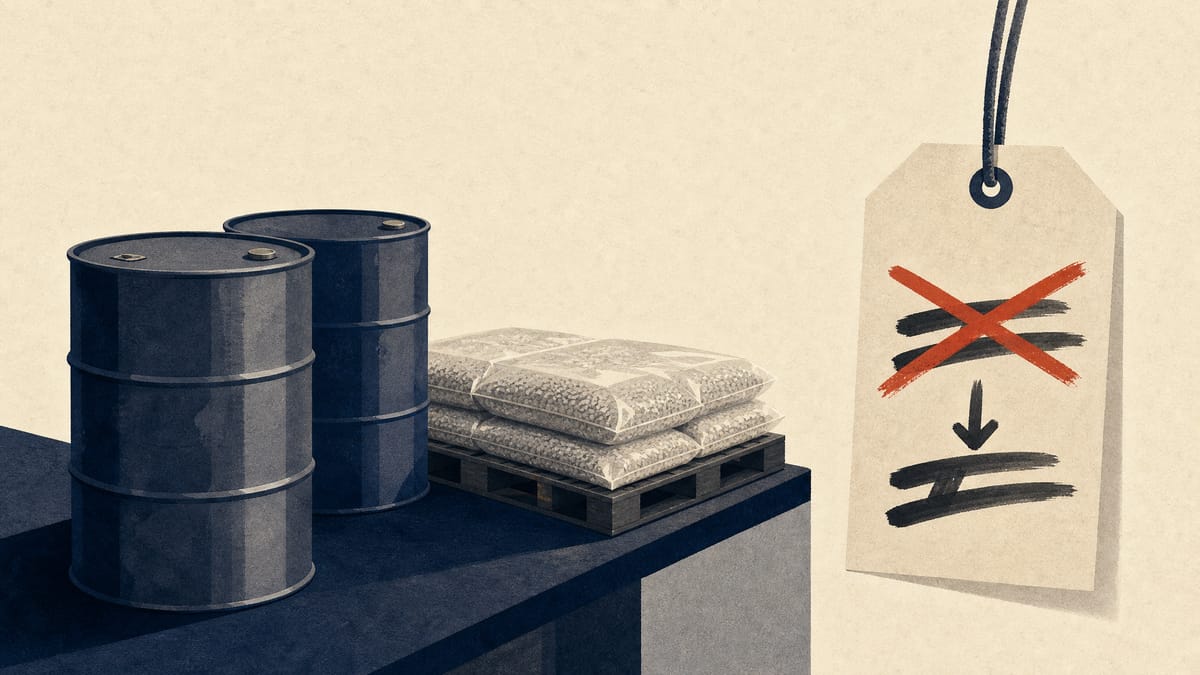
Japan's Fair Trade Commission has published the results of an emergency survey into how buyers responded when suppliers asked for higher prices to cover this year's petroleum-driven cost inflation, and the answer is: on average, buyers granted just under half of what was asked.
The commission ordered the survey after Prime Minister Takaichi told a May press conference that the government wanted the effects of the Middle East situation on petroleum-related product prices tracked, and after a Cabinet Secretariat working group in June called for closer scrutiny of price pass-through. The JFTC folded new questions on petroleum costs into a web questionnaire it already runs each year under its price pass-through and payment-practices survey program, covering conduct from late February through late July.
The commission asked 150,000 businesses across 47 industries whether they had passed on rising costs for fuel, oil-derived resin, packaging film, lubricants and similar petroleum-linked inputs. Only 27,622 of them, an 18.4% response rate, answered the questions, so the figures that follow describe that smaller group of respondents rather than the full population contacted.
Among those who did answer, 64.1% of suppliers said the petroleum price spike had hit them, rising to 79.9% in manufacturing and 75.1% in distribution. Fourteen industries reported impact rates of 80% or higher, led by petroleum and coal product makers (92.9%), pulp and paper (89.8%), plastics (89.6%), food manufacturing (89.2%) and car repair shops (88.9%). The most common complaint, cited by 80.5% of affected suppliers, was that energy, materials and consumable costs rose and profit fell; 40.2% also reported that procurement shortages had curtailed shipments or delayed deliveries.
Negotiated, but only partly
Where suppliers did ask for higher prices, the JFTC's headline figure is an acceptance rate of 48.3% across energy, raw-material, sub-material and consumable costs combined, meaning buyers on average granted less than half of what was requested. That average hides a split market: 26.9% of suppliers got their full asking price, while 23.4% got less than a fifth of it and another 27.2% landed between 20% and 40%. Pass-through was weakest specifically at the transaction stage between second-tier subcontractors and third-tier-and-further subcontractors, a pattern most pronounced in manufacturing and services.
| Supply-chain stage | Energy | Raw materials | Sub-materials | Consumables | Overall cost |
|---|---|---|---|---|---|
| Demand side to manufacturer | 49.6% | 52.2% | 45.5% | 43.2% | 48.9% |
| Manufacturer to first-tier supplier | 46.8% | 54.9% | 43.0% | 45.2% | 49.1% |
| First-tier to second-tier supplier | 48.8% | 52.9% | 44.7% | 47.2% | 49.4% |
| Second-tier to third-tier and beyond | 37.8% | 51.5% | 44.6% | 39.4% | 45.4% |
Slightly more than half of affected suppliers, 51.7%, say they at least partially succeeded after raising the issue with a buyer, and the JFTC found that suppliers who ask for a renegotiation mostly get one: only 0.8% said a buyer refused to even discuss it, and 1.8% said talks produced no movement at all. The larger gap is that 38.5% of affected suppliers had not asked for a price increase by the time of the survey, citing bargaining-power imbalances with larger buyers and trade customs, such as needing to open price negotiations months ahead of a scheduled revision date, as reasons they had not raised the issue.
Fifty-nine warning letters, two guidance actions
Where a buyer told the JFTC it had kept prices flat without ever discussing a supplier's request, or had refused an increase without giving written reasons, the commission treats that as conduct that could amount to abuse of a superior bargaining position under the Antimonopoly Act. It sent formal warning letters to 59 such buyers, most concentrated in general construction (eight letters), followed by building-material wholesalers, transport-machinery makers, machinery wholesalers, ceramics producers and dairy and poultry farms (four to five letters each). These are cautionary notices meant to prompt voluntary fixes, not findings that the 59 recipients broke competition law.
Separately, under Japan's Subcontract Act, the JFTC checked whether ordering companies were freezing subcontract prices simply because a subcontractor had not formally asked to renegotiate. It found this at two firms and issued them formal guidance for suspected price-squeezing in violation of the law; most other companies it checked had already agreed price adjustments with their subcontractors.
The commission says it will keep pursuing strict enforcement, including measures that could publicly name companies in cases that raise concerns under the Antimonopoly Act, and it is already running on-site inspections of businesses in all 47 prefectures as part of the broader annual pass-through survey, with full results due for publication before the end of the year.