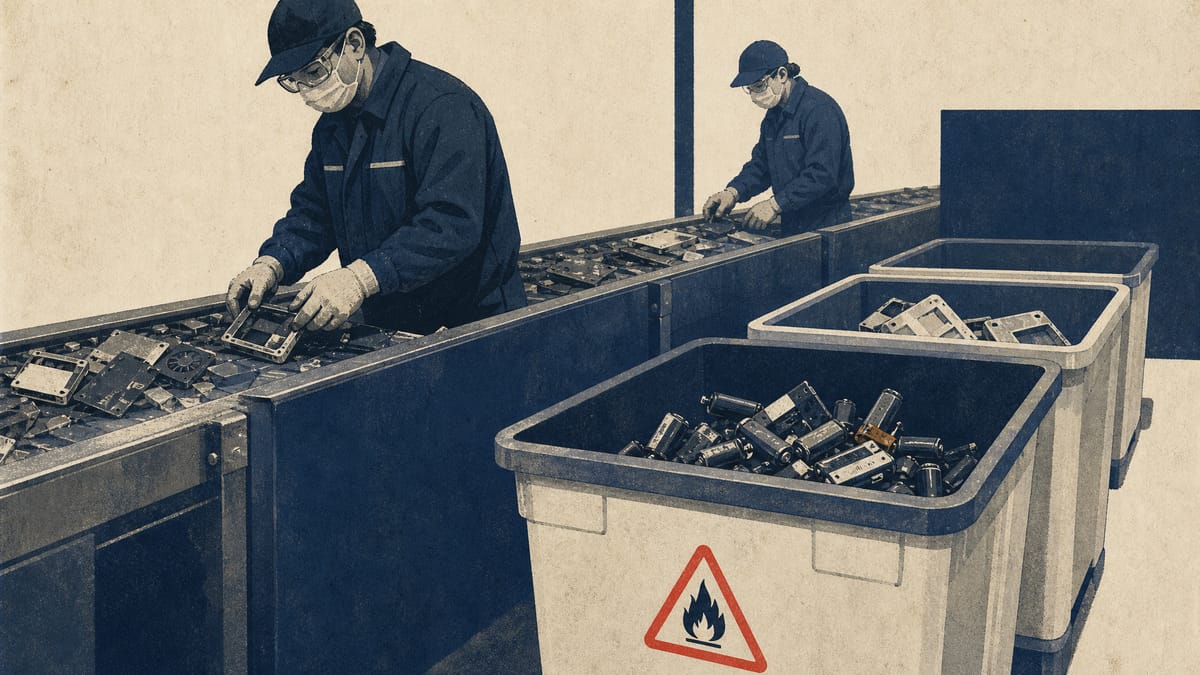
Japan's Ministry of Economy, Trade and Industry (METI) and Ministry of the Environment (MOE) have opened a public comment window on a draft report reviewing how the country's small-appliance recycling law has worked in practice. It is the first such review since February 2019, and the joint working group behind it points to a problem the original 2012 law never anticipated: lithium-ion batteries catching fire inside the collection and sorting chain.
The review comes from a joint sitting of two advisory panels, the Small Appliance Recycling Working Group under the Industrial Structure Council's resource-circulation subcommittee and the Small Appliance Recycling Subcommittee under the Central Environment Council. Their draft report audits the collection network built under the law: how certified recycling operators are distributed nationally, how many municipalities participate in the collection program, and how collection volumes and metal-recovery volumes have trended since the system's early years.
The table of contents also promises a section on "changes in the environment surrounding the small-appliance recycling system," and three items stand out for anyone running electronics take-back or recycling operations in Japan: shifting conditions for processing used plastics, swings in scrap-metal and resource prices, and the spread of lithium batteries alongside fire accidents at collection and processing sites. The report also has a section on how certified operators are actually taking in appliances, suggesting the panels found gaps between the intake the law expects and what is happening on the ground.
| Milestone | Date |
|---|---|
| Previous implementation review | February 2019 |
| Draft report public comment period opens | July 21, 2026 |
| Public comment period closes | August 19, 2026 |
What the draft report does not yet show, at least in the material released for comment, is a verdict. The chapter headings signal where the panels focused attention, not their conclusions or any proposed rule changes; those specifics were not part of the released excerpt. Businesses that operate under the small-appliance recycling framework, certified recyclers, retailers that host collection bins, and makers of battery-containing devices, have a five-week window to weigh in before the panels move toward any formal follow-up.
Comments must be submitted in Japanese, preferably through the e-Gov portal, following a joint guideline issued by METI's resource circulation division and MOE's resource circulation promotion office. The comment period runs from July 21 to August 19, 2026.