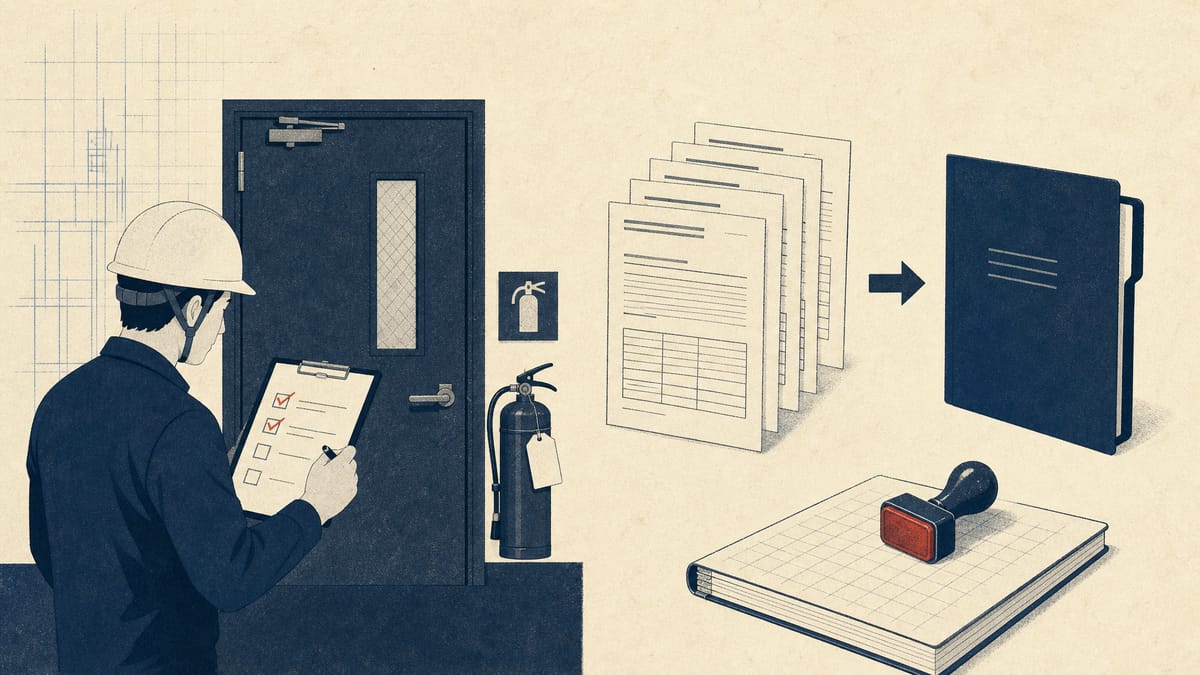
Japan's housing ministry wants applicants to stop filing the same information twice. A draft ordinance opened for public comment on September 8, 2026 would eliminate eight separate "summary" forms that applicants currently submit alongside full building-confirmation applications and periodic inspection reports. Under the once-only principle set out in the Ministry of Land, Infrastructure, Transport and Tourism's overview, information already contained in the main application or report should not have to be resubmitted in a separate summary document just so the public can inspect it under Article 93-2 of the Building Standards Act.
The forms slated for abolition cover building-plan summaries, construction-plan summaries, and periodic inspection-report summaries for elevators, non-elevator building equipment, fire-protection equipment, and amusement facilities, among others. To keep the underlying disclosure obligation intact, the ministry would instead expand the data fields on the primary application and report forms themselves, covering confirmation applications, structural-calculation conformity judgments, periodic inspection reports, and overall-plan approval applications.
Public viewing rights would shift from the abolished summary paperwork to each specified administrative agency's own ledger. Once the change takes effect, those ledgers would record actual dispositions, meaning building confirmations, completion inspections, permits, and approvals, and the ledger entry itself would become the object of public inspection. Two items previously buried inside inspection-summary forms, a building's asbestos survey status and its seismic diagnosis or renovation status, would become directly viewable in their own right rather than as a subset of a summary sheet.
The draft also drops the ink-seal requirement from eighteen categories of notices covering permits, certifications, designations and their revocations, including approvals for grouped housing developments and overall construction plans. The ministry's reasoning is that once the underlying disposition can be checked against the public ledger, a stamp adds nothing to a notice's authenticity.
On fire safety, the periodic inspection report for fire-protection equipment currently only asks whether corrections are needed, yes or no. The revised format would require reporting the total number of fire-protection devices in a building alongside the number flagged for correction, giving specified administrative agencies a way to spot buildings with a high share of unresolved fire-safety defects and prioritize follow-up guidance.
None of this is law yet. The comment period runs from September 8 to October 8, 2026 under the Administrative Procedure Act, and the ministry expects to promulgate the ordinance in October 2026. Implementation, though, would not begin until April 1, 2028. The ministry says municipalities need more than a year to build or upgrade shared digital systems before the once-only rule and paperless notices can work nationwide, since some local governments still run individual systems that will need reconfiguring.
| Stage | Date |
|---|---|
| Public comment opens | September 8, 2026 |
| Public comment closes | October 8, 2026 |
| Planned promulgation | October 2026 |
| Planned implementation | April 1, 2028 |
For construction and real-estate compliance teams, the immediate task is not systems planning. It is deciding whether to weigh in during the one-month comment window before the paperwork rules for building permits and periodic inspections are locked in for the rest of the decade.