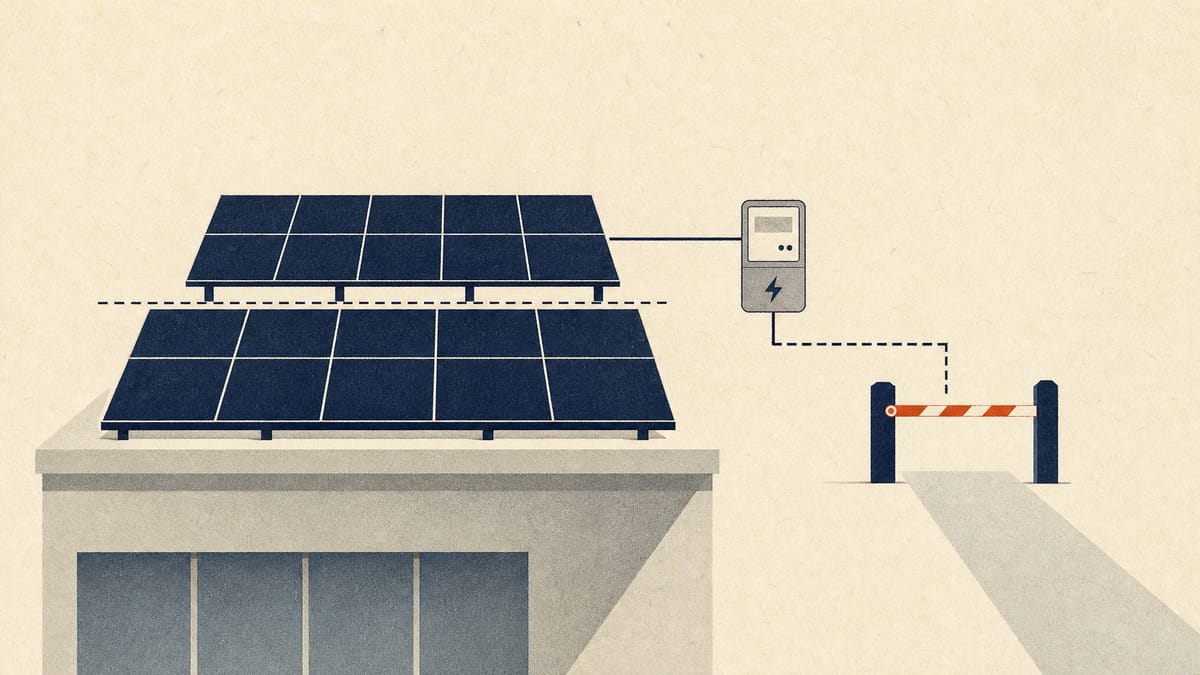
Solar panels that a Tokyo building owner must install earn no J-Credits. A draft revision from the Ministry of Economy, Trade and Industry (METI) would carve out one exception: capacity installed beyond what Tokyo requires could be assessed for eligibility, provided the excess is identified objectively and confirmed by the city.
What the draft changes
J-Credit rules already hold that reductions from equipment required by law lack additionality, the test that a project would not have happened anyway, and so cannot be registered. Where a local government mandates installations, project owners must check how that mandate interacts with the scheme.
The draft uses Tokyo's building environment plan system and its building environment reporting system as the worked example. The plan system dates from 2002, was amended in 2025, and covers owners of new buildings of 2,000 square metres or more. The reporting system started in April 2025 and covers smaller buildings. Equipment that fulfils those obligations stays, in principle, without additionality.
The proviso applies to solar only. Where capacity exceeds the amount Tokyo requires, the excess can be treated as not mandated and assessed for additionality, if it can be identified objectively and quantitatively and Tokyo has confirmed it. METI's summary describes the current position as treating mandated installations as uniformly lacking additionality, which bars project registration or joining a program-type project. Under the proposal, the excess portion could be registered or joined.
What would still have to be shown
The proviso opens a door to assessment, not to credits. Additionality for equipment projects is normally judged by economic barriers: a payback period of three years or more, or higher running costs after the project. The draft does not say how Tokyo would confirm an excess, and it gives no estimate of eligible capacity.
Smaller buildings carry an extra check. For buildings under 2,000 square metres, installation on an existing building and its site can count as meeting the obligation, so owners must check whether such an installation does.
Schemes elsewhere that require solar or minimum energy performance in new homes are to be treated the same way. If a scheme is designed differently, the project owner must set out the reasoning and consult the scheme administrator. In the program-type rules, which cover projects that bundle many individual activities, this check is made for each activity when a membership application is accepted.
Other items in the package
The consultation covers three documents: the implementation rules for project owners (Ver.11.6), the program-type rules (Ver.1.6), and a new methodology, EN-S-047, for renewing water-for-injection production equipment. The methodology targets plants that swap distillation-and-cooling systems for equipment with ultrafiltration membranes. It requires about a year of pre-project energy and output data to set the baseline, and the new equipment's water must meet Japanese Pharmacopoeia standards.
Timing
The notice was published on 21 October 2026. The voluntary comment period runs from 13:00 that day to 18:00 on 4 November 2026, through the e-Gov portal. METI plans to bring all three documents into force in mid-November 2026. The ministry says it will use comments as reference for its final decision and will not reply to individual submissions.