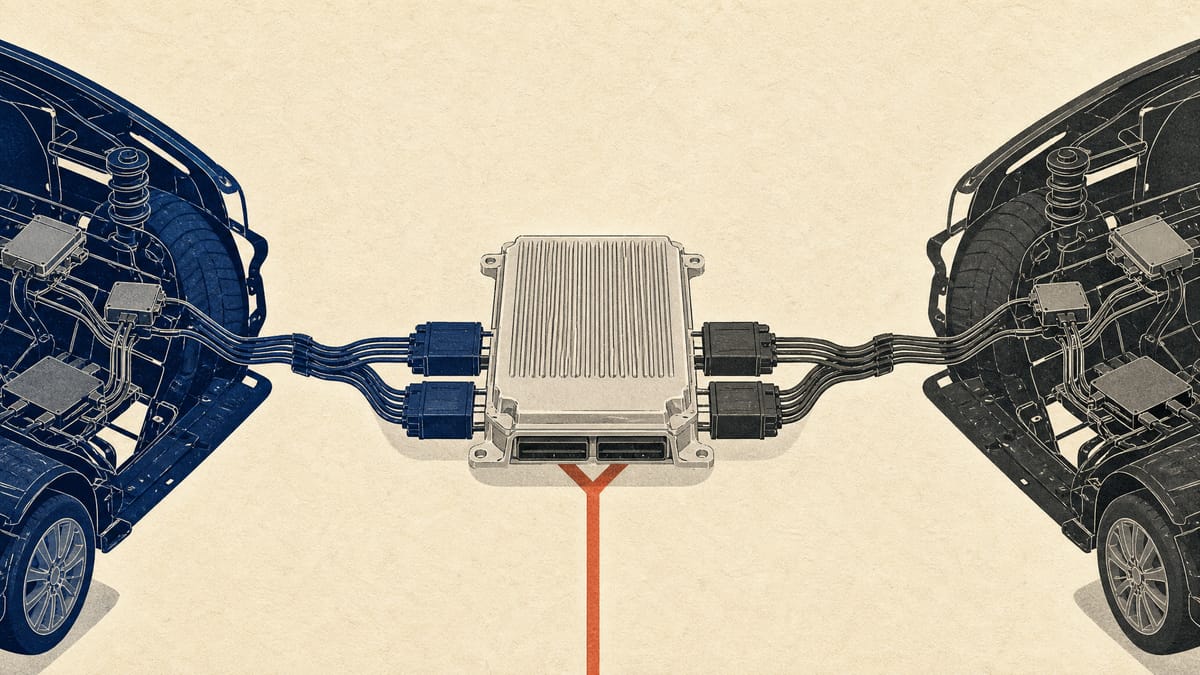
Honda and Nissan have stopped talking about cooperation and started building it. The two automakers disclosed on August 31 that they signed a joint development contract to make the core computing hardware and software inside their next-generation vehicles common to both companies.
What gets shared
The agreement covers several core electronic control units, including a high-performance main ECU built on a system-on-chip and the zone ECUs that oversee different areas of a vehicle, along with the vehicle operating system, middleware and major portions of the vehicle control software that runs on top of them. This is the electronic backbone of a software-defined vehicle.
| Component | Details |
|---|---|
| Core ECUs | A high-performance main ECU built on a system-on-chip, plus zone ECUs that oversee each area of the vehicle |
| Vehicle OS | In-vehicle operating system running on the shared ECUs |
| Middleware | Middleware software that runs on the shared ECUs |
| Vehicle control software | Major portions of the software governing vehicle operation |
The shared E&E architecture is targeted for use in both companies' next-generation software-defined vehicles from the 2029 fiscal year onward.
Why two rivals are sharing a stack
The deal sits inside the existing Honda-Nissan strategic partnership, which the companies frame around carbon neutrality and cutting traffic deaths from their vehicles. Software for software-defined vehicles was singled out as a priority because the pace of technological change there is unusually fast, and the companies say improving research and development speed and investment efficiency has become an urgent competitiveness issue on its own. Their stated goal is to combine technical know-how and staff, maximize development resources and efficiency, speed up development, and lower development costs through scale. Neither company has put a number on the expected savings or synergies.
The money question
Honda's filing states that the transaction's effect on its consolidated results for the fiscal year ending March 2027 will be minor, and Nissan discloses the same language for its own accounts over the same period. That is a signal about timing rather than ambition: the near-term earnings impact is small. The payoff the companies are describing is structural, cheaper and faster software development at scale, not a line item investors will see in the current fiscal year. What is not in either disclosure is a cost target, a headcount figure for the combined engineering effort, or detail on how the two companies will divide development work and intellectual property once the common specification exists.