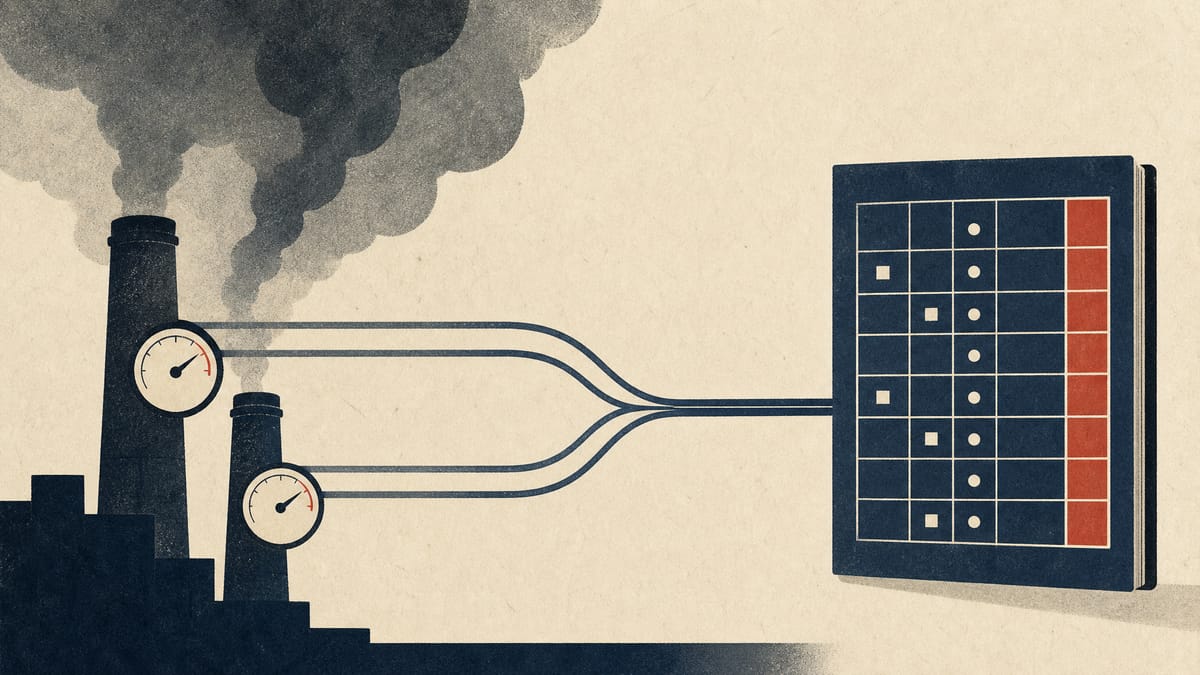
Japan's Financial Services Agency has added a fourth document to the list of sustainability disclosure standards it designates under the Cabinet Office Ordinance on Disclosure of Corporate Affairs, and the practical effect is to spare filers from calculating the same greenhouse-gas numbers twice.
The amendment, issued September 15, 2026 and signed by the agency's commissioner, designates the Sustainability Disclosure Practical Response Standard No. 1 under Article 19-9(5) of the ordinance. The new standard lets a company satisfy the SSBJ's climate-related disclosure requirement by reusing the greenhouse-gas figures it already measures and reports under the SHK scheme, the calculation-reporting-publication system built into Japan's Act on Promotion of Global Warming Countermeasures. Instead of running a separate compliance exercise for its securities filing, a company can point to numbers it has already been submitting under that law for roughly two decades.
The same notice moves a technical cutoff date that determines which version of the SSBJ's still-expanding rulebook companies can rely on: standards the SSBJ has published up to June 11, 2026 now count as designated, up from the previous cutoff of March 13, 2026.
| Feature | Before | After |
|---|---|---|
| Eligible SSBJ publication cutoff | Standards published by the SSBJ up to March 13, 2026 qualify | Standards published by the SSBJ up to June 11, 2026 qualify |
| Designated standards list | Universal, general disclosure, and climate-related SSBJ standards | Adds Practical Response Standard No. 1, allowing SHK-scheme GHG data to satisfy the climate standard |
The FSA ran a public comment period from June 24 to July 24, 2026, and received four submissions. Three of them pressed on how far GHG-only climate disclosure should reach. One argued the standard should force reporting on heat sources beyond greenhouse gases, including thermal and nuclear power plants and data centers; the FSA replied that the SSBJ climate standard exists to reveal risks and opportunities reasonably expected to affect a company's cash flow, financing access or cost of capital, not to serve as a global-warming policy tool, and noted that purchased electricity, steam, heat or cooling already counts as Scope 2 emissions. A second urged the FSA to fix the underlying Global Warming Countermeasures Act so that non-GHG heat sources such as nuclear power and AI data centers no longer escape regulation; the agency declined to answer, saying that law is not under its jurisdiction. A third flagged a narrower gap: the SHK scheme only tracks energy used on a company's own factory sites, so emissions from company vehicles or a construction firm's heavy machinery, plainly the company's own emissions, fall outside it, even as securities filings increasingly require Scope 3 disclosure of emissions a company doesn't directly control. The FSA thanked the commenter for supporting the amendment but again said neither that law nor the Energy Saving Act sits under its authority.
The fourth comment took a different tack, arguing that disclosure obligations should be pared back to industries already flagged as high climate risk for EU investment exclusion, such as power, oil, steel and defense companies, with other companies exempted outright. The FSA said it noted the comment as valuable input and pointed out that the SSBJ climate standard is designed for functional consistency with the ISSB's international baseline.
The amendment took effect the day it was published. Tokyo Brief has separately covered FSA Drafts New Tagging Rules for Japan's Mandatory Sustainability Disclosures, the agency's related work on how these disclosures get tagged in filings; this notice instead settles a narrower question, which SSBJ standards and which shortcut methodologies actually count toward compliance.