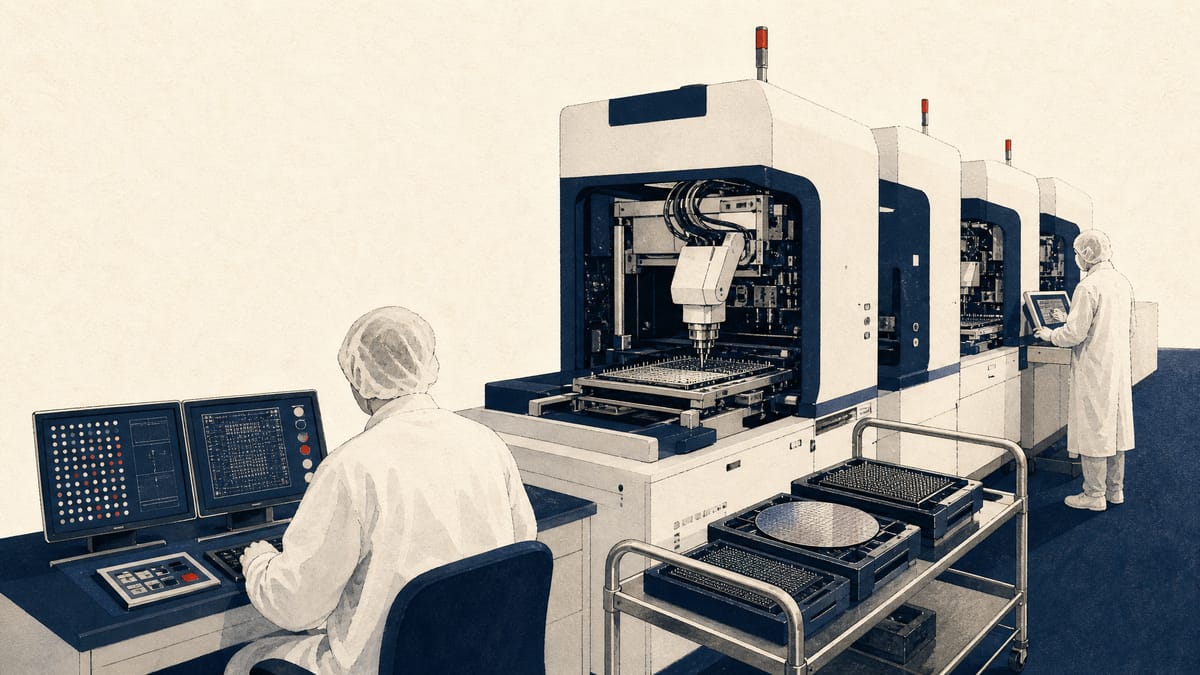
Advantest has revised its full-year forecast upward for the second time this year, and the reason it gave investors is specific: demand to test chips that run AI inference workloads has already outpaced what the company assumed three months ago.
The Tokyo-listed semiconductor tester maker now expects net sales of ¥1,714.0bn for the year to March 2027, up 20.7% from the ¥1,420.0bn it guided in April. Operating profit guidance rises 34.8% to ¥846.0bn, pretax profit climbs 41.7% to ¥891.0bn, and net profit attributable to shareholders is revised up 41.8% to ¥660.0bn, lifting projected earnings per share to ¥911.64 from ¥641.61.
| Metric | April forecast | Revised forecast | Change |
|---|---|---|---|
| Net sales | ¥1,420.0bn | ¥1,714.0bn | +20.7% |
| Operating profit | ¥627.5bn | ¥846.0bn | +34.8% |
| Pretax profit | ¥629.0bn | ¥891.0bn | +41.7% |
| Net profit | ¥465.5bn | ¥660.0bn | +41.8% |
Management's explanation leaves little room for interpretation. The company says test demand for inference-focused AI semiconductors "significantly exceeded" its April 2026 assumptions, and it now expects the calendar-2026 semiconductor market to top $1tn, with the tester market reaching a record size on the back of rising AI chip production volumes and growing device complexity. In its investor briefing, Advantest quantified the shift further: it raised its calendar-2026 tester total addressable market forecast by roughly 19% at the mid-point, to $13.0bn-$14.5bn from an April estimate of $10.9bn-$12.2bn, with demand for AI inference-related ASICs, CPUs and DRAM cited as the driver.
The upgrade follows a first quarter that already ran far ahead of the prior year. Sales for the three months to June 30 rose 39.3% year-on-year to ¥367.5bn, operating profit rose 53.3% to ¥190.0bn, and net profit rose 93.8% to ¥174.8bn. The jump in the bottom line was not purely operational: financial income of about ¥44.7bn included a ¥41.075bn valuation gain on financial instruments tied to the company's strategic investment holdings. A weaker yen also helped, with the quarter's average dollar rate at ¥159 against ¥146 a year earlier, and the euro at ¥185 against ¥162.
Inside the numbers, the test-systems division, which makes the machines that check chips before they ship, posted sales of ¥333.6bn, up 38.7%, with segment profit of ¥190.7bn, up 50.3%. The smaller services and others business, which covers support contracts and consumables such as interface boards, grew sales 46.0% to ¥33.9bn and segment profit 216.4% to ¥8.6bn, though last year's comparison period included a one-off gain from a partial business divestiture.
Advantest is backing the new guidance with more spending. Full-year research and development is now budgeted at ¥110.0bn, up from ¥100.0bn previously, and capital expenditure rises to ¥50.0bn from ¥45.0bn, as the company accelerates production capacity expansion to keep pace with orders, particularly for SoC test systems tied to inference AI chips. The company's outlook assumes a dollar rate of ¥150 and a euro rate of ¥170 for the nine months from July, and it says the direct impact of Middle East tensions on its business has so far been limited to some cost pressure, including in logistics. Whether inference-chip demand keeps outrunning forecasts at this pace, or the current quarter's pricing power and 51.7% operating margin prove harder to sustain, will show up in the next set of numbers due alongside the half-year results.