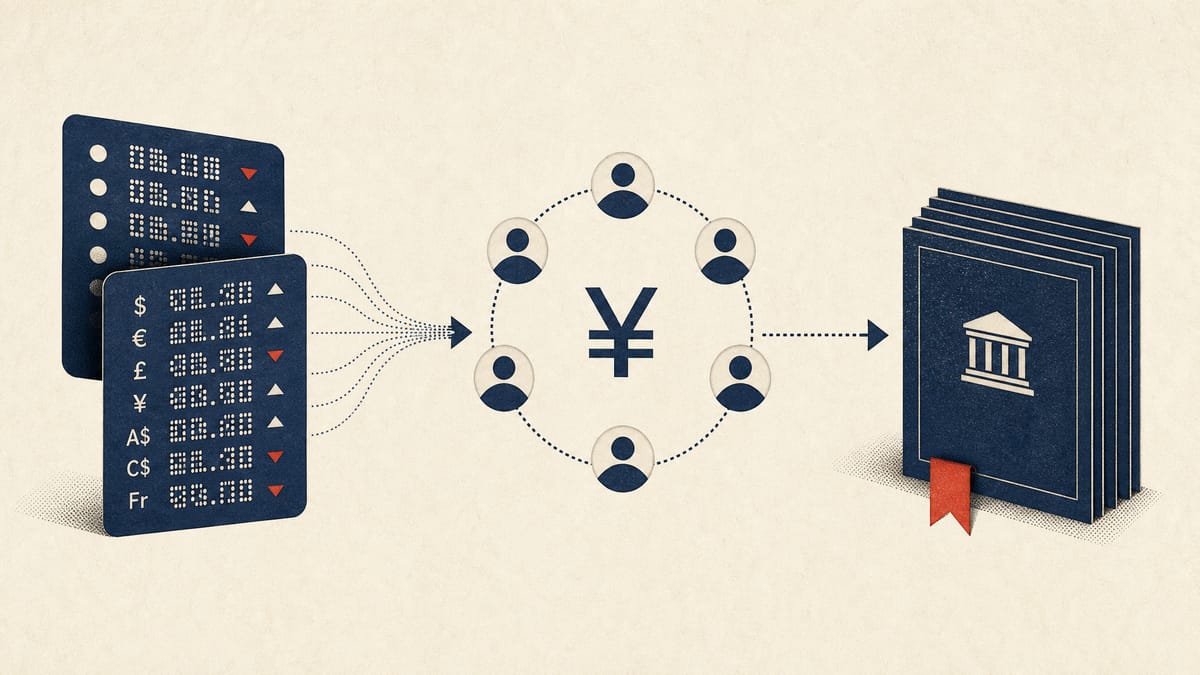
Japan's finance minister and the Bank of Japan's governor held a joint press conference on September 1, 2026, after the second day of the G20 finance ministers meeting in Asheville, North Carolina, according to the Ministry of Finance's official readout. The most consequential line from the finance minister concerned Japan's recent currency intervention: he said it was carried out under an international agreement with the G7 and with the support of the United States, and that no participant at the meeting objected when he raised it. He declined, as he always does, to discuss specific intervention levels.
That framing matters because it is Tokyo's own account of international cover for its market operations, not an independent confirmation from Washington or other G7 capitals in this readout. The ministry's text records agreement in the room, not a joint statement affirming the intervention.
On debt, Japan's finance minister said the IMF flagged concerns about swelling global debt loads, and that participants broadly agreed with the diagnosis without making concrete commitments. He told the group that Japan's single-year fiscal deficit is the smallest in the G7 and explained Tokyo's approach of lowering the debt-to-GDP ratio while pursuing growth, a formulation he said drew no pushback from the IMF, and which a European Central Bank counterpart, speaking separately, called sensible. He also said the US Treasury secretary indicated Washington is already talking with its own budget office about a fiscal discipline framework and hopes to have something to say by autumn, though he stressed no country made any binding commitment.
The meeting produced a chair's statement from the United States rather than a full G20 communique, and Japan's finance minister said this format let the drafters be more explicit about where consensus broke down. He said every G20 member except South Africa attended and all but China endorsed the full text, with China's dissent falling specifically on paragraphs covering critical minerals, supply-chain distortions and debt restructuring, issues he described as long-running points of contention. He characterized broad agreement, including from Russia, that supply-chain distortions and practices amounting to exporting unemployment or deflation to other countries could not be overlooked.
The Bank of Japan's governor offered a narrower account of his own contribution, saying only that central bankers exchanged views on the importance of clear communication around price stability as the global environment shifts, without elaborating on Japan's monetary policy specifically. He confirmed meeting the US Treasury secretary but declined to detail their conversation, and separately declined to comment on the roughly 30-year high in Japanese long-term bond yields near 3%, saying rate levels are market-determined and reflect a mix of Middle East-driven inflation pressure, AI-related financing demand and fiscal-policy perceptions across countries.
The readout stops there: it documents what officials said they discussed and the positions taken in the room, not any new intervention, a specific yen level, or a timetable for the US fiscal framework the US Treasury secretary is reportedly drafting.