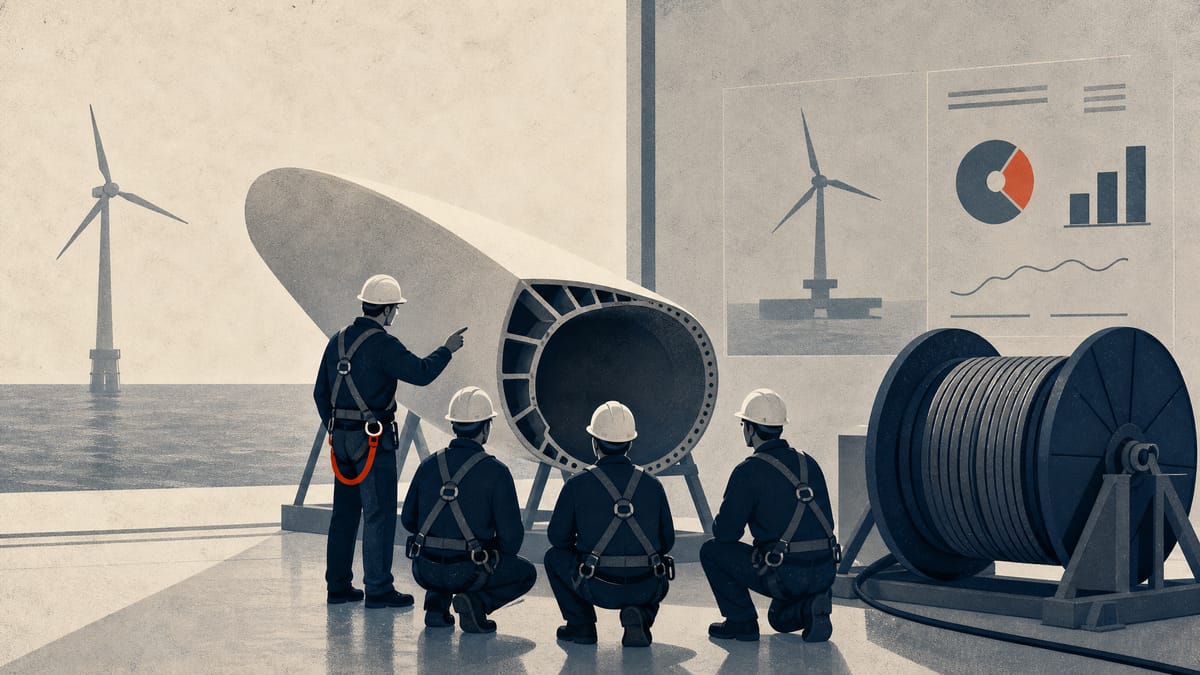
Japan's first call for the Offshore Wind Power Human Resource Development Subsidy is notable for what it treats as the bottleneck. The notice is not confined to turbine technicians. It explicitly covers three talent lanes for offshore wind: business development, including finance and legal work, engineering, and specialist operations in construction and maintenance.
| Feature | What the notice says |
|---|---|
| Eligible applicants | Private businesses, educational institutions, and public research organizations |
| Training lanes | Business development, including finance and legal; engineering; specialist operations in construction and maintenance |
| Supported activities | Curriculum design and delivery, plus experimental and training facilities needed to run the curriculum |
| Funding terms | Up to ¥500mn, within two-thirds of eligible costs |
| Timing and scope | Applications June 19 to July 10, nationwide |
Eligible applicants are private businesses, educational institutions and public research organizations. The subsidy can support curriculum design and delivery, plus the experimental and training facilities needed to run those programs. Just as important, the notice says the resulting courses or facilities must be offered broadly to society in Japan, not reserved for one company's internal use.
That makes this less a reward for a single project and more a state-backed attempt to build a domestic offshore-wind skills base. Applications opened on June 19 and run through July 10. Support is capped at ¥500mn and limited to within two-thirds of eligible costs. The stated policy goal is to help meet Japan's 2030 energy and greenhouse-gas targets. What the publication does not yet provide is a recipient list, or the full scoring detail behind awards, so readers should treat it as a directional workforce policy notice, not a project allocation announcement.