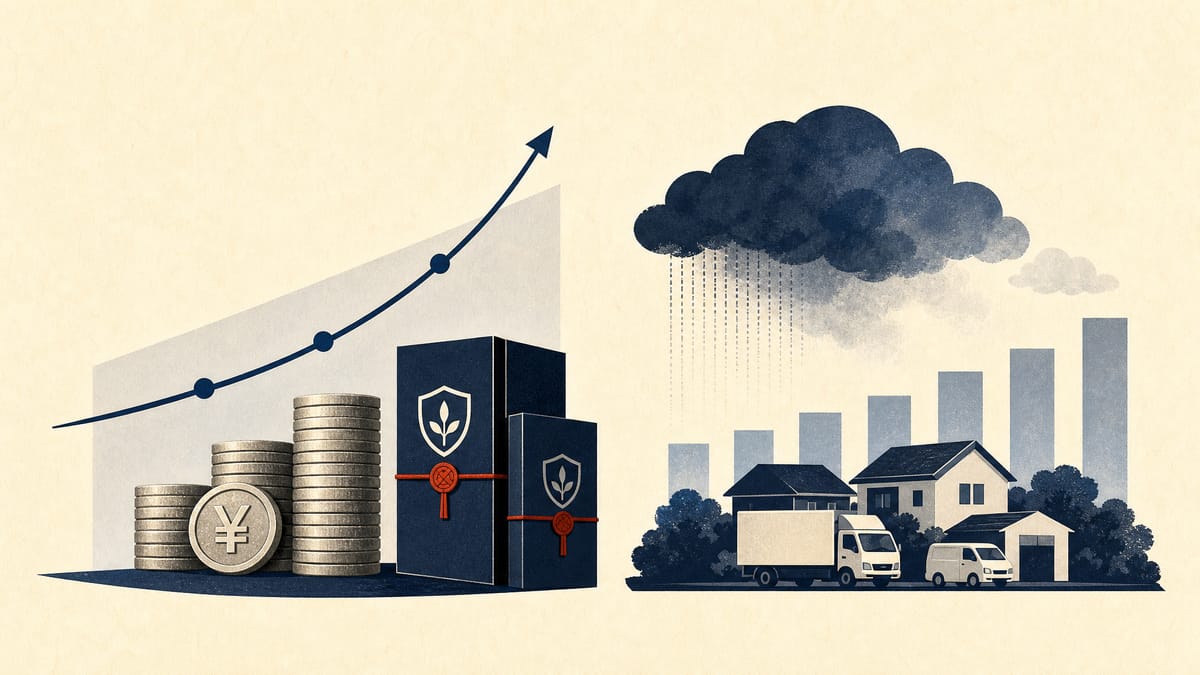
Japan's insurers got help from two very different forces in the year ended March 2026. For the 21 major life insurers in the Financial Services Agency's tally, premium income rose to ¥38.94tn as higher domestic interest rates boosted sales of single-premium yen-denominated policies. The three large non-life groups also increased top-line insurance revenue, helped by domestic rate and product revisions and overseas underwriting expansion. Profit improved in both sector summaries, although one big non-life group still went the other way.
| Group or segment | Metric | Year ended March 2026 | YoY change |
|---|---|---|---|
| Life insurers (21 companies) | Premium income | ¥38.94tn | +¥3.12tn |
| Life insurers (21 companies) | Base profit | ¥4.67tn | +¥496.2bn |
| Life insurers (21 companies) | Capital gains/losses | -¥2.07tn | -¥1.61tn |
| Life insurers (21 companies) | Net income | ¥2.54tn | +¥249.9bn |
| Tokio Marine HD | Net income | ¥980.4bn | -¥74.8bn |
| MS&AD HD | Net income | ¥787.3bn | +¥95.6bn |
| SOMPO HD | Net income | ¥640.0bn | +¥396.9bn |
For life insurers, the cleaner story sat in core earnings rather than capital markets. Base profit rose to ¥4.67tn, up ¥496.2bn from a year earlier, as interest and dividend income increased. That more than offset a sharp deterioration in capital gains and losses, which fell to a ¥2.07tn loss after larger securities sale losses. Even with that drag, aggregate net income still climbed to ¥2.54tn, up ¥249.9bn.
That matters because higher Japanese rates changed both product demand and earnings mix. The FSA says premium income increased because sales of single-premium yen-denominated insurance rose as domestic interest rates moved up. In plain English, life insurers got more sales and better investment income at the same time, even if realizing securities losses made the capital line uglier.
Non-life insurers had a different helper, the weather. The FSA says overall profit for the three major groups rose as natural disasters decreased. Revenue also increased across the board, with Tokio Marine HD at ¥6.53tn, MS&AD HD at ¥5.76tn and SOMPO HD at ¥5.37tn. But the gain was not universal. Tokio Marine's net income fell to ¥980.4bn from ¥1.06tn, while MS&AD rose to ¥787.3bn and SOMPO to ¥640.0bn.
The catch is comparability. The life figures are a standalone aggregate for 21 companies, while the non-life numbers are group-consolidated results for three holdings. The FSA also notes that SOMPO uses IFRS 17. So this is best read as a sector health check, not a neat league table. It does, however, show the two forces that mattered most in the year, higher rates for life insurers and a lighter catastrophe bill for non-life groups.