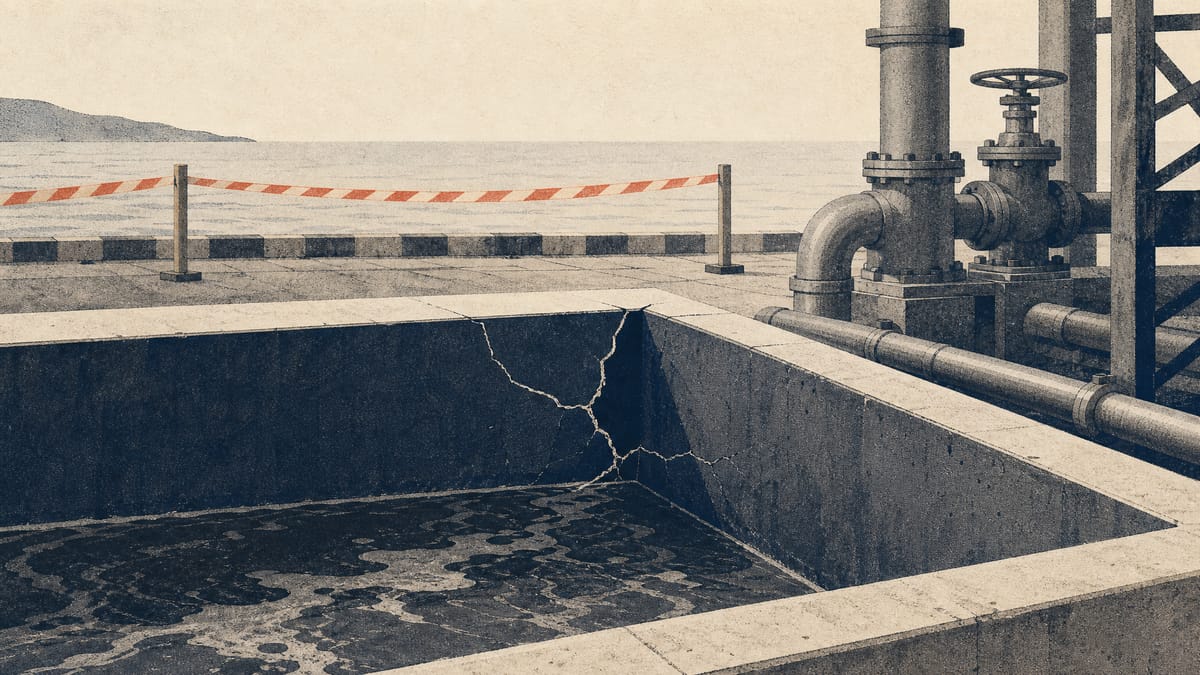
Hokko Chemical Industry (TSE: 4992) told Tokyo Stock Exchange investors on July 21 that wastewater containing benzene and other organic compounds leaked from its Okayama plant into a coastal quay foundation near the site. Tamano City authorities first reported liquid flowing from the area at around 4:15pm on July 14; Hokko Chemical says its own investigation confirmed by around 10pm on July 17 that the discharge contained chemicals the company handles at the plant.
The company identifies the leaked substances as benzene, toluene, xylene and other organic compounds, but says the volume and concentration released are still under investigation. Local authorities have posted signs prohibiting entry to the affected quay area, and Hokko Chemical says it is still checking whether other units at the Okayama complex are involved.
Cracked pit lining, two units down
Hokko Chemical traces the likely cause to a crack in the resin coating of a wastewater pit at the plant. The two units most associated with the detected chemicals, Synthesis Plant No. 6 and Synthesis Plant No. 7, have been taken offline, and the company has pumped out waste liquid from each unit's pit. It has also stopped using every wastewater pit across the Okayama site while the cause is investigated.
The filing is Hokko Chemical's first report on the incident, and it reads like one: short on scope, long on caveats. The company apologizes to nearby residents, fishing operators and the local and prefectural governments in Okayama, and says it is acting under their instruction as it works to determine the cause and prevent a repeat.
What is still unknown
Hokko Chemical has not disclosed how much wastewater escaped, what concentration of benzene or the other compounds reached the water, or how long the crack had been leaking before the July 14 report. It also has not said whether fishing grounds or drinking-water sources near Tamano City are affected. On the financial side, the company says only that it will disclose any impact on its consolidated results promptly once that impact becomes clear. For a mid-cap agrochemical maker whose Okayama plant is a core production site, the size of any cleanup, remediation or output loss from two idled synthesis units is the number investors will be watching for in the company's next report.