Cash first
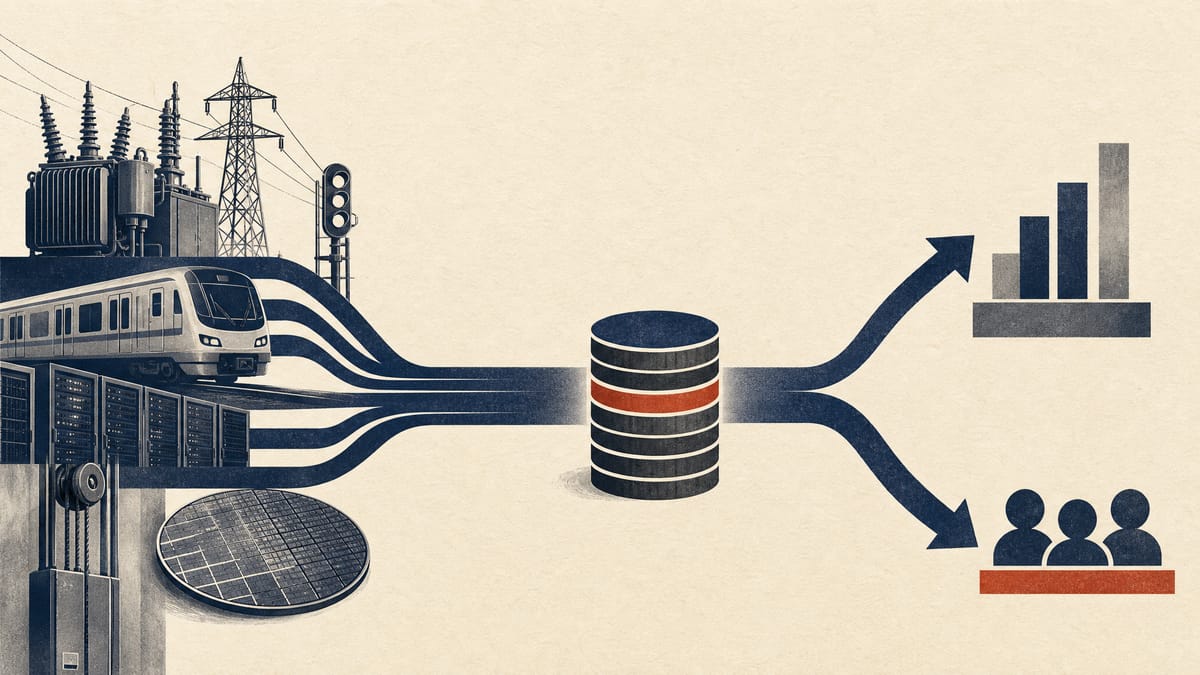
Ahead of its June 10 investor day, Hitachi is asking investors to start with cash generation and capital discipline, then decide whether the group’s AI and industrial strategy deserves the benefit of the doubt. The CFO materials put that hierarchy in plain view. Core free cash flow, excluding large advance payments, is framed as growing at a 28% annual rate from 2024 to 2026, with conversion moving from 83% to 103% and then 100%. Earnings per share over the same stretch are shown growing 19% a year.
The spending rules
The spending script is unusually explicit. Hitachi says at least half of core free cash flow and net income should go to shareholder returns over the medium to long term. Dividend comes first, then growth investment or buybacks, then debt repayment. If attractive growth opportunities are scarce, surplus cash should go back to shareholders. New acquisitions are supposed to clear hurdle rates tied to the group’s 2027 financial KPIs, adjusted EBITA of 13% to 15% and ROIC of 12% to 13%, while leverage stays within a D/E ratio of 0.5 times and net debt to EBITDA of 1 to 2 times.
| Feature | What the materials say |
|---|---|
| Cash generation | Core free cash flow excluding large advance payments is shown growing at a 28% annual rate from 2024 to 2026, with conversion at 83%, 103% and 100%. |
| Shareholder returns | At least half of core free cash flow and net income should go to shareholders over the medium to long term. Dividend comes first, then growth investment or buybacks, then debt repayment. |
| M&A hurdle | New deals are supposed to clear hurdle rates tied to adjusted EBITA of 13% to 15% and ROIC of 12% to 13%. |
| Leverage guardrails | D/E ratio of 0.5 times, net debt to EBITDA of 1 to 2 times. |
| Capital efficiency | ROIC target of 12% to 13% by 2027, supported by asset sales, AI-led productivity and equity optimization. |
The CEO deck reinforces the point. Hitachi says the latest year delivered record profit, core free cash flow and ROIC, alongside 1,753 of growth investment and 5,572 of shareholder returns, both stated in units of ¥100mn. It also says Lumada’s sales mix rose 11 points year on year and Lumada’s adjusted EBITA margin improved by 1 point. Management’s line is that the agenda is unchanged, but execution is speeding up.
Where the growth case sits
The operating decks try to make that financial discipline look like a growth strategy rather than a brake. Digital Systems & Services is pitching AI-related sales growth of 20% to 25% a year through 2027 and HMAX growth of 50% to 60%, built on an installed base of about 15,000 operating customer systems and a plan to train 5,000 people through on-the-job programs tied to its Forward Deployed Engineer teams.
Energy is where Hitachi is most obviously raising the bar. The company says it has revised up its 2027 targets after record orders, revenue, profit and cash, and now wants the energy sector to deliver 15% to 17% annual revenue growth, adjusted EBITA above 14%, and ROIC above 20% by 2027. Within that, Hitachi Energy is aiming for adjusted EBITA above 15%, says services should grow from about $2.5bn in 2024 to about $6bn to $8bn by 2035, and flags data-center orders up more than 150% in the latest year.
Mobility and Connective Industries give the AI story more physical form. Mobility says more than 90% of the next year’s revenue, excluding services, is already covered by backlog, and that its HMAX pipeline now spans more than 100 identified projects across 20-plus countries and 70-plus customers. Connective Industries is concentrating investment on facilities, semiconductors, diagnostics and biopharma, targeting 6% to 8% annual revenue growth through 2027, a Lumada sales mix of about 50%, and a rise in three-year R&D spending from 2,750 to 3,700, stated in units of ¥100mn, to back what it calls physical AI.
What remains uncertain
These are still investor-day materials, not a guarantee that every target will land. A good deal of the package rests on management framing, internal market estimates and long-range ambitions, especially around AI, HMAX and sector-specific addressable markets. Even the risk slides carry that caution: Hitachi says only direct first-quarter effects from Middle East tensions are built into the current outlook, at minus 400 in revenue and minus 200 in adjusted EBITA, both stated in units of ¥100mn, with later effects still being watched. The message before June 10 is clear enough, though: Hitachi wants investors to judge it by whether tighter capital rules can turn a broad industrial portfolio into steadier cash, higher returns and a cleaner digital growth mix.