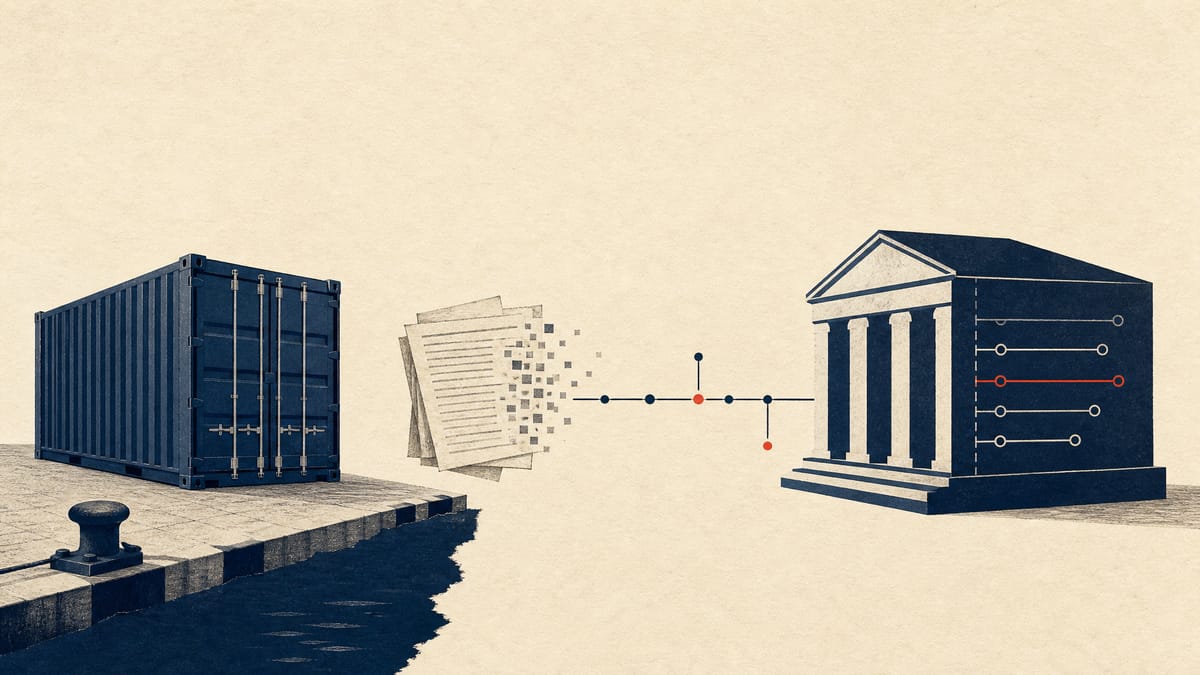
The Financial Services Agency (FSA) on 29 September chose a pilot that would link electronic trade documents to a yen stablecoin the three megabanks plan to issue jointly. It is the fourth project in the agency's Payment Innovation Project (PIP), according to the briefing deck for the first meeting of its on-chain finance forum, dated 30 September 2026. The forum itself was launched earlier this autumn; the new material shows what is already running under it.
The trade pilot
The FSA says many steps in trade, payment included, still run on paper exchanged among exporters, importers, banks and logistics firms. A trade-documentation platform operator plans to put those documents on chain and connect them to the stablecoin the megabanks will issue, so that the exchange of documents and the payment move together. The deck says that if electronic bills of lading, now under discussion, come into use, document and settlement work could be linked on chain. The deck gives no start date and names no participating exporters or importers.
Four projects so far
The PIP opened on 7 November 2025 inside the FSA's existing FinTech pilot hub. The deck lists the projects and their support dates.
| Project | Support decided | Focus |
|---|---|---|
| No. 1 | 7 November 2025 | Yen stablecoin issued jointly by the three megabanks and others, for a major trading house's cross-border payments |
| No. 2 | 13 February 2026 | On-chain securities settlement by Nomura, Daiwa and the three megabank groups |
| No. 3 | 3 April 2026 | Moving tokenized deposits between banks, led by DCP and GMO Aozora Net Bank and others |
| No. 4 | 29 September 2026 | Linking on-chain trade documents to the megabanks' planned stablecoin |
The megabanks said in June 2026 that real transactions in their stablecoin would begin within the current fiscal year. The deck adds that 43 regional banks and others had said they would join the tokenized-deposit pilot as of August 2026.
The forum's work plan
The minister in charge of financial services chairs the forum. Its members are eight academics and other experts, plus the FSA, the Digital Agency, the Ministry of Finance, the Bank of Japan and the national banking association. The agenda for the first meeting lists an opening, reports from the relevant ministries, discussion and a close, and the agenda page carries no record of what was said.
The deck says a second meeting in early 2027 will produce an interim summary and a public-private roadmap. Two study groups feed in: one on the environment for on-chain finance (asset tokenization, stablecoins, decentralized exchanges and wallet providers) and one on the sound use of AI in finance.
The deck also restates follow-up tasks from the government's 21 July 2026 financial strategy for growth investment:
- The Bank of Japan is to set out, within the year, the issues and path for putting its current accounts on chain.
- The Digital Agency is to study using stablecoins and tokenized deposits for public payments.
- The Ministry of Finance is to look at tokenizing government bonds and paying principal and interest on chain.
- The FSA is considering enlarging its own organization to lead on private payments.
The market backdrop
The FSA puts the global stablecoin market at about $310bn (about ¥48tn), with USDC and USDT, both dollar-denominated, making up roughly 83% of market value, citing CoinMarketCap data to the end of August 2026. The yen-denominated stablecoins in circulation in Japan are JPYC, issued in October 2025, and JPYSC, issued in June 2026.