Web View
Japan puts fraud tracing online as the FSA tightens the rulebook
Japan is speeding police-to-bank fraud tracing at nine lenders just as the FSA hands accountants, insurers and banks a thicker rulebook. Efficiency meets supervision.
MARKETS
Market pulse
Tokyo equities advanced while the 10Y JGB yield nudged higher.
Sourced from JPX, BOJ, MOF - values, not commentary.
lead
The Main Move
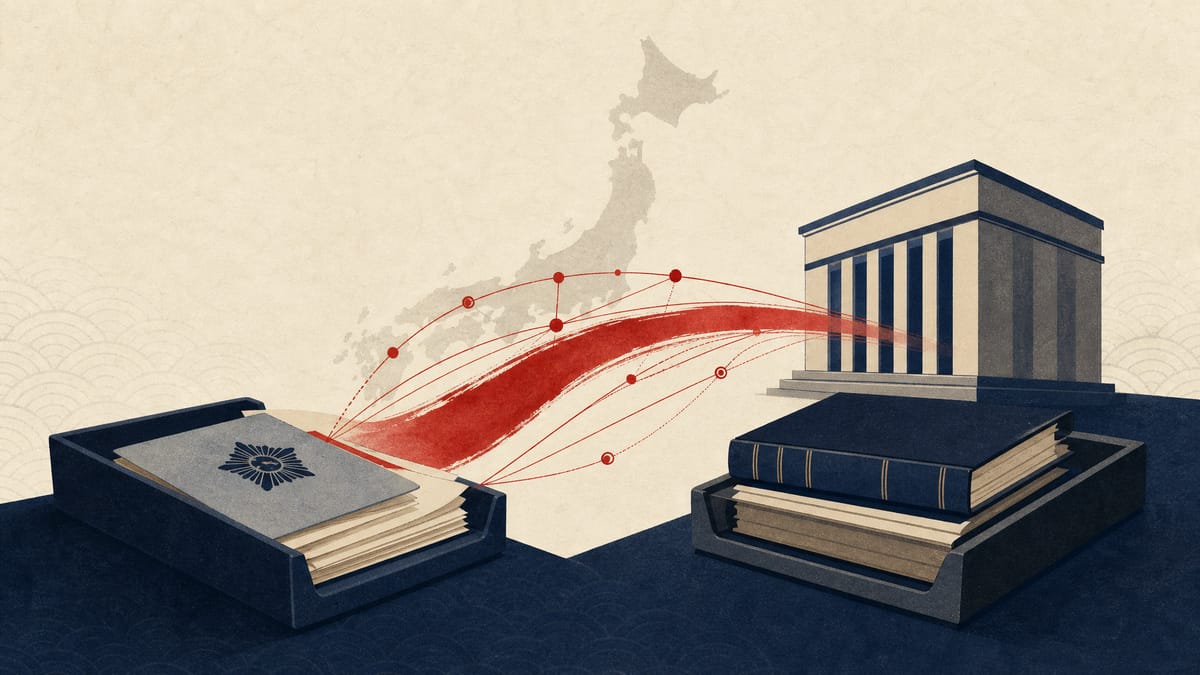
Japan's nine-bank fraud-tracing channel goes live June 1 From June 1, prefectural police will be able to send online inquiries to participating financial institutions through the National Police Agency under a new public-private framework aimed at tracking, freezing and recovering funds lost to special fraud. The first wave covers Mizuho Bank, MUFG Bank, Sumitomo Mitsui Banking Corporation, Resona Bank, Seven Bank, Rakuten Bank, AEON Bank, SBI Shinsei Bank and Japan Post Bank. The point is speed. The FSA says fraud proceeds often leave the original recipient account before mailed bank inquiries are answered, making recovery harder. The new channel moves that law-enforcement-to-bank workflow online so police can reach the bank handling the destination account earlier. It is not a consumer portal, but it is a rare piece of anti-fraud plumbing that could matter before the money disappears.
secondary
Rules, Audits and Disclosure

FSA drafts tougher AML framework for accountants The FSA has published a draft guideline for certified public accountants and audit firms that would formalize customer due diligence, beneficial-owner checks, extra confirmation for high-risk transactions and record retention, while explicitly extending the framework to proliferation financing as well as money laundering and terrorist financing. The draft is framed against FATF standards, so the read-through is less about a new slogan than about firms needing a compliance process the regulator can actually inspect. Equal footing, tailored wording for small insurers In its public-comment response on revised supervision guidelines for small amount and short term insurance providers, the FSA says rules shared with insurance companies should generally carry the same treatment and interpretation, but the sector's handbook can differ where its business model requires it. One clear signal is sales incentives: even without transplanting the larger-insurer commission clause word for word, the agency says commission formulas must not give agents improper incentives that undermine sound solicitation. FSA hardens sales-control expectations for authorized specific insurers The FSA's revised guidance for authorized specific insurers makes sales oversight more operational. It spells out expectations for training, management and guidance of insurance solicitors, says firms should test agency practices through day-to-day supervision and agency audits, and lays out off-site monitoring, report requests and possible administrative action if serious issues emerge. The package also keeps the ban on special benefits in contract conclusion and solicitation squarely in view. Japan's ISSB report maps the SSAF room and agenda The FSA has published fiscal 2025 output on its outreach around ISSB-related discussions, including a Sustainability Standards Advisory Forum meeting report. The material is useful because it shows Japan working through topics such as IFRS S1 and IFRS S2 implementation with peer standard setters, regulators and ISSB participants, but the public packet reads as a map of who was in the room and what was on the agenda, not as a new domestic disclosure rule.
quick hits
Quick Hits
Banks approved most loan modification requests through April.
Read moreThrough the end of April, banks executed 380,501 SME loan-condition changes out of 394,543 applications, and 6,715 household mortgage changes out of 8,125. Regional banks handled the biggest SME volume, and the FSA notes the tables include some carryover applications from before March.
The FSA's March bank checklist was fund, flex, prepare and restructure.
Read moreIn meetings with major, regional and second-tier bank groups, it told lenders to keep cash-flow support flowing, stay ready for market volatility, maintain Nankai Trough disaster readiness and use revised regional finance and restructuring guidance.
FSA narrowed the perk rulebook for small short-term insurers.
Read moreThe revised guidance tied to the 2025 Insurance Business Act amendment says the sector follows the larger-insurer handbook where appropriate, but keeps sector-specific differences where business characteristics justify them. The practical conduct test is whether deals around solicitation stray into prohibited special benefits.
IP360's second promotion and localization window is open.
Read moreThe promotion-support track backs company-led marketing by content IP rights holders to grow foreign fan bases, and a companion localization track supports individual localization work. Both programs run from March 10, 2026 to March 31, 2027, and their second application windows are open from May 29 to June 19 at 5 p.m.
IP360 is also subsidizing bundled content exports.
Read moreThe ecosystem program backs overseas expansion projects led by four or more content IP rights holders, including cross-industry combinations, with a second application window open from May 29 to June 19 at 5 p.m. The point is coordinated launches, not solo titles trying to do all the work themselves.
Hydropower support is still aimed at the homework stage.
Read moreThe FY2026 hydropower feasibility-support program run by the New Energy Foundation is a second-deadline call for local governments studying promising sites under a PFI framework. It pays for surveys, feasibility work and design that can turn a river on a map into a tenderable project.
A new circular-economy subsidy backs demos and equipment.
Read moreThe program is designed to help companies use the public-private-academic circular-economy partnership to run demonstrations that clarify economic and technical hurdles, then back equipment investment. The policy aim is to move recycled-material supply, eco-designed products, CE commerce and lifecycle data-sharing systems closer to working business lines.