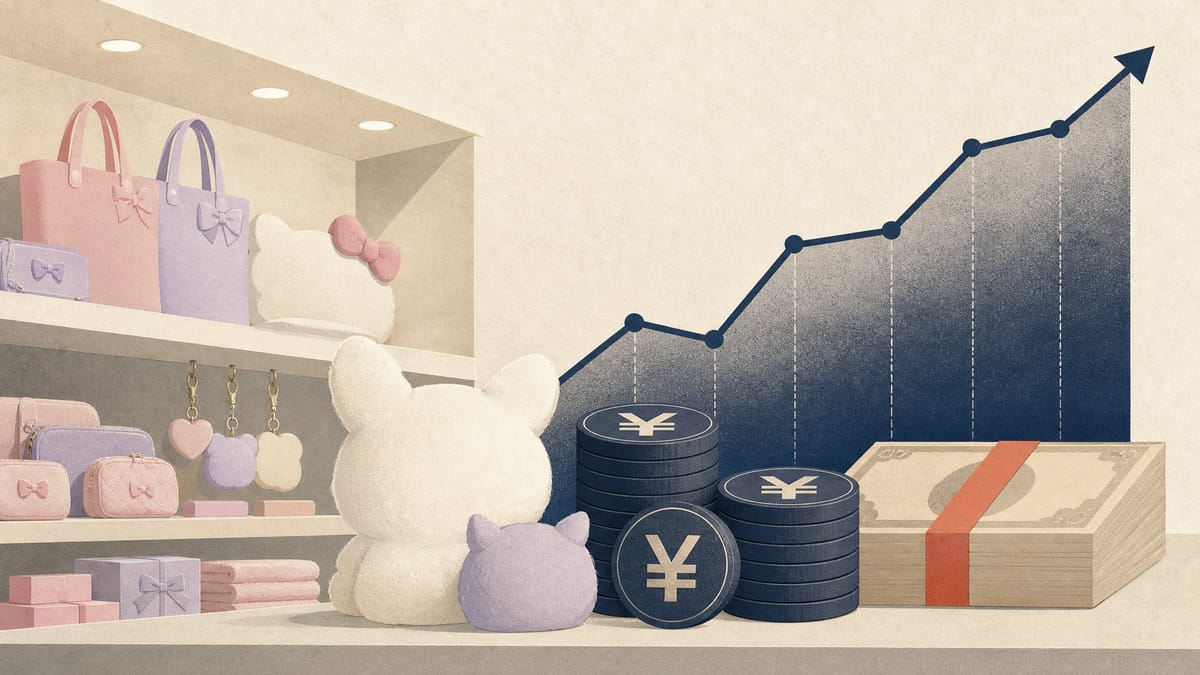
Sanrio’s filings for the year to March 2026 delivered the combination investors usually want and seldom get all at once: higher sales, higher profit, a stronger balance sheet and a bigger cash payout. Revenue rose 33.9% to ¥194.1bn, operating profit jumped 50.3% to ¥77.9bn, and net profit attributable to owners climbed 30.9% to ¥54.6bn. The company said all three were record highs. It also disclosed an adjusted operating profit figure of ¥78.5bn, up 41.0%, to account for different reporting periods at overseas subsidiaries.
The beat against Sanrio’s own revised February plan was smaller but still useful. Revenue came in ¥3.4bn above that plan, operating profit ¥2.7bn above and net profit ¥2.6bn above, according to the earnings release. Operating margin widened to 40.1% from 35.8%, while net assets ended the year at ¥156.0bn versus ¥107.6bn a year earlier.
| Metric | Year to Mar 2025 | Year to Mar 2026 | Reported change |
|---|---|---|---|
| Revenue | ¥144.9bn | ¥194.1bn | +33.9% |
| Operating profit | ¥51.8bn | ¥77.9bn | +50.3% |
| Net profit attributable to owners | ¥41.7bn | ¥54.6bn | +30.9% |
| Net assets | ¥107.6bn | ¥156.0bn | +44.9% |
| Annual dividend per share | ¥53 | ¥69 | +¥16 |
| Dividend payout ratio | 30.0% | 30.4% | +0.4pt |
In the presentation, which uses a company-defined contribution profit measure for regional comparisons, Sanrio said licensing and retail strength across regions underpinned the step-up. Japan remained the largest earnings base, with sales up 31.2% to ¥148.3bn and adjusted operating profit up 47.1% to ¥53.8bn. Asia was the standout growth engine, with sales rising 62.6% to ¥45.5bn and contribution profit up 58.2% to ¥28.3bn. Europe, though still small in absolute terms, posted sales growth of 83.6% to ¥11.7bn, while the Americas were far steadier, with sales up 5.4% and contribution profit up 1.4%.
The shareholder-return signal was equally direct. On June 23, Sanrio’s board approved a year-end dividend of ¥38 per share for March 31 holders, above the ¥35 it had forecast in February and up from ¥33 a year earlier. The year-end portion totals ¥9.214bn. Together with the interim dividend of ¥31, that takes the annual payout to ¥69 per share from ¥53. The annual dividend amount disclosed in the earnings release is ¥16.8bn, and the consolidated payout ratio came to 30.4%.
That matters because the increase still sits squarely inside the policy Sanrio repeated in both the dividend notice and presentation: stable and continuous dividends, with a consolidated payout ratio of 30% or more as the guidepost. The company said it raised the year-end payment because net profit for the year exceeded its earlier forecast and reached ¥54.6bn. The year-end dividend is due to take effect on July 21.
One footnote deserves more attention than it usually gets. Sanrio carried out a 5-for-1 stock split effective April 1, so the ¥38 year-end dividend and ¥69 annual dividend for the year to March 2026 are both shown on a pre-split basis. The current-year forecast dividend in the earnings release is ¥16 per share on a post-split basis, which the company says also implies a 30.4% payout ratio. The return policy looks consistent, but the unit of account changed.
The balance sheet makes that payout easier to believe. Sanrio’s equity ratio improved to 66.4% from 52.9%. In the presentation, the company also showed net cash rising to ¥111.5bn from ¥78.7bn as interest-bearing debt fell to ¥13.9bn from ¥40.3bn. Operating cash flow rose to ¥52.6bn from ¥40.8bn, although year-end cash and cash equivalents were ¥96.7bn after investment and financing outflows during the period.
A same-day convertible bond notice supplied a neat technical proof that the higher dividend is real cash, not just presentation gloss. Under the bond terms, the approved year-end payout adjusted the conversion price on Sanrio’s 2028 euro-yen convertible bonds to ¥504.1 from ¥507.9, effective from April 1. For the current fiscal year, Sanrio forecast revenue of ¥229.8bn, operating profit of ¥89.5bn and net profit of ¥63.8bn. For investors, the message from this cluster of disclosures is fairly plain: Sanrio is turning another jump in earnings into higher net assets and a larger dividend, while keeping the payout ratio only slightly above its 30% floor.