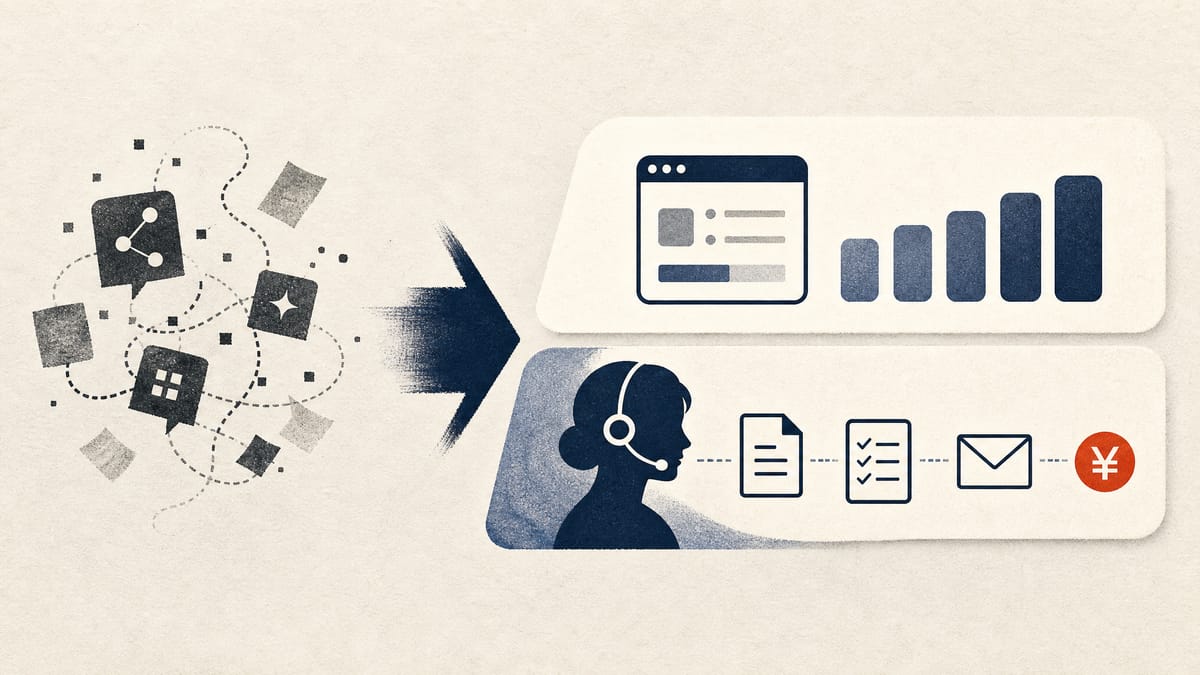
Lightup, a company listed on Tokyo's Growth market, is telling investors that its soft finish to the year to March 2026 was the price of changing how it sells AI, not evidence that demand has rolled over. In a new growth-plan disclosure, the company said the March quarter was hit by the end of a relationship with a specific large customer, the carryover of some projects into the following year and a broader shift in its AI business from flow-type work toward stock-type, lifetime-value-focused services. It said already won but unbooked projects are expected to be recognised in the year to March 2027.
That matters because the group is now overwhelmingly an AI business. Lightup said the renamed AI solutions segment accounted for 91.6% of sales and 93.1% of segment profit in the year to March 2026, leaving the rest of the business at 8.4% and 6.9% respectively. Management also said operating profit for the first nine months reached its highest level of the past three years, even though the March quarter alone slipped into an operating loss because of temporary factors and management issues at a subsidiary.
| Feature | Value |
|---|---|
| AI solutions share of sales | 91.6% |
| AI solutions share of segment profit | 93.1% |
| Target SME customers | 10,000 |
| Target as share of nationwide SME market | 0.3% |
| Minimum annual AI spend per target customer | ¥1mn+ |
| Claimed monthly order capacity | 1,000+ orders |
| Mid-term financial goal | Revenue ¥10bn, operating profit ¥3bn to ¥4bn |
The operating playbook is to pull small and midsized businesses into a broader AI stack. Lightup's disclosed menu includes AI training from ¥1mn, BPO support from ¥50,000 a month, recruitment automation from ¥30,000 a month, sales automation from ¥150,000 a month and custom AI development from ¥2mn per project. The sequence is simple enough: train staff, choose processes to automate, then keep usage in place through operational support. The company also said it plans to sell some of that know-how to larger companies for ¥500,000 to ¥2mn a month.
The more consequential change is in the yardstick. Lightup said it has switched its main KPI from the value of AI-related orders, including training and development work, to the number of AI package and AI SaaS orders. It said the shift from contract-style AI packages to in-house AI SaaS temporarily reduced order counts in March 2026, but that it has already built capacity to handle more than 1,000 orders in a single month. Management's mid-term goal is to support 10,000 SMEs, which it describes as 0.3% of the nationwide market, with at least ¥1mn a year of AI spending per customer, taking revenue to ¥10bn and operating profit to ¥3bn to ¥4bn.
For readers outside Japan, the practical signal is that at least one listed SME-services group thinks the better AI business is not a one-off software sale, but a recurring mix of SaaS and outsourced workflow support. The caveat is that this remains a management plan, not an outcome: the same presentation that maps out a larger recurring model also acknowledges a large-client loss, project timing slippage and subsidiary management problems.