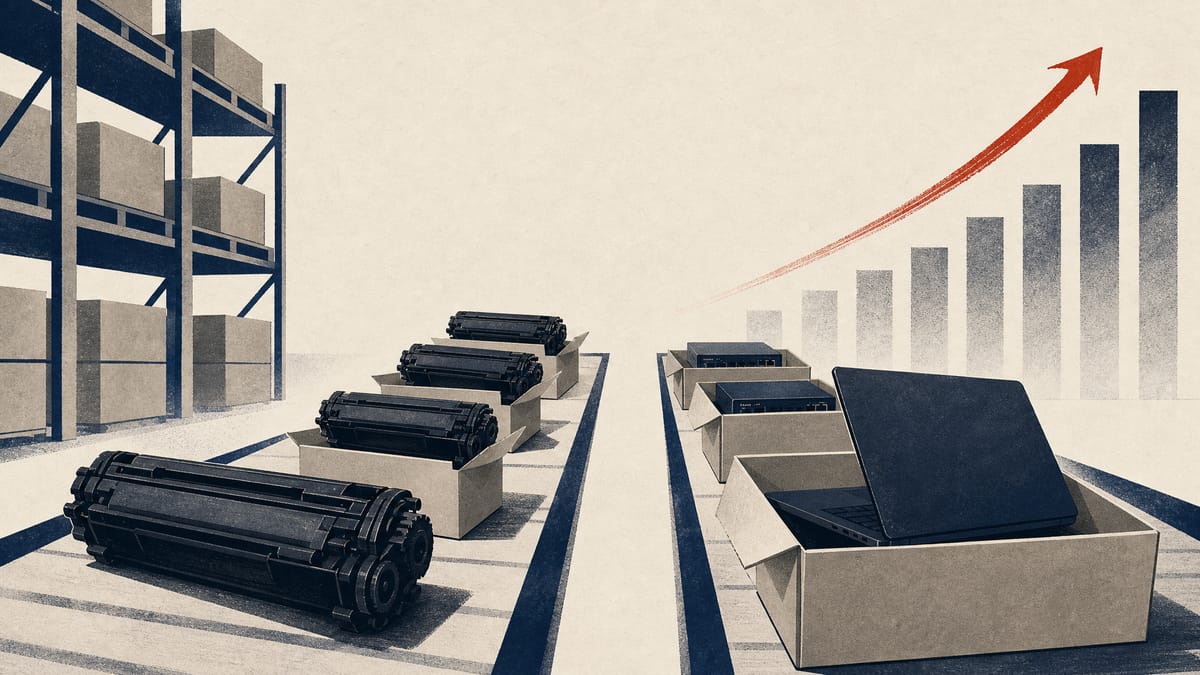
KTK left its full-year targets untouched after a stronger nine months in both office supplies and IT. Sales for the nine months to May 20 rose 7.3% to ¥15.1bn, operating profit climbed 29.5% to ¥418.8mn, ordinary profit rose 24.9% to ¥488.3mn, and net profit increased 36.1% to ¥361.5mn. The company still expects full-year sales of ¥19.7bn, operating profit of ¥500mn, ordinary profit of ¥600mn and net profit of ¥420mn, alongside an annual dividend of ¥20 a share.
| Metric | Nine months to May 20 | Year on year |
|---|---|---|
| Revenue | ¥15.1bn | +7.3% |
| Operating profit | ¥418.8mn | +29.5% |
| Ordinary profit | ¥488.3mn | +24.9% |
| Net profit | ¥361.5mn | +36.1% |
| Supplies sales | ¥11.5bn | +5.4% |
| Supplies segment profit | ¥727.2mn | +16.2% |
| IT solutions sales | ¥3.61bn | +13.7% |
| IT solutions segment profit | ¥131.7mn | +14.8% |
The useful point here is that this was not a one-division rescue job. The supplies business, still the larger engine, posted ¥11.5bn in sales and ¥727.2mn in segment profit. KTK said stable demand for reuse products, new customer wins and stronger sales of its own reused-toner products helped offset the longer-run drag from paperless offices and digital shift. IT solutions sales grew faster, reaching ¥3.61bn, with segment profit at ¥131.7mn as PC demand and cross-selling and upselling of security equipment and services held up.
The supplementary presentation helps explain why management felt no need to rewrite the outlook. Operating profit has already reached 83.8% of the full-year target, ordinary profit 81.4%, and net profit 86.1%. Gross profit margin improved to 24.0% from 23.2%, and KTK said expansion of higher-margin in-house reused-toner sales lifted gross profit even as personnel and transport costs increased.
There are still reasons not to draw a straight line to August. KTK said subsidiary Seiun Crown tends to book more sales from the third quarter onward because many customers sit around fiscal year-end and the start of a new year. The balance sheet also expanded as cash, receivables and payables rose, and the equity ratio slipped to 44.5% from 48.0%. In its presentation, the company said that reflected the usual swell in balances around March year-end business. That leaves the final stretch looking less like a turnaround story than a test of whether reuse-toner demand and IT cross-selling can keep doing their quietly profitable jobs.