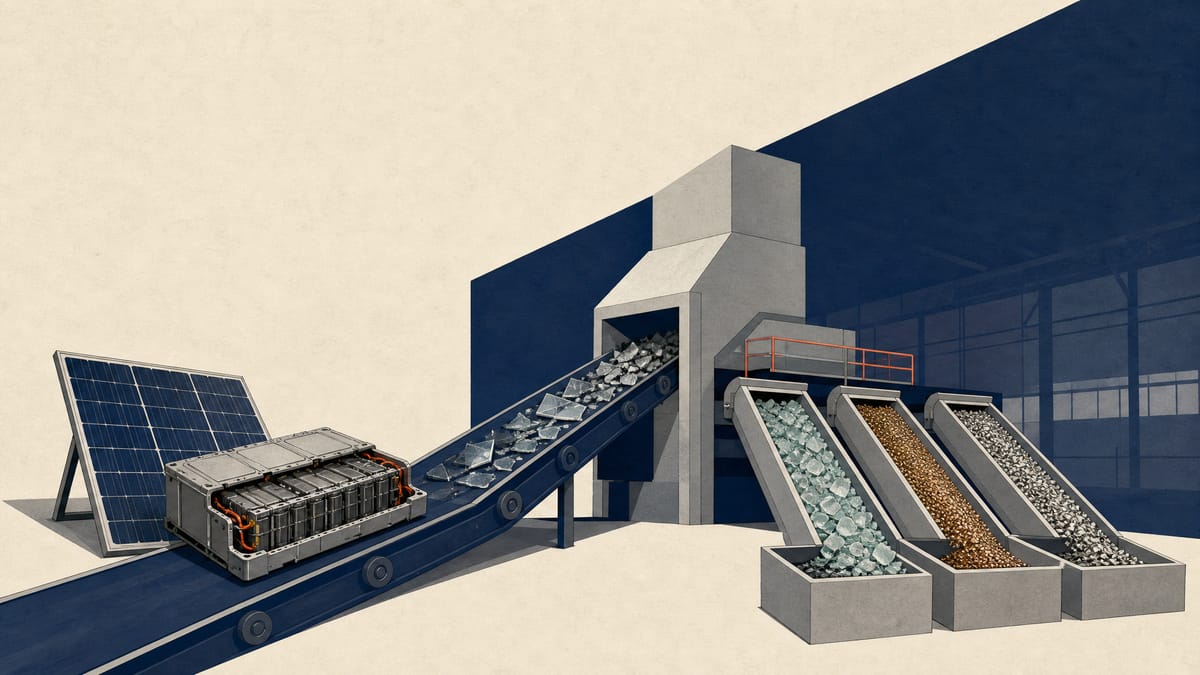
Japan has opened a subsidy call aimed at a less glamorous part of the energy transition: what happens when solar panels, in-vehicle batteries and other material-heavy equipment reach the end of the line. The program will part-fund demonstration projects meant to build a domestic resource-circulation system around renewable-energy-related products and base materials, including glass. The source says large volumes of solar panels and in-vehicle batteries are expected to be discarded in coming years, while recycled substitutes for glass and other base materials have struggled because of contamination concerns and the need to assure quality.
The point is not simply to collect waste. The program purpose is to improve low-CO2 recycling technology, lift the quality of recycled inputs and support systems that can put underused resources back to work. It explicitly targets the reuse and recycling of non-ferrous and rare metals contained in solar panels and in-vehicle batteries, and links the problem to rising demand for automated products, IoT equipment and electrified products. As those markets grow, the portal says, so will discarded sensors, electronic boards and batteries, all of which contain materials worth recovering rather than replacing with virgin inputs.
That makes this a circular-economy subsidy with a fairly industrial brief. Japan is steering money toward the processes that make recycled material usable again, not just recoverable in theory. Glass is in scope for the same reason: the published summary says substitution away from natural resources has not advanced enough because unwanted substances can mix into recycled material and quality has to be kept tight. If policymakers want domestic recycling to do more than decorate strategy papers, they need material quality as well as collection volume.
The terms are concrete enough to matter. The portal shows a nationwide application window from June 2 to July 1, allows multiple applications, and sets a project end deadline of February 26, 2027. It lists a maximum subsidy amount of ¥278.2 million. Headline subsidy rates are one-half for applicants that qualify as SMEs under the Small and Medium-sized Enterprise Basic Act, and one-third for other applicants.
One caveat belongs near the top, not in the footnotes. This is a call for applications, not an announcement of funded projects. The portal summary also gives headline terms, not a full public explanation of every eligible cost or award condition in the packet, so companies planning around the scheme should check the detailed program materials directly.