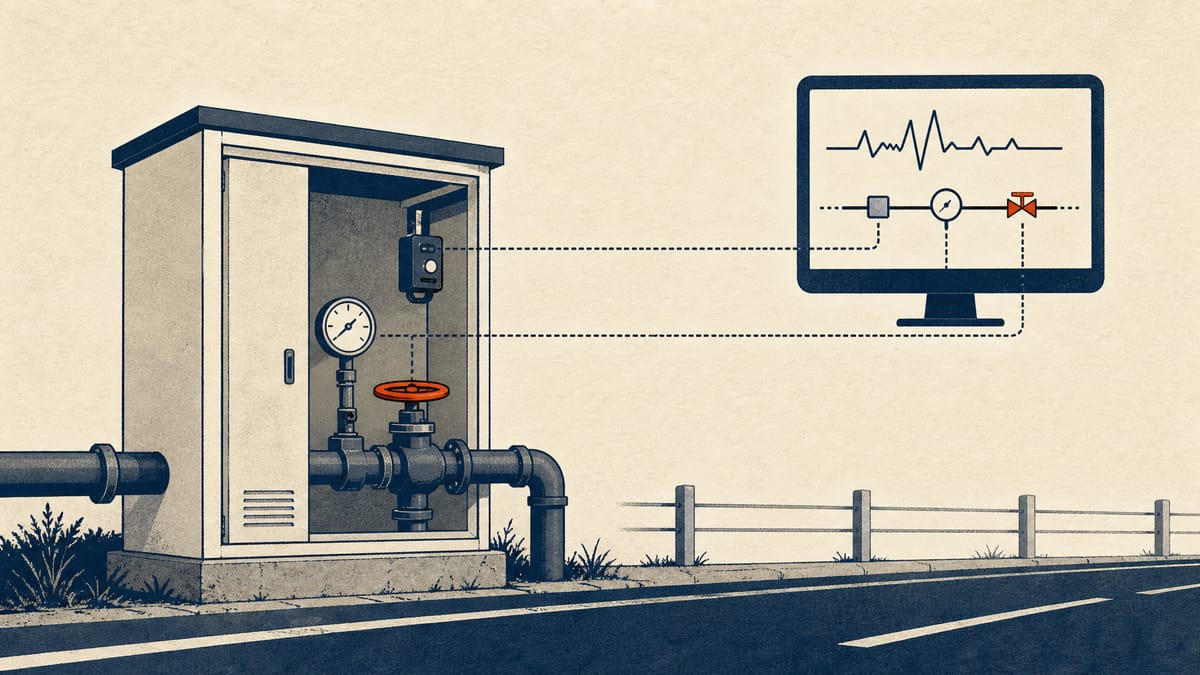
Small gas pipeline operators in Japan can now apply for a subsidy covering half the cost of remote monitoring and shutoff equipment for their district pressure regulators, known as governors. The cap is ¥20mn per operator per fiscal year. The scheme is run by the City Gas Promotion Center, a general incorporated association, and is paid for with public money from the Ministry of Economy, Trade and Industry. The first application window runs from 7 to 28 October 2026.
What the money buys
The programme backs systems that can monitor a governor's gas pressure, leaks or seismic SI readings, or control it automatically or remotely, including opening or closing it. The equipment must also work through a power cut. Eligible kit covers central servers, routers, control software and uninterruptible power supplies, plus on-site pressure sensors, gas leak detectors, seismic sensors and shutoff devices. Installation work on those systems is also covered. District governors are in scope; customers' dedicated governors are not.
The stated purpose is to strengthen the disaster plans that amended gas business law now requires pipeline operators to file, so that crews can limit the area to be supplied and speed repairs after a major quake.
Who qualifies, and the catches
Applicants must be general pipeline operators that are small or mid-sized: private companies with capital of ¥300mn or less, or no more than 300 employees, and public operators with no more than 300 employees. Firms deemed large because of ownership or board overlap are excluded.
The subsidy is for new systems. Replacing an existing system with the same specification does not count. Extending or upgrading an existing system does, as does moving from FOMA-era links to LTE and other current communications standards. Consumption tax is not covered, and contracts or orders placed before the grant decision are not eligible.
Contractors are to be chosen by competitive tender or at least three comparative quotes. Where that is extremely difficult or inappropriate, the operator must submit a reason statement to the Center in advance, and the Center can reject the reason, in which case the affected portion may be excluded from the subsidy. The cost basis for the subsidy is capped at the lowest eligible-cost quote, even if the operator signs with another bidder. A prime contractor on a monitoring-system job whose contracted construction value is ¥5mn or more including tax must hold a telecommunications construction permit under the Construction Business Act.
Timing and budget
The Center's pamphlet pencils in grant decisions from mid-November 2026, issued in sequence. Work must start after approval and finish, including payment, by 26 February 2027. The subsidy is paid after completion and a final inspection, not up front. The explainer materials list a budget frame of ¥130mn.
If first-round applications exhaust that frame, the Center will score them on cost-effectiveness and fund the highest scorers; those below the line are rejected. After the first round, applications are reviewed in order of receipt until the budget runs out. A grant this year does not guarantee support next year.
Money that is misused is clawed back with a surcharge of 10.95% a year. An online briefing is scheduled for 13 October, 14:30 to 16:30.