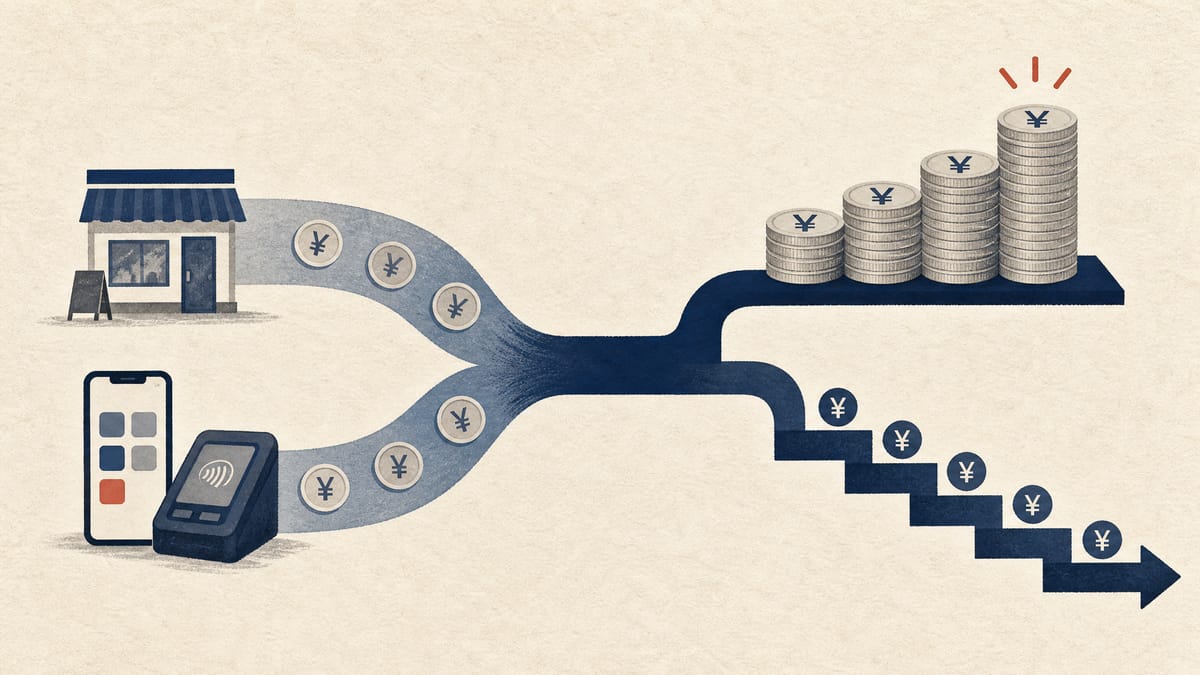
GMO Commerce is not changing how generous it wants to be, only which set of accounts it uses to decide. After agreeing to buy GMO Digital Lab and consolidate it from July 1, the company raised its year-end dividend forecast to ¥50.56 from ¥48.24 and rewrote its shareholder-return policy so the familiar thresholds, a 65% payout ratio or 8% DOE, are measured on a consolidated basis rather than a standalone one. The new policy applies from distributions for the year ending December 2026.
| Item | Before | After |
|---|---|---|
| Payout rule | Standalone DOE 8% or payout ratio 65%, whichever is higher | Consolidated DOE 8% or payout ratio 65%, whichever is higher |
| Year-end dividend | ¥48.24 | ¥50.56 |
| Revenue guide | ¥2,956m | ¥3,356m |
| Operating profit guide | ¥640m | ¥660m |
| Ordinary profit guide | ¥641m | ¥651m |
| Net profit guide | ¥423m | ¥428m |
The accounting switch is tied directly to the deal structure. GMO Commerce is buying all shares in GMO Digital Lab from GMO GlobalSign Holdings for ¥700 million, plus about ¥1 million of advisory costs, with an additional earn-out of up to ¥100 million tied to performance from 2026 through 2028. The seller is a fellow GMO group company, so GMO Commerce treated the transaction as a related-party deal and said the fixed price plus earn-out sat within an independent DCF valuation range. Two directors with roles at the parent group did not take part in the board vote, according to the acquisition notice.
The financing is almost a mirror image of the cash price. GMO Commerce separately approved a ¥700 million floating-rate loan from Sumitomo Mitsui Banking Corporation, due to be drawn on June 30, with a five-year term, equal principal repayment and no collateral or guarantees. That helps explain why the revised group outlook gets thinner as it moves down the profit line. The company now expects revenue of ¥3,356 million and operating profit of ¥660 million, up from the standalone plan of ¥2,956 million and ¥640 million, because it will include GMO Digital Lab's second-half results after July 1. But ordinary profit rises only to ¥651 million from ¥641 million, and net profit to ¥428 million from ¥423 million, because the acquisition financing brings interest and other non-operating costs into the picture.
That is a useful reality check on the target itself. GMO Digital Lab produced ¥887 million of revenue and ¥7 million of operating profit in 2025, after what GMO Commerce described as a temporary sales hit from ending one service. The disclosed numbers suggest the current-year appeal is reach as much as immediate margin. The target adds store-promotion apps, mobile payment and digital voucher services, and relationships with small and mid-sized merchants plus 38 municipalities and organizations, which GMO Commerce says complement its existing large-chain customer base.
For shareholders, the message is tidy enough: management is keeping the headline return formula intact while moving it onto a group basis and accepting modest new leverage to do it. The raise from ¥48.24 to ¥50.56 is small, but it shows the company wants the acquisition to read as additive to shareholder returns, not a reason to hoard cash. The fine print is that both the higher dividend and the new group forecast assume the July 1 closing and GMO Digital Lab's second-half performance, so the real test comes once those assumptions turn into reported results.