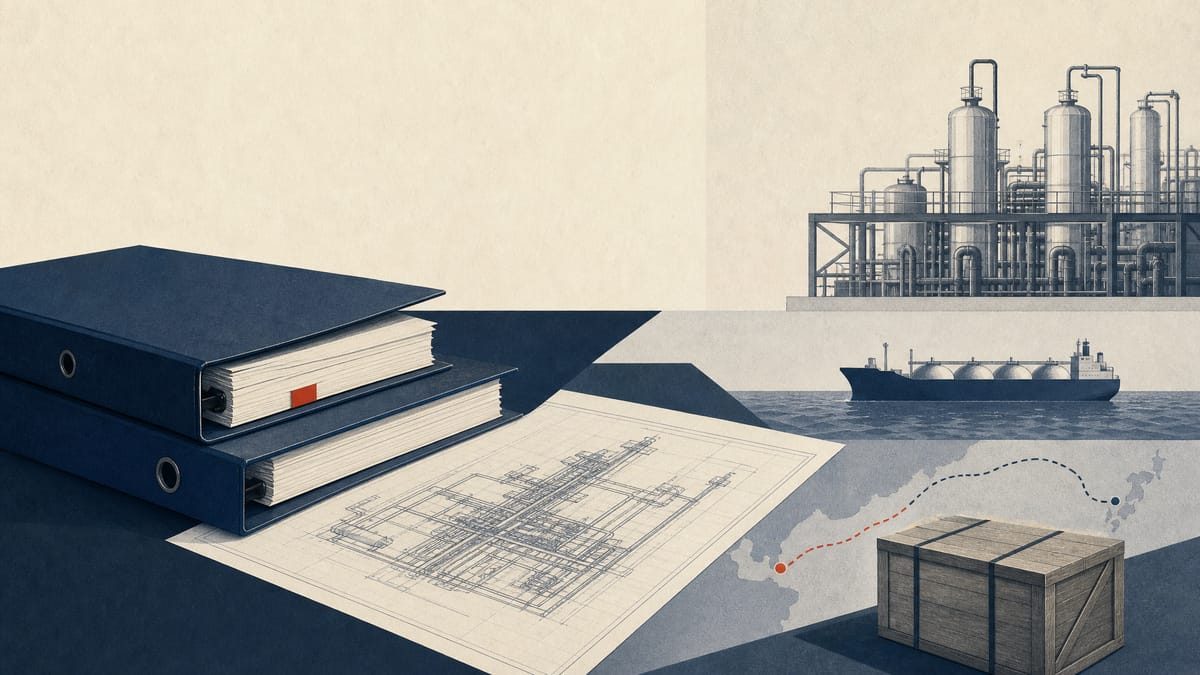
Chiyoda's latest account of Middle East exposure is less about damaged assets than disrupted logistics. In a corrected management-status report issued on May 27, the engineering contractor said two projects in the region, Qatar NFE LNG and a Middle East oil and petrochemical EPC job, suffered no physical damage. Construction has been restarted in stages and activity is now almost back to previous levels. The catch is that Chiyoda still cannot reasonably calculate what the disruption means for the current fiscal year forecast. The same filing also discloses a new EPC order from Idemitsu Kosan for a large solid-electrolyte pilot plant tied to all-solid-state batteries.
The projects are moving again, and they are not small
The Middle East language matters because these are still big lines in the book. Chiyoda's project table shows more than ¥100 billion of order backlog in Qatar NFE LNG, while another Middle East oil and petrochemical project sits in the ¥50 billion to under ¥100 billion band. The company also says Qatar NFE is in the late stages of design and procurement and is already in construction, so "almost back" does not mean a paper project returning from pause. It means a live site with live logistics.
To keep that work moving, Chiyoda said it has substituted air and land transport for some seaborne deliveries, set up an emergency task force on March 2, and built a system for daily monitoring of local conditions. For the year ended March 2026, management said the regional disruption had almost no effect on results. That is the reassuring part.
The uncertainty has not gone away
The less reassuring part is the forecast. Chiyoda said it cannot currently make a reasonable estimate of the effect on the year ending March 2027. If extra costs do arise, the company said it will seek recovery under force majeure and other contractual provisions, with the stated aim of avoiding as much earnings damage as possible. It also warned that shortages and price increases in materials and equipment could spill over into domestic projects.
That leaves business readers with a familiar contractor problem: operations may be recovering faster than the spreadsheet. The sites are working again, but the final bill depends on shipping routes, contract language and whether today's workaround becomes tomorrow's standard cost base. Chiyoda's disclosure does not pretend otherwise.
The battery contract gives the domestic side some fresh substance
Alongside the risk update, Chiyoda said it won EPC work from Idemitsu Kosan for a large pilot plant at Idemitsu's Chiba site that will manufacture solid electrolyte, a key material for all-solid-state batteries. The company said the project is intended to help establish production technology and mass-production capability ahead of Idemitsu's stated 2027 to 2028 commercialization window, and that the pilot plant is expected to have annual capacity of several hundred tons.
Chiyoda also said it is working toward completion during 2027 and has signed a strategic partnership with Idemitsu aimed at the medium- to long-term mass production of solid electrolytes. The company linked the new award to work it has already carried out for Idemitsu, including EPC work on a first demonstration plant expansion completed in 2025, basic design work won in 2024, and a large lithium sulfide manufacturing unit now under way for completion in 2027.
One useful caveat: while Chiyoda lists the solid-electrolyte pilot plant among major ongoing projects, the table does not attach an order-backlog value to that job. So the contract is clearly real, but the filing does not support turning it into a precise revenue call.
What the correction notice itself still does not tell readers
The May 27 replacement notice says only that part of the earlier May 11 report required correction. What the new version does make clear is the balance Chiyoda wants investors to hold in mind: Middle East project exposure is large but physically intact, construction activity is recovering, contract recovery will matter if costs rise, and domestic advanced-materials work now includes a concrete Idemitsu battery-materials assignment.