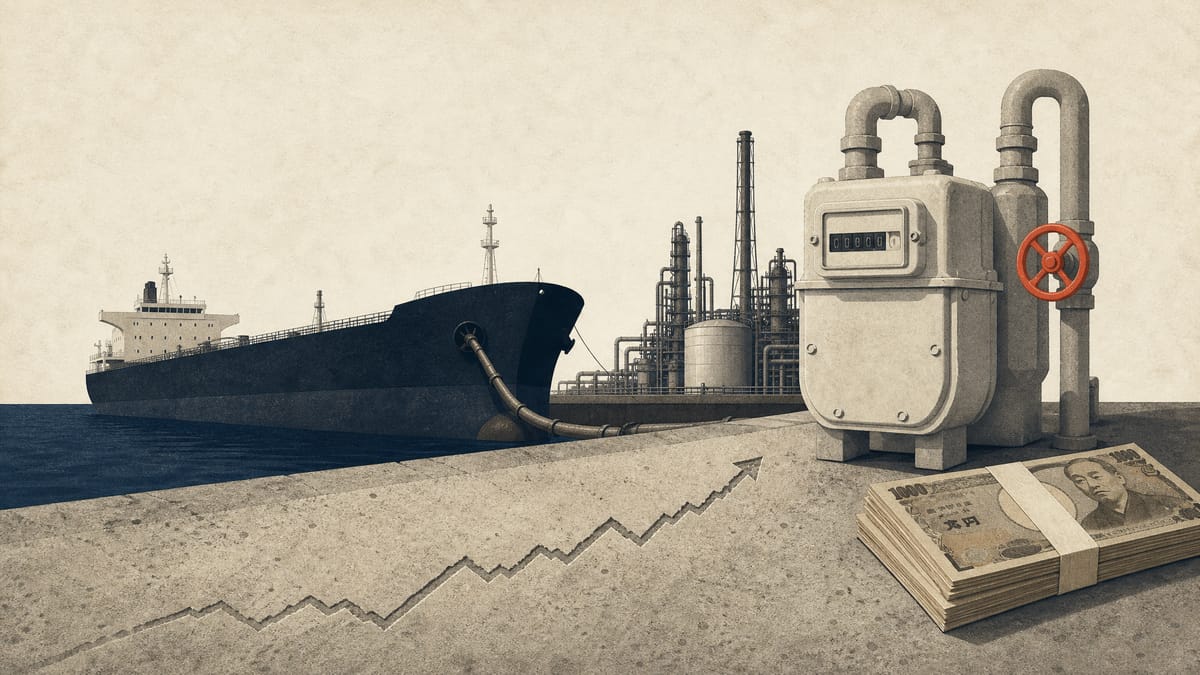
The Bank of Japan's latest outlook, released Monday, describes an economy caught between a near-term oil shock and a medium-term inflation problem that refuses to go away.
Growth slows before it speeds up
The central bank expects Japan's economy to keep growing, but at a decelerated pace, over the current fiscal year. The drag comes from crude oil prices that have risen since early spring, which the bank links to the situation in the Middle East. Offsetting that are government support measures, accommodative financial conditions and rising global demand tied to AI. The bank expects growth to pick back up moderately from next fiscal year, as the oil-price drag fades and a self-reinforcing cycle of higher incomes feeding into spending gradually strengthens.
The inflation call: clearly above 2%, then back toward it
The more consequential number in the report is on prices. The Bank of Japan expects core CPI (all items excluding fresh food) to accelerate to a level "clearly above 2 percent" from the second half of the current fiscal year. Three forces are doing the work: firms continuing to pass wage increases through to selling prices, the crude oil rise pushing up energy and goods costs, and semiconductor prices rising on the back of global AI demand alongside a weaker yen, which together are expected to lift durable goods prices. As the oil effect fades, the bank expects the inflation rate to ease back toward around 2% in the latter part of its projection window. Underlying inflation, meanwhile, is expected to reach a level broadly consistent with the bank's 2% price stability target sometime between the second half of the current fiscal year and the following one, and to hold near that level afterward. The bank attributes the durability of that pressure to a persistently tight labor market, which it says should keep sustaining a loop where wages and prices rise moderately together, gradually lifting medium- to long-term inflation expectations.
What changed from the last outlook
Against the bank's previous projection, real GDP growth estimates are largely unchanged. The CPI forecast for the current fiscal year, however, has been revised lower, and the bank cites factors including government measures cutting households' summer electricity and gas bills.
Risks tilt higher, not lower
The bank flags the Middle East situation as the swing factor to watch for its effect on financial markets, the yen and Japan's real economy, alongside how AI-related demand and future exchange-rate moves feed through to activity and prices. On the balance of risks, the bank judges growth risks as roughly even but says CPI risks are skewed to the upside. It warns underlying inflation could overshoot its 2% target if firms lean further into raising wages and prices and if medium- to long-term inflation expectations keep climbing. The supplied excerpt of the report ends mid-sentence on that risk discussion, so further caveats or conditions the bank attaches to that upside case are not captured here.