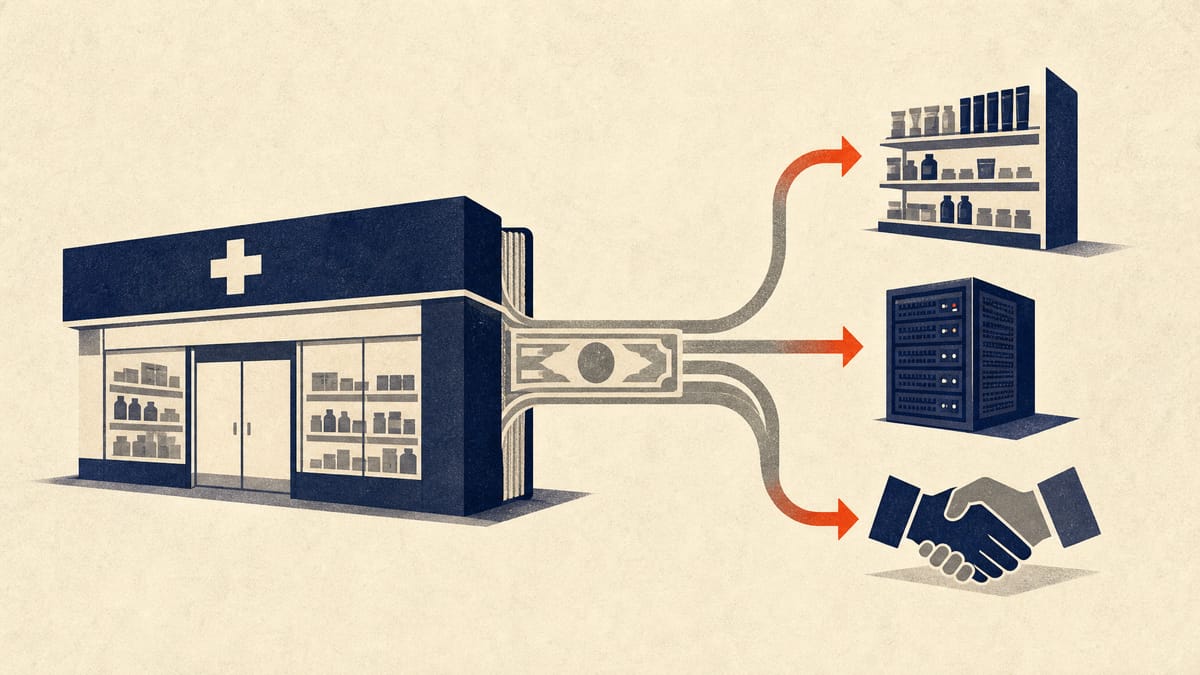
Sugi Holdings' board approved a plan on July 9 to sell 5,082,000 new shares to GIC Private Limited, Singapore's sovereign wealth fund, in a third-party allotment priced at ¥3,195 a share. The placement raises ¥16.24bn before costs and ¥16.01bn net, after ¥228.55mn in advisory, legal and registration fees. Payment is due July 27, 2026.
The issue price is 97.2% of Sugi's July 8 closing price of ¥3,287, a discount to the prior trading day but a premium of 3.53% to the one-month average and 3.10% to the three-month average. The new shares dilute existing holders by 2.67% of shares outstanding and 2.81% of voting rights.
Sugi, which runs 2,321 drugstore and pharmacy outlets across the Kanto, Chubu, Kansai and Hokuriku-Shinetsu regions, says the placement is not simply a capital raise. The company is targeting ¥1tn in sales, with a longer-term goal of ¥1.6tn, and wants a deeper bench of long-term global institutional shareholders to get there. Rather than borrow from banks or run a public offering, Sugi chose GIC specifically to preserve its bank credit lines for opportunistic acquisitions while building what it calls a strategic partnership, citing GIC's record of large co-investments alongside industry leaders.
| Use of proceeds | Amount | Spending window |
|---|---|---|
| Store openings and renovations | ¥4.01bn | Aug 2026 - Mar 2028 |
| DX and AI investment, including supply-chain systems | ¥8.00bn | Mar 2027 - Feb 2029 |
| Strategic investment and M&A | ¥4.00bn | Aug 2026 - Feb 2031 |
Sugi frames the proceeds as fuel for its new five-year plan, which began with the year to February 2027. Roughly a quarter goes to new stores and renovations, half to a rebuild of the company's data, AI and supply-chain systems, and the remainder to strategic investment and M&A as Japan's drugstore and pharmacy sector consolidates under pressure from a shrinking customer base, rising minimum wages and falling drug-price and dispensing-fee reimbursements. The company says it has no specific acquisition targets lined up yet, and any deal would need to clear a hurdle rate above its cost of capital.
GIC already held 2,519,900 Sugi shares as of June 19, 2026, and the placement lifts the fund's stake to 2.86% of the company, without displacing Sugi's top shareholder, Sugi Shoji, which falls only slightly to 36.40% of the stock after the deal. Sugi plans to obtain a written undertaking from GIC requiring it to report immediately, and to let Sugi disclose publicly, if GIC sells any of the new shares within two years of payment.
The allotment lands alongside Sugi's first-quarter results, in which sales for the three months to May rose 10.1% to ¥270.18bn and operating profit rose 10.9% to ¥12.21bn, while net profit fell 67.5% to ¥6.90bn, a comparison skewed by the prior year's additional recognition of deferred tax assets tied to tax-loss carryforwards following the absorption merger of I&H Co.. Sugi says the share placement's effect on its full-year guidance for the year to February 2027 will be minor. The company is also folding into its consolidated group a pharmacy chain it plans to make a subsidiary, and carrying out a two-for-one stock split, both effective September 1, 2026.